
SLIDE 1
1
Pacemaker Training Program
Special Functions Managed Ventricular Pacing Modes
Scott Streckenbach, M.D. Director of Perioperative Electrophysiology Cardiac Anesthesia Division Mass General Hospital Harvard Medical School
Introduction
- Pacemakers are programmed to ensure
an adequate atrial and ventricular rhythm
- Sometimes the pacer will pace the
ventricle even when intrinsic conduction is present, just slower than the pacer’s programmed AV delay
- RV pacing is good for patients needing
cardiac resynchronization therapy….
- But is not good for everyone
Why should Pacemakers try to Reduce Ventricular Pacing?
- RV apical pacing leads to essentially a
LBBB and suboptimal systolic contraction
- Late-systolic contraction delays the
passive ventricular filling and thereby shortens the effective duration of diastole resulting in suboptimal diastolic filling
Why should Pacemakers try to Reduce Ventricular Pacing?
- Excessive RV pacing has several
suboptimal outcomes:
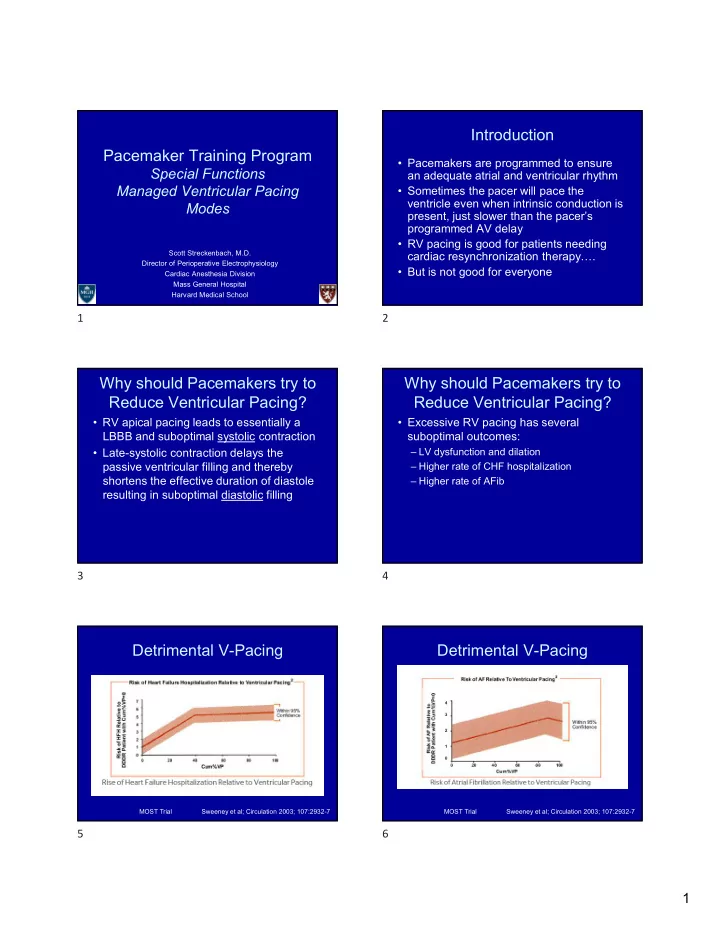
– LV dysfunction and dilation – Higher rate of CHF hospitalization – Higher rate of AFib
Detrimental V-Pacing
Sweeney et al; Circulation 2003; 107:2932-7 MOST Trial
Detrimental V-Pacing
Sweeney et al; Circulation 2003; 107:2932-7 MOST Trial