Introducing Nature Climate Change, Nature Energy , and our Editorial - - PowerPoint PPT Presentation

introducing nature climate change nature energy and our
SMART_READER_LITE
LIVE PREVIEW

Introducing Nature Climate Change, Nature Energy , and our Editorial - - PowerPoint PPT Presentation

Illustration inspired by the work of John Maynard Keynes Introducing Nature Climate Change, Nature Energy , and our Editorial Process Jenn Richler, Ph.D. Senior Editor March 2020 2 About me PhD in Psychology


slide-1
SLIDE 1

Introducing Nature Climate Change, Nature Energy, and

  • ur Editorial Process

Jenn Richler, Ph.D.

Senior Editor

March 2020

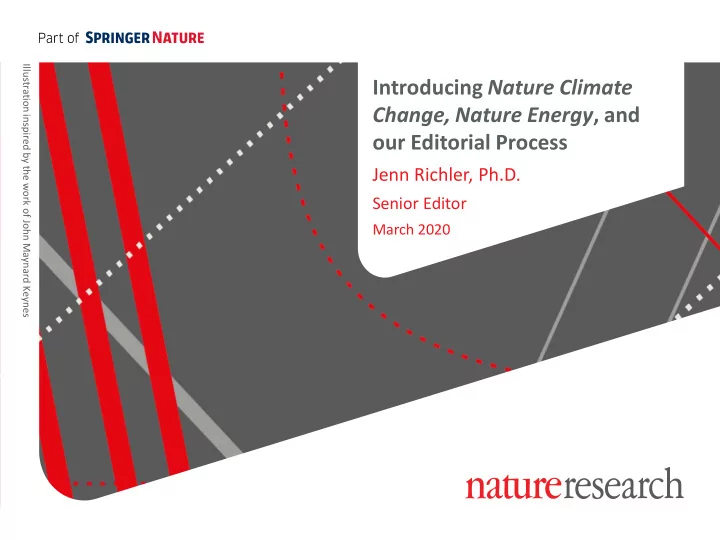
Illustration inspired by the work of John Maynard Keynes
slide-2
SLIDE 2

2

  • PhD in Psychology from Vanderbilt University in cognitive psychology
  • Postdoc turned Research Associate also at Vanderbilt
  • Associate Editor at Journal of Experimental Psychology: General
  • Writer for the American Psychological Association
  • Joined Nature Energy and Nature Climate Change as Senior Editor in 2016
  • Served as Acting Head of Nature Research Social Sciences from 2017-2019

About me

slide-3
SLIDE 3

3

1

Introducing Nature Research

slide-4
SLIDE 4

4

  • Nature: exceptional research, a forum for discovery and debate and a source

for top scientific news Nature Research Journals: the most significant advances and landmark papers of interest to their specific communities Nature Communications: open access, high-quality papers from all areas of science that represent important advances within specific scientific disciplines

slide-5
SLIDE 5

5

  • We’re trained scientists.

But we no longer do our own

  • research. Instead, we are dedicated,

professional editors.

We retain close ties to the community.

We stay in touch with researchers and prioritise time out in the field.

We’re independent.

We do not have external editorial boards, and we take full responsibility for our decisions.

We focus on the significance

  • f the research.

We do not make decisions based on who the authors are, where the research was done, what number of citations it might receive, or whether it will receive media coverage.

Editorial culture at Nature Research

slide-6
SLIDE 6

6

  • SharedIt

Allows authors to publicly share a full- text pdf version of the paper without restrictions.

ORCID

Corresponding authors of accepted papers are asked to provide information on their Open Researcher and Contributor Identifier (ORCID).

Preprints

Can be posted at any time prior to submission and do not influence our evaluation of novelty.

Data Availability

All papers include a data availability statement, and our preferred approach is to share research data via public repositories that can be cited and referenced.

Editorial policies at Nature Research

slide-7
SLIDE 7

7

2

Introducing Nature Climate Change & Nature Energy

slide-8
SLIDE 8

8

  • Nature Climate Change and Nature Energy are thematic journals – they cover a

subject, not a discipline. 12 issues per year, subscription model Green Open Access: self-archiving of non-formatted final author copy following 6 month embargo period. Aimed at broad readership including researchers in relevant disciplines, policy- makers and industry Original primary research, plus Comments, Reviews, and Perspectives science of contemporary climate change and its impacts and implications for the economy, policy and society all aspects of energy, from scientific & technological advances to the energy needs & behaviors of society

slide-9
SLIDE 9

9

  • To meet the needs of the different communities they serve, the

formats available differ between journals. However, all journals share important general principles when it comes to formats. Initial submissions do not need to be formatted in journal style.

Style and length will not influence consideration of a manuscript, within reason.

Our editors can help you navigate format choices.

Our editors are experts in differences between format options, and can provide suggestions to this end once a manuscript is submitted.

Our format requirements aim to maximize the accessibility

  • f the research.

The Nature journals are read by scientists from diverse backgrounds, and thus our aim is to publish research that will be considered theoretically and technically complete to topic specialists, while remaining accessible to interested readers from other areas.

slide-10
SLIDE 10

10

  • Manuscripts that present new primary data and/or empirical

analysis are considered primary research.

slide-11
SLIDE 11

11

  • Manuscripts that present new primary data and/or empirical

analysis are considered primary research.

slide-12
SLIDE 12

12

  • Manuscripts that present new primary data and/or empirical

analysis are considered primary research.

slide-13
SLIDE 13

13

  • Manuscripts that present new primary data and/or empirical

analysis are considered primary research.

slide-14
SLIDE 14

14

  • Most of the research published is quantitative, but we are seeking to

increase representation of qualitative & mixed-methods approaches.

slide-15
SLIDE 15

15

  • A Review is an authoritative, balanced survey of a research field.

They should be recognized as scholarly by specialists in the field, but written with a view to informing non-specialist readers.

slide-16
SLIDE 16

16

  • A Perspective reviews a literature to advance a novel viewpoint or
  • framework. They may be opinionated but should remain balanced

and are intended to stimulate discussion and new approaches.

slide-17
SLIDE 17

17

  • Comments are opinion pieces that focus on topical issues relevant to

policy, science, or society. They should be of immediate interest to a broad readership & written in an accessible, non-technical style.

slide-18
SLIDE 18

18

  • Focus Issues bring together a variety of pieces commissioned by the

editors on a given topic.

Social Dynamics of Energy Behaviour

slide-19
SLIDE 19

19

  • We usually can’t cover current events due to our production

schedules, which make it impossible for us to compete with traditional media outlets. But there are exceptions.

slide-20
SLIDE 20

20

  • We publish a limited number Comments, Reviews, and Perspectives, and the

majority are commissioned – if you have an idea you’d like to pitch, we recommend that you submit a pre-submission inquiry.

  • explain the general motivation and timeliness of the piece (~300 words)
  • provide a skeleton outline that lists the sections and their key arguments
  • list up to 15 key references that illustrate the timeliness and significance

Pre-submission inquiries tend to be less useful for primary research – we cannot provide a full assessment of the work until we’ve seen the full text and data, and so can usually only comment on fit for the journal scope.

  • the current working title of your study
  • a summary paragraph of the findings and contribution, citing relevant literature.

A complete manuscript should not be submitted as a pre-submission inquiry — it’s better we give it the attention it deserves as a full submission instead

Pre-submission inquiries

slide-21
SLIDE 21

21

3

Editorial Process

slide-22
SLIDE 22

22

  • The editorial process
slide-23
SLIDE 23

23

  • ‘Insert’

this text box and select ‘Reset slide’

Submitting your paper

Which journal?

Pro-environmental behaviour Nature Human Behaviour Public opinion on climate and energy polices Nature Sustainability Nature Climate Change Nature Energy Climate-induced migration Energy consumption interventions

slide-24
SLIDE 24

24

  • ‘Insert’

this text box and select ‘Reset slide’

Submitting your paper

At initial submission, focus on getting your main message across.

Your paper should:

  • Be good science
  • Establish context of the field

(why should we care?)

  • Link the results back to the context to

demonstrate significant progress

  • Communicate your results efficiently

(do not try to impress others with how smart you are)

Remember:

  • For initial submission, your paper does not need

to be in Nature style

  • If you want to opt-in to double-blind peer

review, make sure that the paper does not reveal your identity

  • Be sure to familiarize yourself with our policies

prior to submission

  • Include a cover letter to the editors with your

submission

slide-25
SLIDE 25

25

  • Tips on cover letters

Your chance to:

  • Have a confidential discussion with the

editor

  • Give your ‘elevator pitch’ for the paper
  • Explain the importance of the findings

(but don’t oversell)

  • Put the work in context

This is where you should mention:

  • Your suggestions for reviewers

(not including former supervisors, recent or current collaborators, friends, or relatives‏)

  • Any reviewer exclusions

(up to three individuals; we try to honor exclusions within our guidelines but there are exceptions)

  • Any related papers submitted elsewhere
  • r in press

(we may ask to see these)

  • Any competing papers or other special

circumstances

slide-26
SLIDE 26

26

  • ‘Insert’

this text box and select ‘Reset slide’

Initial editorial evaluation

Mainly:

  • Relevance to the journal's readership
  • Significance of the findings
  • Conceptual novelty
  • Strong support for conclusions
  • Well-controlled, quality data

We look for papers with potential.

Other considerations that may apply:

  • Mechanistic insight
  • Resource value
  • Technological advance
  • Policy relevance
  • Practical applicability
slide-27
SLIDE 27

27

  • How we choose reviewers

A good peer reviewer has:

  • Technical expertise and knowledge
  • f the field
  • A fair and constructive attitude
  • No conflicts of interest
  • Good attention to detail but can also

see the big picture

  • Familiarity with journal standards

Our editors:

  • Seek geographic, demographic and

disciplinary balance on every paper

  • Honour author exclusions

(within reason)

  • Involve as many reviewers as

needed; usually three but could be more

Choosing the peer review panel is one of our most important responsibilities.

slide-28
SLIDE 28

28

  • How our decisions are made

Editors, not referees, take the ultimate responsibility for decisions.

  • We often face contradictory recommendations
  • We don’t count votes; we consider arguments
  • We make our own decisions and do overrule reviewers, both positive and negative
  • We use our judgment on which of the reviewer requests are feasible
  • We try to avoid numerous rounds of review and ineffective revision cycles
  • The editors are alert to inappropriate reviewer behaviour to ensure that our decisions

are based on sound advice

slide-29
SLIDE 29

29

  • Addressing the referee reports

Make the most of your opportunity to revise.

  • View the critiques as an opportunity to improve your work and respond constructively
  • Resubmit only after you have comprehensively addressed all key points
  • If further experiments or analyses are needed, don’t try to argue your way around the

concerns

  • If you cannot address a specific point, explain why
  • Stay professional - persuasion and diplomacy are key
  • Referees (and editors) are only human – they can make mistakes. If you feel something

has been misunderstood, state your position clearly and rationally

  • If you have questions, consult with your editor. We want to help authors and we aim to

resolve disputes, sometimes with additional input

slide-30
SLIDE 30

30

  • Reasons for rejection
  • The conclusions are not sufficiently supported
  • There are significant technical flaws
  • The interpretation is too ambiguous
  • The findings are not novel
  • The results are not significant enough for the field
  • The results will only be of interest to specialists in a subfield
slide-31
SLIDE 31

31

  • Appeals

We consider appeals of rejections in cases where the concerns can be addressed convincingly.

Reasons to appeal You have additional data that address the concerns There were factual errors in the reviews or the editor’s comments You have specific evidence of reviewer bias When appealing is not the best choice Decisions based on judgments of novelty or importance are difficult to overturn

slide-32
SLIDE 32

32

  • How to appeal

Do:

  • Present new data to make your

points and address issues raised in review

  • Argue scientifically
  • Discuss how the findings fit with

previous work in the field

Don’t:

  • Simply rewrite the paper
  • Make unsubstantiated claims of bias
  • r request a new editor/referee
  • Try to guess the referees’ identities
  • Rely on ‘celebrity endorsements’ or

your reputation

  • Criticize previous papers published

in the journal

slide-33
SLIDE 33

33

  • Manuscript Transfer at Nature Research

If your paper was not a good fit for the first journal you submitted it to, you can transfer it to another Nature Research journal.

  • It’s the author’s choice: indicate whether you are open to consultations between editors at

different journals when you submit

  • You can transfer papers regardless of whether they were peer reviewed
  • If your paper was reviewed, reviewer reports and identities will be passed on
  • If you transfer your paper post-review, please also send in a response to the reviews
  • The editors at the receiving journal will make an independent decision
  • Even if you opt out of consultations, you can still transfer after receiving a decision if you wish
  • If you do not want your paper considered on the basis of the reviews from the first journal, you

can always submit it as a new manuscript

slide-34
SLIDE 34

34

  • After acceptance

Celebrate! We’ll get your work the attention it deserves.

Production We copyedit your manuscript to ensure accuracy and get it into house style We layout your text and figures in a visually appealing way We ensure that your Supplemental Information is well-structured We make sure that key methodological details and relevant datasets are readily accessible Visibility We promote your paper through several channels- our press office, our social media accounts We provide you with opportunities to promote your paper - our Community webpage, Policy Briefs We may feature your paper with a News & Views

slide-35
SLIDE 35

35

  • In Behind the Paper posts authors tell the personal story behind their Nature Research publication.

Our Dialogues channel is open the research community on any topic, and we sometimes solicit posts across our community sites to tie-in with particular theme days & events, like Peer Review Week and International Women’s Day. Posts from the social science editors about conferences we’re attending, journal policies, interviews with Early Career Researchers, and more.

socialsciences.nature.com

slide-36
SLIDE 36

36

  • Policy Briefs at Nature Energy are designed to provide succinct

summaries of a paper’s policy messages or policy relevance.

slide-37
SLIDE 37

37

  • Nature Climate Change and Nature Energy aim to

publish research across the full breadth of the journal theme.

If you don’t see it in the journal, that doesn’t mean we aren’t interested – it just means we haven’t published it yet!

Editors are your guide to the editorial process.

We are here to answer your questions, provide guidance, and help maximize the impact and readership of your work – we want to publish your paper!

slide-38
SLIDE 38

38

  • 38

The story behind the image

John Maynard Keynes (1883–1946)

John Maynard Keynes was a British economist who revolutionised the theory and practice of macroeconomics, reformed economics and had a profound influence on economic policy. This illustration represents the Keynesian model which shows that in a monetary economy it is possible to have periods of high unemployment unless governments use active monetary and fiscal policy to stimulate aggregate demand.

Thank you

Web: www.nature.com/natureenergy www.nature.com/nclimate socialsciences.nature.com Twitter: @NatureEnergyJnl @NatureClimate @JennRichler Mail: natureenergy@nature.com nclimate@nature.com jennifer.richler@us.nature.com Questions?