Intro: Tolstoys story - How Much Land Does a Man Need? Leo Tolstoy - - PowerPoint PPT Presentation

intro tolstoy s story how much land does a man need leo
SMART_READER_LITE
LIVE PREVIEW

Intro: Tolstoys story - How Much Land Does a Man Need? Leo Tolstoy - - PowerPoint PPT Presentation

Intro: Tolstoys story - How Much Land Does a Man Need? Leo Tolstoy wrote a short story called "How Much Land Does a Man Need?" It was about a peasant, Pahom, who swore, "If I had plenty of land, I shouldn't fear the devil


slide-1
SLIDE 1

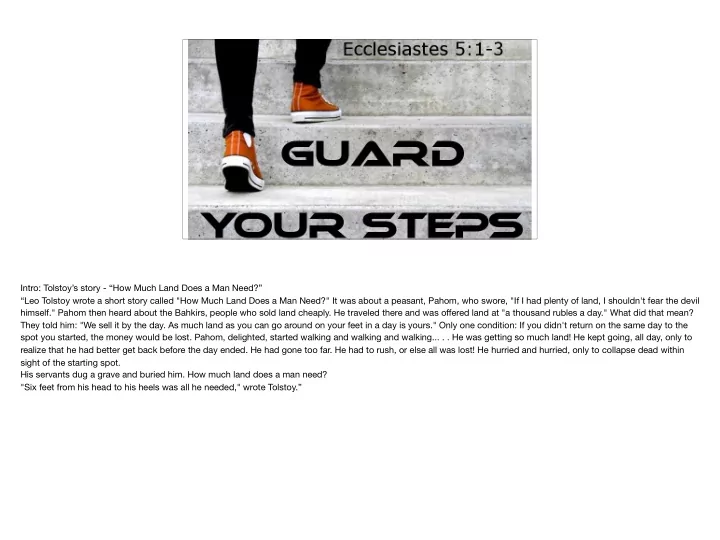
Intro: Tolstoy’s story - “How Much Land Does a Man Need?” “Leo Tolstoy wrote a short story called "How Much Land Does a Man Need?" It was about a peasant, Pahom, who swore, "If I had plenty of land, I shouldn't fear the devil himself." Pahom then heard about the Bahkirs, people who sold land cheaply. He traveled there and was offered land at "a thousand rubles a day." What did that mean? They told him: "We sell it by the day. As much land as you can go around on your feet in a day is yours." Only one condition: If you didn't return on the same day to the spot you started, the money would be lost. Pahom, delighted, started walking and walking and walking... . . He was getting so much land! He kept going, all day, only to realize that he had better get back before the day ended. He had gone too far. He had to rush, or else all was lost! He hurried and hurried, only to collapse dead within sight of the starting spot. His servants dug a grave and buried him. How much land does a man need? "Six feet from his head to his heels was all he needed," wrote Tolstoy.”

slide-2
SLIDE 2

Guard Your Steps

  • Theology of Ecclesiastes -

What does Solomon believe about God?

  • Examination of Solomon’s

Practical Religion

  • God’s Judgment on Solomon
  • Verdict on Solomon by

Posterity

Theology of Ecclesiastes - What does Solomon believe about God? Examination of Solomon’s Practical Religion God’s Judgment on Solomon Final Verdict of Solomon in Posterity

slide-3
SLIDE 3

“Guard your steps as you go to the house of God…” Eccl. 5:1-3

“Guard your steps as you go to the house of God and draw near to listen rather than to offer the sacrifice of fools; for they do not know they are doing evil. Do not be hasty in word or impulsive in thought to bring up a matter in the presence of God. For God is in heaven and you are on the earth; therefore let your words be few. For the dream comes through much effort and the voice of a fool through many words.” (Ecclesiastes 5:1–3 NAS95)

slide-4
SLIDE 4

Compare to Theological Statement of Jesus in Matthew 21:28-31 ““But what do you think? A man had two sons, and he came to the first and said, ‘Son, go work today in the vineyard.’“And he answered, ‘I will not’; but afterward he regretted it and went.“The man came to the second and said the same thing; and he answered, ‘I will, sir’; but he did not go.“Which of the two did the will of his father?” They *said, “The first.” Jesus *said to them, “Truly I say to you that the tax collectors and prostitutes will get into the kingdom of God before you.” (Matthew 21:28–31 NAS95)

slide-5
SLIDE 5
  • “We would do well to ask
  • urselves how we feel in

the presence of Jesus.” -

SDABC on Luke 15:2

“It is a paradox that those who considered themselves paragons of righteousness felt so uncomfortable in the presence of Jesus, whereas those who admittedly made no claim to righteousness felt drawn to the Saviour (COL 186). Undoubtedly it was the hypocrisy of the former and the lack of pretense of the latter that made the difference (see Luke 18:9–14). The one class felt no need of the blessings Jesus had to offer, the other class realized its need and made no effort to conceal it (see on

  • Matt. 5:3; Mark 2:5; Luke 4:26; 5:8). The one was content with its own righteousness; the other knew that it had no righteousness of its own to offer. We would do well to

ask ourselves how we feel in the presence of Jesus.” - SDABC on Luke 15:2

slide-6
SLIDE 6

Key Archaeological Discovery

Nearly 2 miles outside the Old City by the Israel Antiquities Authority

“One of the largest collections of royal Kingdom of Judah seal impressions has been uncovered at a massive First Temple-period public tax collection and storage complex being excavated near the new United States Embassy in Jerusalem.” - Times of Israel “Prevalent among the stamped inscriptions is “LMLK,” “LamMeLeKh,” or “Belonging to the King,” a way of marking that the foodstuffs stored in the jars had been tithed to the Judean ruler.”

slide-7
SLIDE 7

Pagan Worship

  • “Some of the figurines are

designed in the form of women, horse riders or as

  • animals. These figurines are

usually interpreted as

  • bjects used in pagan

worship and idolatry — a phenomenon, which according to the Bible, was prevalent in the Kingdom of Judah.” - Times of Israel

“Some of the figurines are designed in the form of women, horse riders or as animals. These figurines are usually interpreted as objects used in pagan worship and idolatry — a phenomenon, which according to the Bible, was prevalent in the Kingdom of Judah.”

slide-8
SLIDE 8

False Worship. Solomon was an Oriental monarch who loved luxury, and who unfortunately followed in many of the ways of Oriental despots. Outstanding among his mistakes was his taking many foreign wives. These brought about disloyalty toward God, which in turn resulted in the breakup of his empire after his death. To accommodate these women he erected pagan sanctuaries and shrines and he himself occasionally worshipped at them.

slide-9
SLIDE 9

Solomon’s Harem “He had seven hundred wives, princesses, and three hundred concubines, and his wives turned his heart away.” (1 Kings 11:3 NAS95)

“He had seven hundred wives, princesses, and three hundred concubines, and his wives turned his heart away.” (1 Kings 11:3 NAS95) Wives - Ishshah - Hebrew Word for Concubine - “pilegesh; of uncertain derivation; a concubine; also (masculine) a paramour: — concubine, paramour”

slide-10
SLIDE 10

Summary of Solomon’s Reign

1 Kings 11

Painting: Alex Levin 1 Ki 11:1–13 Key Verse about the Theology of Solomon - “Solomon did evil in the sight of the LORD, and did not fully follow the LORD, as did his father David.” (1 Kings 11:6 NKJV) List of foreign Gods that Solomon built temples for around Jerusalem Ashteroth Milcom Chemosh Molech

slide-11
SLIDE 11

Domenico Antonio Vaccaro Taxes - Another mistake Solomon made was to tax the people heavily over an extended period. His forced-labor program was especially unpopular and became the most visible cause of the breakup of the kingdom immediately following his death (ch 12:4–16). - SDABD

slide-12
SLIDE 12
  • “Now the LORD was angry with Solomon because his heart was turned

away from the LORD, the God of Israel, who had appeared to him twice, and had commanded him concerning this thing, that he should not go after other gods; but he did not observe what the LORD had

  • commanded. So the LORD said to Solomon, “Because you have done

this, and you have not kept My covenant and My statutes, which I have commanded you, I will surely tear the kingdom from you, and will give it to your servant. “Nevertheless I will not do it in your days for the sake

  • f your father David, but I will tear it out of the hand of your son.

“However, I will not tear away all the kingdom, but I will give one tribe to your son for the sake of My servant David and for the sake of Jerusalem which I have chosen.”” (1 Kings 11:9–13 NAS95) “Now the LORD was angry with Solomon because his heart was turned away from the LORD, the God of Israel, who had appeared to him twice, and had commanded him concerning this thing, that he should not go after other gods; but he did not observe what the LORD had commanded. So the LORD said to Solomon, “Because you have done this, and you have not kept My covenant and My statutes, which I have commanded you, I will surely tear the kingdom from you, and will give it to your

  • servant. “Nevertheless I will not do it in your days for the sake of your father David, but I will tear it out of the hand of your son. “However, I will not tear away all the

kingdom, but I will give one tribe to your son for the sake of My servant David and for the sake of Jerusalem which I have chosen.”” (1 Kings 11:9–13 NAS95)

slide-13
SLIDE 13

God raised up Adversaries

Hadad Rezon Jeroboam

God raised up adversaries to Solomon: Hadad the Edomite exiled in Egypt after Joab slayed every male in Edom, propped up by Pharaoh. Rezon of Zobah, Wanted revenge on David & Israel Jeroboam the Ephraimite of Zeredah

slide-14
SLIDE 14

Key Point - Naked in the Dust However much Ecclesiastes has challenged Bible students over the centuries, if there is one message that comes through, perhaps it could be found in Ecclesiastes 5:15: “As he had come naked from his mother’s womb, so will he return as he came. He will take nothing from the fruit of his labor that he can carry in his hand.” (Ecclesiastes 5:15 NAS95) He’s talking about some of the foibles and challenges of wealth, such as gaining money only to lose it all before it can be passed on to the next generation (Eccles. 5:14). Ecclesiastes 5:15 in the original Hebrew reads like this: "As he came forth from his mother's womb, naked he will go again as he came, and he will not carry in his hand anything of his work when he does go." The point is obvious. The rich die along with the rest of us, and in death all their money becomes meaningless. Yet, the message is bigger than that. Solomon's whole point in the book is that, Hey, look at your life—what are you living for? What matters in an existence that's filled with hebel? What, then, are the important things that we should be focusing on? - SDA Study Quarterly - “Ecclesiastes” 2007

slide-15
SLIDE 15

Solomon’s Theology of Judgment - “Rejoice, young man, during your childhood, and let your heart be pleasant during the days of young manhood. And follow the impulses of your heart and the desires of your eyes. Yet know that God will bring you to judgment for all these things.” (Ecclesiastes 11:9 NAS95) Of the 40 instances in 35 verses of Solomon’s usage of the Elohim to mean God, 11 of them occur in chapter 5 where he urges us to “Guard our steps”

slide-16
SLIDE 16
  • “Through bitter experience he had “learned the

emptiness of a life that seeks in earthly things its highest good” (PK 76). Gradually, he came to realize the wickedness of his course, and sought how he might lift a voice of warning that would save others from the bitter experiences through which he himself had passed (PK 80–82, 85), and thereby counteract, as best he could, the baleful influence of his folly.” - Seventh-day Adventist Bible Commentary “Introduction to Ecclesiastes”

“Through bitter experience he had “learned the emptiness of a life that seeks in earthly things its highest good” (PK 76). Gradually, he came to realize the wickedness of his course, and sought how he might lift a voice of warning that would save others from the bitter experiences through which he himself had passed (PK 80–82, 85), and thereby counteract, as best he could, the baleful influence of his folly.” - Seventh-day Adventist Bible Commentary

slide-17
SLIDE 17

Further Wisdom

  • “Although a sinner does evil

a hundred times and may lengthen his life, still I know that it will be well for those who fear God, who fear Him

  • penly.” (Ecclesiastes 8:12)

“Although a sinner does evil a hundred times and may lengthen his life, still I know that it will be well for those who fear God, who fear Him openly.” (Ecclesiastes 8:12 NAS95)

slide-18
SLIDE 18

God Preserved Judah

1 Kings 11:32-43

God commits to keep one tribes within Jerusalem’s rule - 1 Kings 11:32-43 “The Lord’s afflictions are temporal, not eternal; His mercies endure forever (Ps. 103:8, 9, 17). Because of the failure of David’s descendants, the promises to David were to meet their complete fulfillment in the spiritual house of the NT church and in Christ, the Son of David, the Head of the church.”

slide-19
SLIDE 19
  • “Solomon's later writings reveal that as he realized more and still

more the wickedness of his course, he gave special attention to warning the youth against falling into the errors that had led him to squander for nought Heaven's choicest gifts. With sorrow and shame he confessed that in the prime of manhood, when he should have found God his comfort, his support, his life, he turned from the light of Heaven and the wisdom of God, and put idolatry in the place of the worship of Jehovah. And now, having learned through sad experience the folly of such a life, his yearning desire was to save others from entering into the bitter experience through which he had passed.” - Prophets & Kings pg. 80

“Solomon's later writings reveal that as he realized more and still more the wickedness of his course, he gave special attention to warning the youth against falling into the errors that had led him to squander for nought Heaven's choicest gifts. With sorrow and shame he confessed that in the prime of manhood, when he should have found God his comfort, his support, his life, he turned from the light of Heaven and the wisdom of God, and put idolatry in the place of the worship of Jehovah. And now, having learned through sad experience the folly of such a life, his yearning desire was to save others from entering into the bitter experience through which he had passed.” - Prophets & Kings pg. 80

slide-20
SLIDE 20

“The light is pleasant, and it is good for the eyes to see the sun. Indeed, if a man should live many years, let him rejoice in them all, and let him remember the days of darkness, for they will be many. Everything that is to come will be futility. Rejoice, young man, during your childhood, and let your heart be pleasant during the days of young manhood. And follow the impulses of your heart and the desires of your eyes. Yet know that God will bring you to judgment for all these things. So, remove grief and anger from your heart and put away pain from your body, because childhood and the prime of life are fleeting.” (Ecclesiastes 11:7–10 NAS95)

slide-21
SLIDE 21

“From such examples we should learn that in watchfulness and prayer is the only safety for both young and old. Security does not lie in exalted position and great

  • privileges. One may for many years have enjoyed a genuine Christian experience, but he is still exposed to Satan's attacks. In the battle with inward sin and outward

temptation, even the wise and powerful Solomon was vanquished. His failure teaches us that, whatever a man's intellectual qualities may be, and however faithfully he may have served God in the past, he can never with safety trust in his own wisdom and integrity. In every generation and in every land the true foundation and pattern for character building have been the same. The divine law, “Thou shalt love the Lord thy God with all thy heart, ... and thy neighbor as thyself,” the great principle made manifest in the character and life of our Saviour, is the only secure foundation, the only sure guide. Luke 10:27. “Wisdom and knowledge shall be the stability of thy times, and strength of salvation,” the wisdom and knowledge which God's word alone can impart. Isaiah 33:6.” - PK 82

slide-22
SLIDE 22

Battle of Cold Harbor by Kurz and Allison, 1888 Appeal Story - “Desire To Be Identified” During a lull between the charges at the second Battle of Cold Harbor, in June 1864, with combined casualties over 18,000; officers going through the Union ranks saw the men, sitting on the grass under the trees, or in the thickets, sewing their names on the sleeves of their coats. Why? Because they expected to die in the ensuing charge, and shrank from the oblivion of a nameless grave. They wanted someone in the hills of Virginia, to know how they had died and where and when, and where their bodies rested. —C. E. Macartney

slide-23
SLIDE 23

Appeal Prayer - May we heed the wise repentance of Solomon and “Guard our Steps” as we approach a holy Heavenly Father.