
SLIDE 1
Intro
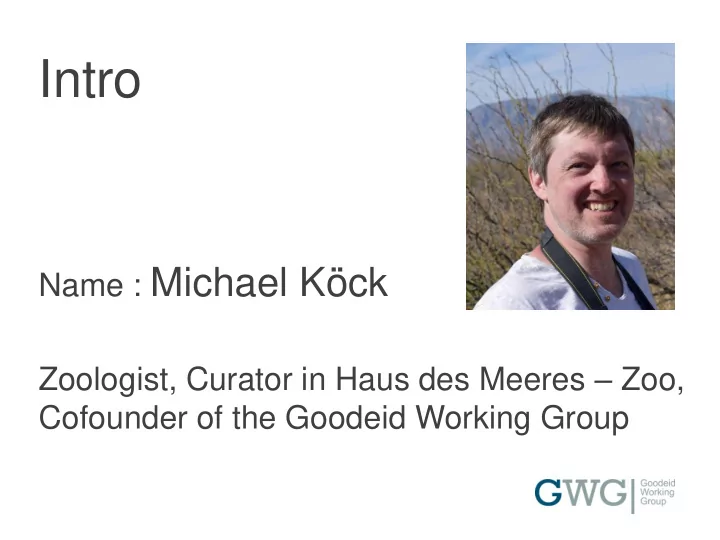
Name : Michael Köck Zoologist, Curator in Haus des Meeres – Zoo, Cofounder of the Goodeid Working Group
Intro Name : Michael Kck Zoologist, Curator in Haus des Meeres Zoo, - - PowerPoint PPT Presentation
Intro Name : Michael Kck Zoologist, Curator in Haus des Meeres Zoo, Cofounder of the Goodeid Working Group Todays Topic: Redlisting Goodeids for the IUCN, process and shortcommings The talk will be about the Differences between
Name : Michael Köck Zoologist, Curator in Haus des Meeres – Zoo, Cofounder of the Goodeid Working Group
… about the Differences between CITES and the IUCN Redlist … about assessing Goodeids for the Redlist … about the Redlist Criteria and their Shortcommings in assessing fish
Convention on International Trade in Endangered Species
The international trade of CITES-listed species is regulated in the Appendices I, II and III.
that are the most endangered listed species. They are threatened with extinction and CITES prohibits international trade in specimens of these species except when the purpose of the import is not commercial (e.g. scientific research).
that are not necessarily now threatened with extinction but that may become so unless trade is closely controlled. It also includes so- called "look-alike species", i.e. species whose specimens in trade look like those of species listed for conservation reasons.
included at the request of a Party that already regulates trade in the species and that needs the cooperation of other countries to prevent unsustainable or illegal exploitation.
I II III Fish 16 107 24 Teleosts 6 50 1 Goodeids 0 0 0
1. CITES is a trade regulative 2. Species listed don’t need to be threatened 3. Goodeids are not on the list because they are not traded. 4. It has no effect on Goodeid conservation. 5. CITES consults the IUCN Redlist for the status
The IUCN Red List is a critical indicator of the health of the world’s biodiversity. Far more than a list of species and their status, it is a powerful tool to inform and catalyze action for biodiversity conservation and policy change, critical to protecting the natural resources we need to survive. It provides information about range, population size, habitat and ecology, use and/or trade, threats, and conservation actions that will help inform necessary conservation decisions.
International Union for the Conservation of Nature, Red List of Threatened Species
1. Characodon garmani (EX) 2. Ameca splendens (EW) 3. Skiffia francesae (EW) 4. Allotoca diazi (CR) 5. Allotoca maculata (CR) 6. Girardinichthys viviparus (CR) 7. Hubbsina (G.) turneri (CR) 8. Zoogoneticus tequila (CR) 9. Ataeniobius toweri (EN)
The Species Information Service (SIS) is IUCN’s web application for conducting and managing species assessments for the IUCN Red List of Threatened Species™.
IUCN Species Information Service
AOO of 8km² (smaller than 10km²):
AOO of 12km² (larger than 10km²):
AOO of 8km², but 2 locations:
AOO of 8km², 2 locations, but severeley fragmented:
AOO of 12km², 3 locations, but severeley fragmented:
AOO of 12km², 2 locations, but severely fragmented:
The pitfalls of EOO and location number:
1. The Redlist is comprehensive, focusing also on threats and conservation, on development, not
2. It is an international instrument and popular. 3. It has effects on Goodeid conservation. 4. The Criteria are made for mammals and birds and show issues with small fish, and has therefore shortcommings that need to be solved.