
SLIDE 1
1
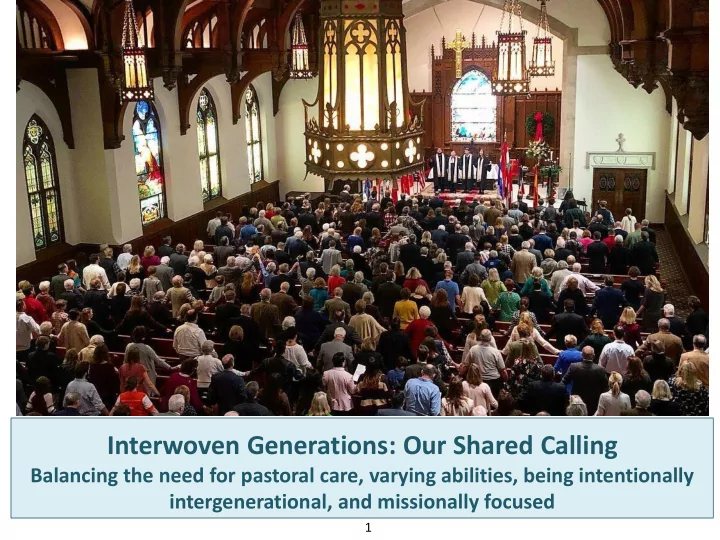
Interwoven Generations: Our Shared Calling
Balancing the need for pastoral care, varying abilities, being intentionally intergenerational, and missionally focused
Interwoven Generations: Our Shared Calling Balancing the need for - - PowerPoint PPT Presentation
Interwoven Generations: Our Shared Calling Balancing the need for pastoral care, varying abilities, being intentionally intergenerational, and missionally focused 1 In our connections with all generations POAMN recognizes a new resolve to break
1
Balancing the need for pastoral care, varying abilities, being intentionally intergenerational, and missionally focused
In our connections with all generations POAMN recognizes a new resolve to break down the stereotypes and create a new understanding of aging. The population shift is astounding as we move from a predominately young to an aging culture.
2
2
3
WILL OUTNUMBER
3
Largest Group in PC(USA) continues to be 65 and older
4
4
https://www.pcusa.org/news/2019/3/1/congregations-are-decline-age-ranges-remain-same/
5
5
6
6
105+ 85-95+Age
Age 65 -75+ Active Adults Living Longer 100+
In 1990 there were 2.9 centenarians for every 10,000 adults ages 65 and
grew to 7.4 by 2015 and is projected to rise to 23.6 by 2050.
Age 98+ Centenarian Yoga Master Tao Porchen-Lynch
7
8
8
9
There are now 6 generations living in the U.S. in our denominations, congregations, and communities
Which Generation are You?
Generation Name Births Start Births End Youngest Age Today* Oldest Age Today*
The Greatest Generation 1910 1924 95 100+
The Silent Generation 1925 1945 74 94 Baby Boomer Generation 1946 1964 55 MH 73 Generation X (Baby Bust) 1965 1979 40 54 Millennials 1980 1994 25 39
(Generation Y, Gen Next) “ “ “ “
iGen / Gen Z 1995 2012 7 24 Gen Alpha 2013 2025 1 6 (*age if still alive today)
10
Builder 1, Boomer 1, GenX 5, Millennial 5 , GenZ/Boomlet 12, Gen Alpha – 2
10
Who should you be developing as leaders of all generations? What are the spiritual needs of your older adults that intersect with children and families? When have you seen belonging taking root? How can your congregants questions, doubts, and experiences lead to action? Where can you cross lines of difference to practice living into Loving Christ, Loving One Another, and Loving your City/Community? What is the potential for ministry to mature adults and young adults in your community? What is the possibility of intergenerational engagement in OA? What are the needs of the older adults and caregivers of all ages in your congregation? Community? How does this affect the family and the younger members of the congregation? How will this affect the church's’ programming, facilities, outreach, and overall mission?
11
PMA Christian Formation Covenant Partners
Those ages and stages ministries are
APCE – ASSOCIATION PRESBYTERIAN CHIRSTIAN EDUCATORS PYWA – PRESBYTERIAN YOUTH WORKERS ASSOCIATION UKirk Network – PC(USA) COLLIGEATE MINISTRIES
PCCCA – Presbyterian Camp and Conference Centers POAMN – Presbyterian Older Adult Ministries Network
Stephanie Fritz is PC(USA)’s new Associate Coordinator for Faith Formation at PMA
12 12
I
N T E R G E N E R A T I O N A L M I N I S T R Y
A shift in thinking, away from a ‘senior group’ mentality and toward an intergenerational “maturing adult ministry’ mentality. One that honors diversity...of age, stage, personality, ethnicity, and spirituality and sexuality.
13
Older Adult Ministry Program Ideas
Adult Day Services Advertise in Local Theatre & Senior Citizen Center Alternative Worship Annual Older Adult Picnic Art-Painting Classes Caregiver Support Group Caregiving/Care Teams Children of Aging Parents Classes/Activities Clown Ministry Coffee Connection Day Trips Exercise and Fitness Extended Travel Flowers for At-Home Members Foster Grandparents Game Day Garden Group Gathering Place Helping Hands House Sharing Homebound Bible Study Intergenerational Retreat
An in-depth description for each of these activities can be found in the 2014 Older Adult Ministry Planning Guide - Engaging New Seniors and Older Persons In The Life of The Church by Michele Shultz Hendrix - Pages 36-41. on our website at poamn.org
Alternative Worship The Gathering Intergenerational Art Class Frownbuster Clown Ministry Exercise and Fitness
14
15
15
FPC SA
16
16
FPC San Antonio partners with a variety of local mission partners around the city. These partners focus on showing the love of Christ in a myriad of ways; providing food, shelter, and assistance to low-income or homeless individuals and families, assisting with building life-skills and care, building mentorships, planting church families, evangelism, and education. To find out how you can serve one of our local mission partners, contact Rev. Mitchell Moore at FPC – 210-226-0215
Love Christ, Love One Another, Love our City
SA Christian Hope Resource Center http://www.sachrc.org Christian Assistance Ministries (CAM) http://christianassistanceministry.
Haven for Hope https://www.havenforhope.org/
To work toward transformation of lives for those who are struggling in our downtown neighborhood.
17
18
18
With the handprints of Hurricane Harvey still lingering in many of our Texas Coast cities, we are uniquely positioned in the midst of tragedy and loss to help those displaced by the flooding and not able to return to their homes for months. As a church family we have had a unique opportunity to minister to others more vulnerable to help clean out, clean up, rebuild, and
love through service that cultivates meaningful relationships and supports long-term recovery.
19
Grandparents Raising Grandchildren provides home-based services and community resources to improve the physical and emotional needs of families. It will be a full day of information, resources, and demonstrations. A collaboration of Bexar Area Agency on Aging, Alamo Council of Government, CentroMed, Powerful Tools for Caregivers.
19
20
GRANDFAMILIES = Kinship = GRANDPARENTS RAISING GRANDCHILDREN
Our goal is to show God's love, care and concern to grandparents in need, as they are raising their Grandchildren, helping to establish a safe environment through relational, physical and spiritual support during a time of transition.
Grandparents who are primarily responsible for all aspects of the care of a grandchild (or grandchildren) Can be formal or informal (majority) caregiving Parents often absent (skipped generation households) Reasons and experiences are diverse Usually multiple factors are at work Reasons often reflect societal patterns of marginalization
20
21
22
Love 2.10 Love 2.10 Love 2.10
What do our neighbors need the most help with?
23
LOAVES AND FISHES
“We will be serving our neighbors again on Saturday, October 19 in the Student Center. Last month (September) we fed lunch to 150, provided showers for 41 and 20 people got
women accepted Jesus as their Savior that
are being changed in collaboration with our service partners.” Debra Sirokos, Volunteer Coordinator
24
ORGANIZATIONS PROVIDING BOTH PHYSICAL AND MENTAL HEALTH CARE, AS WELL AS FAITH-BASED RECOURCES AND SERVICES WILL BE THERE TO CONNECT WITH OUR GUESTS ON AN INDIVIDUAL BASIS. WE WILL ALSO PROVIDE SHOWERS, HAIRCUTS, AND A HOT MEAL AS WE JOIN IN FELLOWSHIP WITH OUR GUESTS AS WE SERVE THE HOMELESS AND UNDERSERVED
FPC Mental Health Ministry
PATHWAYS TO HOPE CONFERENCE FPC MHM TEAM
NAMI SUPPORT GROUP
NAMI SUPPORT GROUP
FPC NAMI Connection Recovery Support Group 6:30 PM | Room 309 FPC NAMI Peer-to-Peer Course 6:30 PM | Room 308 FPC NAMI Support Groups for Mental Health First & Third Tuesdays 6:30 PM | Room 300 FPC NAMI Family-to-Family Course 6:30 PM | Room 302
NAMI San Antonio is a grassroots mental health organization dedicated to improving the lives of individuals, families and friends affected by mental illness. We are a self-help, support and advocacy
mental illness.
25
25
26
27
Older Adults are socially isolated
feel lonely 17% American Adults 65+ are isolated Loneliness and the aging population – it is a looming crisis!
Resource: AARP Foundation website Connect2Affect 27
28
65 million adults in the U.S. have provided unpaid care to a disabled adult or a child in the prior 12 months.
caring for a 69 year old female relative
for myself (35%), managing emotional and physical stress (29%), and balancing work and family responsibilities (29%).
(2015-2017)
Globally, the population is aging rapidly.
proportion of the world’s population
12% to 22%.
important in older age as at any other time of life.
among older adults account for 6.6%
group.
and over suffer from a mental disorder.
29
85% of older adults have at least one chronic illness: 50% have arthritis, 40% have hypertension, 30% have heart disease, 12% have diabetes, 30% have hearing loss, 15% cataracts and 10% have a stroke
29
What are Care Clusters? Care Clusters are small groups of ten people who meet regularly and create a caring and welcoming atmosphere where people care for one another, experience the power of the gospel and are transformed through discipleship. Care Cluster Vision: In the next five years, we dream that every Covenant Partner who calls FPC home will be connected to Christ and to one another through the renovation of pastoral care by focusing
want to make disciples who love one another.
Community.
30
Prayer, Patience, Planning, Preparation, Perseverance, and Teamwork
In the next five years, we dream to experience an intense period of institutional renovation of pastoral care at First Presbyterian Church by focusing on spiritual formation in small groups. In the next five years, we dream that every covenant partner who call First Presbyterian Church home will be connected to one another and to Christ through the renovation of pastoral care by focusing on care and discipleship in small groups.
31
32
CARE CLUSTER MINISTRY
What are Care Clusters? Care Clusters are small groups of ten people who meet regularly and create a caring and welcoming atmosphere where people care for one another, experience the power of the gospel and are transformed through discipleship. Care Cluster Vision: In the next five years, we dream that every Covenant Partner who calls FPC home will be connected to Christ and to one another through the renovation of pastoral care by focusing on discipleship in small groups. We want to make disciples who love one another. Three Key Elements: Care Care Cluster members will care for one another, while the Pastoral Staff, Church Staff, Stephen Minister Team, and support groups will provide resources and support. When times of illness, stress, loneliness, grief or any other loss
Communication Care Cluster members will learn to enhance communication by sharing love of Christ with one another, and the Care Cluster will learn to regularly communicate the Cluster’s needs to the pastoral staff so they can provide additional resources and support and the entire congregation can pray for everyone in need. Connection Jesus calls us to connect to Him and to one another so that we can join together in enthusiastic fellowship and care for one another. In the future, the Care Cluster Leadership Team will be working hard to connect every Covenant Partner to Christ and to one another in a Care Cluster. For more information and to become involved with Care Clusters, contact
32
Chronic conditions are on the rise across the nation and can lower quality
this population. Developing evidence-based programs in your congregations and organizations are a proven way to promote health and prevent disease among older adults. Older Americans overwhelmingly prefer to stay in their homes, churches, and communities as they age. The ultimate goal is to improve the health, function, and quality of life of older adults.
The most common chronic conditions include: Heart Disease Cancer Chronic Bronchitis or Emphysema Stroke Diabetes Alzheimer's & Dementia
33
34
To learn more details about Powerful Tools for Caregivers go to www.powerfultoolforcaregivers.org
35
A Matter of Balance - an 8-week structured group intervention that emphasizes practical strategies to reduce fear of falling and increase activity levels. Participants learn to view (a) falls and fear of falling as controllable, (b) set realistic goals to increase activity, (c) change their environment to reduce fall risk factors, and (d) exercise to increase strength and balance. Savvy Caregiver - an educational program focused on providing instructional material for Alzheimer’s and dementia caregivers.. The program teaches the basic knowledge, skills, and attitudes needed to handle the challenges of caring for someone with Alzheimer’s disease. The Savvy Caregiver program has also been tested, researched and evaluated over the years and results have shown that this training program reduces Alzheimer caregiver’s distress effectively.
Talkin’ bout my generation – Coming of Age and Presbyterian identity – Perry Chang
https://www.presbyterianmission.org/story/0117-gofigure/ /
January-February 2017 Presbyterian’s Today –Page 8
Talkin’ ’bout my generation Presbyterians Today December 20, 2017 Go Figure: Coming of age and Presbyterian identity By Perry Chang
(Jeffrey Lawrence) Does coming of age in a particular era decisively shape people’s values, habits and personalities? Yes, say some analysts. They argue, for example, that the “Greatest Generation” — Americans who grew up during the Great Depression, World War II and the Korean War — is known for being loyal, hardworking and disciplined. Other generations have been influenced by times of economic affluence, stock market crashes and wars. Generational characteristics influence religious and political differences among Presbyterians Greatest Generation Presbyterians attend worship, pray and read the Bible more regularly than other generations. They also donate more money and are more likely to identify as theologically conservative and Republican, especially when compared with Generation Y and Millennial Presbyterians. There’s evidence, moreover, that the higher religiosity in older Presbyterians does not occur because they become more devoted as they grow older. Accounting for inflation, giving among the oldest generation hasn’t changed. The percentage
to their congregations is the same today as it was 20 years
Likewise, the percentage of Baby Boomer Presbyterians who pray daily or almost daily is about the same today as it was 10 years ago. Perry Chang is a research associate with Research Services for the Presbyterian Mission Agency. 36 36
37
Sarah Erickson Director, Lifelong Learning 404 687-4526 EricksonS@CTSnet.edu Patricia Baker OAM Certificate Program Coordinator Presbyterian Older Adult Ministry Network 678-438-3673 Pcbaker22@comcast.net http://www.p
Michele Hendrix, President Presbyterian Older Adult Ministries Network - POAMN poamn.org tmichelehendrix@icloud.com 832-731-6127
Michele Hendrix is President of Presbyterian Older Adult Ministries Network (POAMN). She is a Deacon, Stephen Leader, Caregiver Specialist, Speaker, and Master Trainer for Powerful Tools for Caregivers with expertise in intergenerational and older adult ministry and
educate, involve and motivate individuals in the process of aging and self-care. Recognizing the connections among church, health care, non-profit, community, state, federal, and local agencies. Conducting workshops nationally for POAMN, APCE-Association Presbyterian Church Educators, Presbytery of the Cascades Older Adult Ministry Leadership Retreat, Presbytery of New Covenant, Cascades Presbytery, Presbytery of Shapley and the James, Philadelphia Presbytery Older Adult Ministry Task Force, Texas Ministry Conference, Area Agency on Aging State Conferences in Ohio and Texas, Interfaith Care Partners Caregiver Conferences/Houston, St. Luke’s Methodist Church Caregiver Conferences/Houston, Life Care Centers of America, Older Adult Retreats, Lecture Series, and many individual congregations. Michele was appointed and served on the 2004 GA Task Force for Older Adult Ministry working with middle governing bodies on issues of aging and the church. Michele is married to Dale Hendrix and they have 5 adult married children and 14 grandchildren. Michele refers to them lovingly as her personal flash mob!
38
38
POAMN RESOURCES
An informative website, www.poamn.org Membership at individual, couples, affiliate, or institutional level. POAMN Network News (PNN) is published 5 times/year Older Adult Ministries Planning Guide published annually for celebrating Older Adult Sunday in early May (resources useful year-around.) Annual POAMN Conference held once a year and rotated around the country. Scholarships and grants to ease the cost of attendance are available. POAMN Regional Conference held once a year in various locations throughout the United States in collaboration with congregations, Presbyteries, and ecumenical partners. A Facebook and Twitter Page An Older Adult Ministry Certification Program, through a partnership with the Center for Lifelong Learning at Columbia Theological
http://www.ctsnet.edu/lifelong-learning- certificate-programs
POAMN exists to make everyone’s inevitable aging process the best it can possibly be. Embracing POAMN enables individuals and their loved ones to age sensibly, happily and wisely with God’s full strength.
39