Interprofessional Practice: The Key to Positive Outcomes for - - PDF document

interprofessional practice
SMART_READER_LITE
LIVE PREVIEW

Interprofessional Practice: The Key to Positive Outcomes for - - PDF document

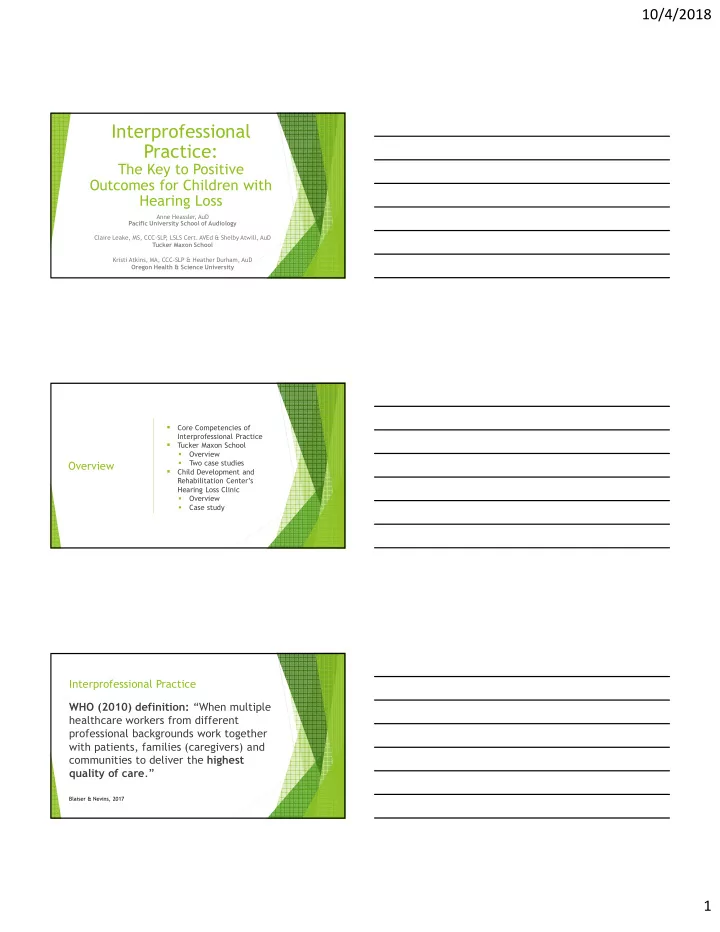
10/4/2018 Interprofessional Practice: The Key to Positive Outcomes for Children with Hearing Loss Anne Heassler, AuD Pacific University School of Audiology Claire Leake, MS, CCC-SLP , LSLS Cert. AVEd & Shelby Atwill, AuD Tucker Maxon


slide-1
SLIDE 1

10/4/2018 1

Interprofessional Practice:

The Key to Positive Outcomes for Children with Hearing Loss

Anne Heassler, AuD Pacific University School of Audiology Claire Leake, MS, CCC-SLP , LSLS Cert. AVEd & Shelby Atwill, AuD Tucker Maxon School Kristi Atkins, MA, CCC-SLP & Heather Durham, AuD Oregon Health & Science University

Overview

  • Core Competencies of

Interprofessional Practice

  • Tucker Maxon School
  • Overview
  • Two case studies
  • Child Development and

Rehabilitation Center’s Hearing Loss Clinic

  • Overview
  • Case study

Interprofessional Practice WHO (2010) definition: “When multiple healthcare workers from different professional backgrounds work together with patients, families (caregivers) and communities to deliver the highest quality of care.”

Blaiser & Nevins, 2017

slide-2
SLIDE 2

10/4/2018 2

Activity

Form 5 groups and discuss:

  • When have you worked in

interprofessional teams?

  • Who was part of those teams?
  • What were some of the

benefits working in that team?

  • What were some of the

challenges?

Interprofessional Practice (IPP)

World Health Organization (WHO)

Framework for Action on Interprofessional Education and Collaboration (2010)

Interprofessional Education Collaborative (IPEC)

Core Competencies for Interprofessional Collaborative Practice (2011)

  • Updated 2016

American Speech- Language-Hearing Association (ASHA)

CAA Accreditation Standards

Core Competencies of IPP

  • Values and Ethics
  • Roles and Responsibilities
  • Interprofessional Communication
  • Teams and Teamwork
slide-3
SLIDE 3

10/4/2018 3

IPP Core Competency: Values and Ethics

  • Competency: Work with individuals of
  • ther professions to maintain a climate
  • f mutual respect and shared values.
  • Professional Silos
  • Common experiences
  • Shared values
  • Problem-solving and language

Values & Ethics Sub- competencies

  • Place interest of patients and populations at center
  • f interprofessional health care delivery/public

health programs/to promote health equity.

  • Respect of patient privacy/confidentiality
  • Embrace cultural diversity and individual difference
  • Respect unique cultures, values,

roles/responsibilities, and expertise of other professions.

  • Work in cooperation with providers and others that

contribute or support all health services

  • Develop collaborative relationships with patients,

families, and other team members

  • Demonstrate high standards of ethical conduct
  • Manage ethical dilemmas
  • Act with honesty and integrity in relationships
  • Maintain competence in profession appropriate to

scope of practice.

IPP Core Competency: Roles & Responsibilities

  • Competency: Uses knowledge of one’s own

role and those of other professions to appropriately assess and address the healthcare needs of patients and to promote and advance the health of populations.

  • Clearly defined roles and responsibilities are

the foundation of an effective team

  • Expanding scope of practice amongst health

professions will increase in multiple team members with overlapping scope:

  • Ex: hearing screening in schools have

audiologists, SLPs, nurses with overlapping scope

  • Prevents “role-blurring” and “role-

expansion”

  • Requires team members understand

expertise and functions of other members

slide-4
SLIDE 4

10/4/2018 4

Roles & Responsibilities Sub- competencies

  • Communicate own r & r clearly
  • Recognize one’s limitations in skills, knowledge,

and abilities

  • Engage professionals and resources that

complement in expertise to develop strategies to meet specific health and healthcare needs of patients and populations

  • Explain r & r of other providers and how the team

works to provide services, promote health, and prevent disease.

  • Use full scope of knowledge, skills, and abilities of

professionals to provide care that is safe, timely, efficient, effective, and equitable.

  • Communicate with team members to clarify each

member’s responsibilities in task.

  • Create interdependent relationships with other

professions both within and external to the system.

  • Use complementary abilities of team members to
  • ptimize health and patient care.
  • Describe how professionals in health and other

fields can collaborate and integrate clinical care and public health interventions to optimize population health.

IPP Core Competency: Interprofessional Communication

  • Competency: Communicate with patients,

families, communities, and professionals in health and other fields in a responsive and responsible manner that supports a team approach to the promotion and maintenance

  • f health and the prevention and treatment
  • f disease.
  • Critical to effective teams.
  • Effective communication requires accessibility

to other members and ability to use appropriate communication skills.

  • Formal meetings were critical to

communication and in supporting team functioning.

  • Informal opportunities (i.e. hallway convos,

quick phone calls to clarify, etc.) are also identified as key to effective communication.

  • Listening and speaking up

Interprofessional Communication Sub- competencies

  • Effective communication tools & techniques

including technologies/info systems to facilitate discussions and enhance team effectiveness.

  • Communicate using understandable, avoiding

discipline specific terminology when possible.

  • Express knowledge and opinions to team members

with confidence, clarity, and respect to ensure common understanding of issue.

  • Listen actively and encourage ideas, opinions of
  • ther members.
  • Give timely, sensitive, and instructive feedback
  • thers and respond reflectively to feedback.
  • Use respectful language appropriate for a given

situation.

  • Recognize how own lens contributes to effective

communication, conflict resolution, and positive working relationship.

  • Communicate the importance of teamwork in

patient-centered care and policies.

slide-5
SLIDE 5

10/4/2018 5

IPP Core Competency: Teams & Teamwork

  • Competency: Apply relationship-building

values and the principles of team dynamics to perform effectively in different team roles to plan, deliver, and evaluate patient/population-centered care and population health programs and policies that are safe, timely, efficient, effective, and equitable.

Facilitates creative solutions to

challenging problems

Increases workforce satisfaction “Status-equal” Required collaborative skills of team

members include: cooperation, assertiveness, responsibility, communication, autonomy, and coordination.

Team & Teamwork Sub- competencies

  • Describe the process of team development and

the roles and practices of effective teams

  • Develop consensus on the ethical principles to

guide all aspects of teamwork.

  • Engage health and other professionals in shared

patient-centered and population-focused problem-solving.

  • Integrate knowledge and expertise of professions

to inform decisions including community values and priority/preference of care.

  • Apply leadership practice that support

collaborative practice and team effectiveness.

  • Engage self and others to to constructively

manage conflict.

  • Share accountability with other professions,

patients, communities for outcomes.

  • Reflect on individual and team performance.
  • Use process improvement to increase

effectiveness of IP teamwork.

  • Use available evidence to inform effective

teamwork.

  • Perform effectively on teams and in different

team roles in a variety of settings.

Example of IPP Team in School Setting

slide-6
SLIDE 6

10/4/2018 6

IPP Example: School-based Hearing Screening

Team Members - Goals and Values

Team Facilitator:

  • School Nurse

Team Members:

  • Audiologist
  • Speech-Language Pathologist

Goals/Values: *defined by team members 1) Implement an effective two-tier hearing screening program 2) Individualized student referral and intervention plans 3) Streamline communication from school to home to healthcare provider 4) Effective monitoring of outcomes of individual students 5) Effective monitoring of hearing screening program outcomes

Roles & Responsibilities - School Nurse

School Nurse

  • Facilitator of team and program

○ Coordinate schedule for team meetings ○ Schedule screening day in coordination with school administrators and teachers ○ Documentation of student screening outcomes in school data management system

  • Drive communication between school and

parents/caregivers ○ Obtain parental/caregiver consent ○ Relay student hearing screening outcomes to parents/caregivers ○ Provide resources for referral needs

  • Monitor individual student outcomes

○ Document outcome of referral ○ Initiate further recommendations based on

  • utcomes of follow-up.
slide-7
SLIDE 7

10/4/2018 7

Roles & Responsibilities - Audiologist

Audiologist

  • Train hearing screening personnel

○ Develop training materials based on best practice protocol

  • Drive appropriate referrals

○ Direct service delivery for rescreens ○ Provide recommendations for follow-up plan based on rescreen

  • utcomes.

○ Document recommendations

  • Monitor screening program outcomes

○ Monitor overall effectiveness of program by recording: ■ Noise levels in test environment ■ Refer rates of initial screening ■ Overall refer rate of screening program ■ Percentage of students who received appropriate follow-up

  • Equipment management

○ Determine appropriate equipment for hearing screening program ○ Annual calibration of equipment ○ Troubleshoot equipment ○ Ensure adequate and appropriate supplies ○ Manage and monitor infection control procedures

Roles & Responsibilities - SLP

Speech-Language Pathologist

  • Complete post-intervention hearing screenings

Provide rescreens of students post-intervention to ensure adequate hearing for effective communication in the classroom

  • In-service staff/teachers on effect on classroom

communication

Provide resources and training for classroom teachers on the effect of hearing loss on listening in the classroom

Interprofessional Communication

Initial planning meeting to discuss scheduling and training needs:

Schedule training of screening personnel, hearing screening date, re-screening date

Day of hearing screening:

Work with school staff/administration to determine appropriate testing environment Coordinate with teachers on student flow throughout the day

Documentation and follow-up:

Audiologist documents referral recommendations and notifies nurse on day obtained Nurse provides referral recommendations to parents/caregivers within 48-hours of

receiving outcomes

Nurse ensure follow-up of referral recommendation within 2-weeks of communicating

to parents/caregivers

Referral to speech-language pathologist for rescreen implemented once follow-up has

been completed or referral to audiologist for full audiologic assessment as needed Immediate team communications as needed Wrap-up meeting to discuss final outcomes and suggested improvement

slide-8
SLIDE 8

10/4/2018 8

Tucker Maxon School

Tucker Maxon School

  • Our Mission: To teach deaf and

hearing children to listen, talk, learn, and achieve excellence together.

  • Located in SE Portland, OR
  • Early Intervention (EI), Preschool

and Elementary Programs

Interprofessional Practice at TMS

  • Teachers of the deaf
  • Speech-language pathologist
  • Audiologist
  • Teachers of the deaf
  • Speech-language pathologist
  • Audiologist

Weekly team meetings

  • Annual evaluations (Audiology, speech, language,

academic)

  • Team meetings prior to IEP meeting to review

results/write goals

  • Annual evaluations (Audiology, speech, language,

academic)

  • Team meetings prior to IEP meeting to review

results/write goals

Individualized Education Plans

  • Annual evaluations
  • Team meetings prior
  • Detailed 6-month progress report
  • Annual evaluations
  • Team meetings prior
  • Detailed 6-month progress report

Individualized Family Service Plans

slide-9
SLIDE 9

10/4/2018 9

Case Study: Red flags (Cindy)

  • Hearing History

Failed newborn hearing screening No follow-up (hospital error) Diagnosed at 15 months:

asymmetrical sensorineural hearing loss

+ Fluctuating conductive loss due

to earwax and outer/middle ear infections Hearing aids fitted at 17 months

(poor compliance)

Unknown etiology, no risk factors

Frequency/Pitch (Hz)

125 250 500 1000 2000 4000 8000

Intensity/Loudness (dB HL)

  • 10

10 20 30 40 50 60 70 80 90 100 110 120 Normal (kids and adults) Slight (kids), still normal (adults) Mild Moderate Moderately Severe Severe Profound X X X X X X X X X O O O O O O O O O

Discussion

What difficulties would you expect Cindy to have? Using Relationship of Hearing Loss to Listening and Learning Needs handout

slide-10
SLIDE 10

10/4/2018 10

Case Study: Red flags (Cindy)

  • Intervention History

EI through County at 17 months Received audiology and TOD services Enrolled in preschool at T

ucker Maxon at 3 years, 2 months

Received audiology, TOD and SLP

services

Case Study: Red Flags (Cindy)

  • IPP team members:

Parents SLP Audiologist Teacher of the Deaf Classroom teacher(s) (ENT)

IPP Year 1: Red flags (Cindy)

Concerns & History Limited hearing aid use at home Needed bone conduction sound processor due to otitis externa Good improvement in vocab and language Limited gains in auditory skill and speech development Assessment Plan Re-evaluate in the fall Treatment Plan Goal: Full-time access to sound with personal hearing aids

  • Switched to anti-microbial earmolds
  • Provided parent-coaching on infection control/sanitization
  • Referred for ENT evaluation
  • Provided parent-coaching around device compliance

Treatment Outcome Increased hearing aid use to all waking hours Tonsillectomy/adenoidectomy & PE tubes summer 2016 Team Follow-up IFSP scheduled for fall

slide-11
SLIDE 11

10/4/2018 11

IPP Year 2: Red flags (Cindy)

Concerns & History Less frequent ear infections - when occurred, refused BCSP Slow progress with the following targets

  • Plural and possessive -s, “is”
  • Voicing and place minimal pair discrimination
  • Speech intelligibility

○ Final consonant deletion ○ K, G, F sound development Assessment Plan Progress report in the spring Assessment Results Actual age: 4 years 10 months Hearing age: 1 year 8 months - 2 years 6 months (optimal hearing vs. initial fitting) Language age: 3 years receptively, 2 years 6 months expressively Treatment Plan Goal: Continue to build foundational language skills

  • Repeat preschool
  • Summer services with a TOD

IPP Year 2, cont: Red flags (Cindy)

Treatment Outcome Fall Evaluation Arizona Test of Articulation (Speech): Similar # of errors, score dropped 72 to 69 EVT/PPVT: Good growth (now just below average) CELF P2: Language split of 22 points between Rec (81) and Exp (59) Language Sample: Stagnate MLU (2.5) Team Follow-up Regular meetings to close language gap during repeat preschool year

IPP Year 3: Red flags (Cindy)

Concerns & History Left hearing aid not providing good audibility Poor reporter of dead battery Expressive language and speech skills plateaued Poor attitude around intervention Assessment Plan Use more sensitive test for plurals CI eval for poorer ear Treatment Plan Goal: Increase access to sound, assuming frustration linked to attitude change

  • Try more powerful hearing aid for left ear (received in Jan)
  • Use of DM device for all services (class and 1:1)
  • Increase Cindy’s awareness of device function
  • Intense focus on battery awareness/battery chart at home &

classroom

  • Minimal pair trials with hearing aid adjustments
slide-12
SLIDE 12

10/4/2018 12

IPP Year 3: Red flags (Cindy)

Treatment Outcome More powerful hearing aid still insufficient No improvement in identification of issues with left hearing aid No improvement with hearing aid adjustments CI surgery scheduled for left ear Team Follow-up IEP scheduled for fall

Minimal Pair Trials

***Limited benefit from amplification, lack of progress in auditory, speech, language skill development***

slide-13
SLIDE 13

10/4/2018 13

CI Referral Letter

Background/History Unaided and aided hearing thresholds Hearing aid programming limitations Speech perception testing results Description of current level of intervention Description of limited goal progress in the areas of audition, speech, language, self-advocacy Personal factors: frustration, awareness she is missing out

IPP Year 4: Red Flags (Cindy)

Concerns & History Limited hearing aid use at home, nearly 0 hours over summer Continues to have poor self-concept as an individual who is deaf/hard-

  • f-hearing

Assessment Plan Fall evaluation for new IEP Email to mom at start of year to check on summer hearing aid use Treatment Plan Goal: Increase hearing/hearing aid knowledge and positive identity

  • Demonstrate learning about the effects of noise and distance on

her hearing and ability to listen by creating a poster, report, orloss Treatment Outcome Maintained hearing aid use to all school hours Completed testing on noise/distance and wrote a summary (w/ SLP/, babysitter and teacher Refused to support a preschooler Team Follow- up ???????

Red Flags

Lack of consistent hearing aid/cochlear implant use Lack of consistent hearing aid/cochlear implant use Alerting to sound is minimal or inconsistent Alerting to sound is minimal or inconsistent Child is relying on visual cues (if traditionally auditory learner) Child is relying on visual cues (if traditionally auditory learner) Learning only taught words, not incidentally Learning only taught words, not incidentally Phonological processes are present Phonological processes are present Missing linguistic structures (s, ed, ly, etc.) Missing linguistic structures (s, ed, ly, etc.) Not responding to any of the Ling 6 sounds (me, oo, ah, ee, sh, s) Not responding to any of the Ling 6 sounds (me, oo, ah, ee, sh, s) Making less than 1 year of growth in 1 year (in the absence

  • f other variables)

Making less than 1 year of growth in 1 year (in the absence

  • f other variables)

Falling behind in school or experience extreme fatigue Falling behind in school or experience extreme fatigue

slide-14
SLIDE 14

10/4/2018 14

Case Study: Self- esteem (Judy)

Hearing History

  • Diagnosed with bilateral, moderate

high-frequency sensorineural hearing loss at 5 years, 7 months

  • Fitted with hearing aids at 5 years 8

months and wore without issue

  • New hearing aids at 6 years 8 months

for nude color due to unwanted attention from classmates

  • Discovered first set not

programmed correctly - new set “too loud”

  • Continued bullying lead to refusal

to wear aids at school and home, leading to placement in behavioral program

Frequency/Pitch (Hz)

125 250 500 1000 2000 4000 8000

Intensity/Loudness (dB HL)

  • 10

10 20 30 40 50 60 70 80 90 100 110 120 Normal (kids and adults) Slight (kids), still normal (adults) Mild Moderate Moderately Severe Severe Profound X X X X X X X X X O O O O O O O O O

Discussion

What difficulties would you expect Judy to have? Using Relationship of Hearing Loss to Listening and Learning Needs handout

slide-15
SLIDE 15

10/4/2018 15

Case Study: Self- esteem (Judy)

Intervention History

  • Kindergarten & part 1st grade:
  • Mainstream education w/

school SLP and itinerant TOD

  • Rest of 1st grade:
  • Behavioral program w/ school

SLP and itinerant TOD

  • 2nd grade:
  • Tucker Maxon to be around

peers with hearing loss

IPP Year 1: Self-Esteem (Judy)

Concerns & History Limited hearing aid use Poor self-concept as an individual who is deaf/hard-of-hearing Assessment Plan Fall evaluation for new IEP Treatment Plan Goal: Increase hearing aid use and positive identity

  • Trials of reward system for home wear
  • Self-advocacy goals
  • Parent education on the impact of unaided hearing loss
  • Decorate with stickers (stickers on stickers on stickers!)
  • Sparkly, colorful molds

Treatment Outcome Increased hearing aid use to all school hours Team Follow- up Pre-summer meeting with parent about hearing aid use at home (community)

Case Study: Self- Esteem (Judy)

  • IPP team members:

Parents SLP Audiologist Teacher of the Deaf Classroom teacher(s) School district

slide-16
SLIDE 16

10/4/2018 16

IPP Year 2: Self-Esteem (Judy)

Concerns & History Limited hearing aid use at home, nearly 0 hours over summer Continues to have poor self-concept as an individual who is deaf/hard-of- hearing Assessment Plan Fall evaluation for new IEP Email to mom at start of year to check on summer hearing aid use Treatment Plan Goal: Increase hearing/hearing aid knowledge and positive identity

  • Create a presentation (e.g., poster/video) about her hearing loss and

equipment

  • Work with a peer to research one hearing-related topic and create a

presentation to share Treatment Outcome Maintained hearing aid use to all school hours Created poster presentation with one peer Presented to each preschool classroom, K-3rd grades Judy and peer discussed trying to wear hearing aids at summer camp Team Follow- up ??????? By Judy and Peer

Judy and Peer

IPP Year 3: Self-Esteem (Judy)

Concerns & History Limited hearing aid use at home, nearly 0 hours over summer Continues to have poor self-concept as an individual who is deaf/hard-

  • f-hearing

Assessment Plan Fall evaluation for new IEP Email to mom at start of year to check on summer hearing aid use Treatment Plan Goal: Increase hearing/hearing aid knowledge and positive identity

  • Demonstrate learning about the effects of noise and distance on

her hearing and ability to listen by creating a poster, report, or presentation

  • Support a preschooler with hearing loss by teaching him or her

about hearing loss and hearing aids Treatment Outcome Maintained hearing aid use to all school hours Completed testing on noise/distance and wrote a summary (w/ SLP/AuD) Shared summary with parent, babysitter and teacher Refused to support a preschooler Team Follow- up ???????

slide-17
SLIDE 17

10/4/2018 17

IPP Year 4: Self-Esteem (Judy)

Concerns & History Limited hearing aid use at home, nearly 0 hours over summer Continues to have poor self-concept as an individual who is deaf/hard-

  • f-hearing

Assessment Plan Fall evaluation for new IEP Email to mom at start of year to check on summer hearing aid use Treatment Plan Goal: Increase hearing/hearing aid knowledge and positive identity

  • Demonstrate learning about the effects of noise and distance on

her hearing and ability to listen by creating a poster, report, or Treatment Outcome Maintained hearing aid use to all school hours Completed testing on noise/distance and wrote a summary (w/ SLPa preschooler Team Follow- up ???????

Other Common SLP/AuD Collaborations

Failed Ling 6 sound check Training for speech perception testing Training for conditioned play tasks Basic equipment troubleshooting

  • What’s usually wrong

and how to fix it

Can they hear it and not say it, or can they not hear it?

Hearing Loss Clinic

slide-18
SLIDE 18

10/4/2018 18

Target Population

  • Patients

Birth-18 years Suspected and/or confirmed

hearing loss

Oregon, WA, ID, CA, etc.

Providers

  • Core Team

Audiology Pediatric Otolaryngologist Speech-Language Pathologist

  • Additional Available Providers

Developmental Pediatrics Genetics Social Work Psychology Occupational Therapy Physical Therapy

Services

  • Diagnostic testing
  • Progress monitoring
  • Developmental surveillance
  • Family/patient education
  • Connection to community

resources (EI/ECSE, private providers etc.)

  • Referrals for further assessment
slide-19
SLIDE 19

10/4/2018 19

Provider Roles and Services

  • Comprehensive hearing eval (ABR,

pure tones, aided testing, etc.)

  • Fitting/verification of amplification
  • Referrals/resources

Audiology Audiology

  • Medical clearance for hearing aids
  • Physical examination
  • Genetic testing
  • Referrals (MRI, lab work, etc.)

Pediatric Otolaryngology Pediatric Otolaryngology

  • Comprehensive speech/language eval
  • Monitor progress of development
  • Provision of family resources to

support communication development

Speech- Language Pathology Speech- Language Pathology

Assessments determined by

  • Child/family needs
  • Age
  • Type and Severity of Hearing loss
  • Services currently provided
  • Timelines

Frequency

  • Annual evaluations (Audio, ENT

, SLP)

  • Bi-annual (single/dual disciplines ENT/Audio, Audio/SLP

, SLP/ENT)

  • Occasionally paired with developmental pediatrics, MRI, Genetics etc.
slide-20
SLIDE 20

10/4/2018 20

Team Goals

  • Coordinate care
  • Determine hearing, medical needs,

communication/developmental needs

  • Provide comprehensive feedback to

families regarding hearing status and speech-language/developmental progress

  • Provide comprehensive recommendations
  • Educate families about hearing loss,

resources, advocacy

  • Collaborate with community professionals

How to make a referral to Hearing Loss Clinic

  • Parent contacts CDRC intake
  • ffice
  • PCP refers to Hearing Loss Clinic

CDRC Hearing Loss Clinic Case Study

slide-21
SLIDE 21

10/4/2018 21

Case Study: Max

  • 9 year old
  • ADHD, Tic disorder

, educational eligibility of autism

  • Referred for SABR
  • Local Audiologist

November 2014: Mild hearing

loss in left ear

March 2015:

Moderate/moderately-severe loss in left ear , Mild low frequency loss right ear

  • Passed newborn hearing screening
  • No family history of hearing loss in

childhood

  • Parental report of loud noise

exposure at 6-8 months of age

Max: CDRC Audiology-Jan 2016

  • Right Ear: Normal
  • Left Ear: Profound to severe

mixed hearing loss

  • Referred to Hearing Loss Clinic

: Hearing Loss Clinic July 2016

Audiology Sedated ABR/MRI Behavioral Testing

Left Ear: Profound

hearing loss

Right Ear: Rising mod-

mild low frequency conductive hearing loss Pediatric Otolaryngology Bilateral EVA

slide-22
SLIDE 22

10/4/2018 22

MRI Results:

  • Enlarged vestibular aqueduct

(EVAs) bilaterally

  • NORMAL

MAX

Max: Pediatric Otolaryngology

Read and discussed MRI Results Provided medical clearance for hearing aids Counseled possible causes/etiologies

Team Recommendations

Amplification Amplification Refer for CI evaluation Refer for CI evaluation Genetic testing (EVA concerning for genetic mutation) Genetic testing (EVA concerning for genetic mutation) Return to HLC- include Speech Language Pathology Return to HLC- include Speech Language Pathology Physical therapy evaluation for vestibular dysfunction Physical therapy evaluation for vestibular dysfunction

slide-23
SLIDE 23

10/4/2018 23

2nd Hearing Loss Clinic-Jan 2017

  • No significant changes in hearing
  • CI eval Oct ’16: Not CI candidate, monitor
  • Hearing aids fit Nov ‘16, but only wearing consistently since Dec ‘16

Audiology

  • Trace middle ear fluid

Otolaryngology

  • Mixed Receptive-Expressive Language Disorder
  • Some social communication challenges associated with prior

diagnosis of autism

Speech Language Pathology

  • Hearing aids during all waking hours
  • Genetic testing (EVA concerning for genetic mutation-previous
  • rders had expired)
  • Hearing evaluation every three months
  • Physical therapy evaluation for vestibular dysfunction

Team Recommendations

3rd visit Hearing Loss Clinic-Jan 2018

  • No changes in hearing

Audiology

  • Genetic testing: Hearing loss panel

revealed two mutations

Otolaryngology

  • Stable development (1 year of

progress)

Speech- Language Pathology

  • Hearing aids during all waking hours
  • Trial FM system at school
  • Hearing evaluation every three months
  • Full HL clinic team eval in one year

Team

Recommendations

Inter-Professional Practice-Take Away

Initially, Audiologist took the lead on care coordination Discovery of EVA prompted transition to ENT care coordination Progressive hearing loss associated with EVA transitions care back to Audiologist

slide-24
SLIDE 24

10/4/2018 24

IPP Challenges

Resides outside of the Portland-Metro area

01

Hearing evaluations and hearing aid services provided by local Audiologist

02

Multiple providers complicates communication

03

Contact Information

NAME WORKPLACE EMAIL

Anne Heassler , AuD Pacific U School of Audiology aheassler@pacificu.edu Claire Leake, MS, CCC-SLP , LSLS Cert. AVEd T ucker Maxon School Claire.leake@tuckermaxon.org Shelby Atwill, AuD T ucker Maxon School Shelby.atwill@tuckermaxon.org Kristi Atkins, MA, CCC-SLP OHSU/CDRC atkinskr@ohsu.edu Heather Durham, AuD OHSU/CDRC durhamh@ohsu.edu

References

  • American Academy of Pediatrics (AAP). (2008) Role of the school nurse in providing school health

services (Policy Statement). Peds 121(5):52-56.

  • American Speech–Language–Hearing Association. (2010) Roles and Responsibilities of Speech–

Language Pathologists in Schools [Professional Issues Statement]. Accessed at www.asha.org/policy.

  • American Speech-Language-Hearing Association. (2016). Schools survey report: Trends in

educational audiology, 2010-2016. Available from www.asha.org.

  • American Speech-Language-Hearing Association. (2016). 2016 Schools Survey. Survey summary

Report: Numbers and Types of Responses, Educational Audiologists. Accessed at www.asha.org.

  • Anderson KL, (2015) Access is the issue, not hearing loss: new policy clarification requires schools

to ensure effective communication access. ASHA Perspectives on Hearing and Hearing Disorders in Childhood (25):24–36.

  • Blaiser, K, Nevins, ME. (2017) Practitioner reflection that enhances interprofessional collaborative

practices for serving children who are deaf or hard-of-hearing. SIg. 9, 2 (1).

  • Crandell C, Smaldino J. (2000) Classroom acoustics for children with normal hearing and with

hearing impairment. Lang Speech Hear Serv Schools 31(4):362–370.

  • Educational Audiology Association (2009). Recommended Professional Practices for Educational
  • Audiology. Westminster CO.
  • Hall P. (2005) Interprofessional teamwork: Professional cultures as barriers. Journal of

Interprofessional Care, 19 Suppl 1:188–196.

  • Hendershot C, Pakulski L, Thompson A, Dowling J, Price J. (2011) School nurses’ role in identifying

and referring children at risk of noise-induced hearing loss. J School Nursing 27(5):380–389.

  • Interprofessional Education Collaborative Expert Panel. (2011) Core competencies for

interprofessional collaborative practice: Report of an expert panel. Washington, DC: Interprofessional Education Collaborative.

  • Interprofessional Education Collaborative. (2016) Core competencies for interprofessional

collaborative practice: 2016 update. Washington, DC: Interprofessional Education Collaborative.

  • Kester, E. (2018). Speech-language pathologists engaging in interprofessional practice: the whole

is greater than the sum of its parts. Sig 16, 3(1).

  • Richburg C, Knickelbein B. (2011) Educational audiologists: their access, benefit, and

collaborative assistance to speech–language pathologists in schools. Lang Speech Hear Serv Schools 42(4):444–460.

  • World Health Organization (WHO). (2010) Framework for Action on Interprofessional Education

and Collaborative Practice. Geneva, WHO. Accessed at www.who.int/hrh/resources/framework_action/en.