1 A NEW AND GROWING PROFESSION AUDIOLOGY NOW INVOLVES A CLEAR - - PDF document

1
SMART_READER_LITE
LIVE PREVIEW

1 A NEW AND GROWING PROFESSION AUDIOLOGY NOW INVOLVES A CLEAR - - PDF document

Outer Ear Examination Cerumen Management Disclaimer Presenter is receiving an honorarium and travel support from the Association Presenter has no relevant non-financial relationships to disclose. Bopanna B. Ballachanda, Ph.D. The purpose of


slide-1
SLIDE 1

1

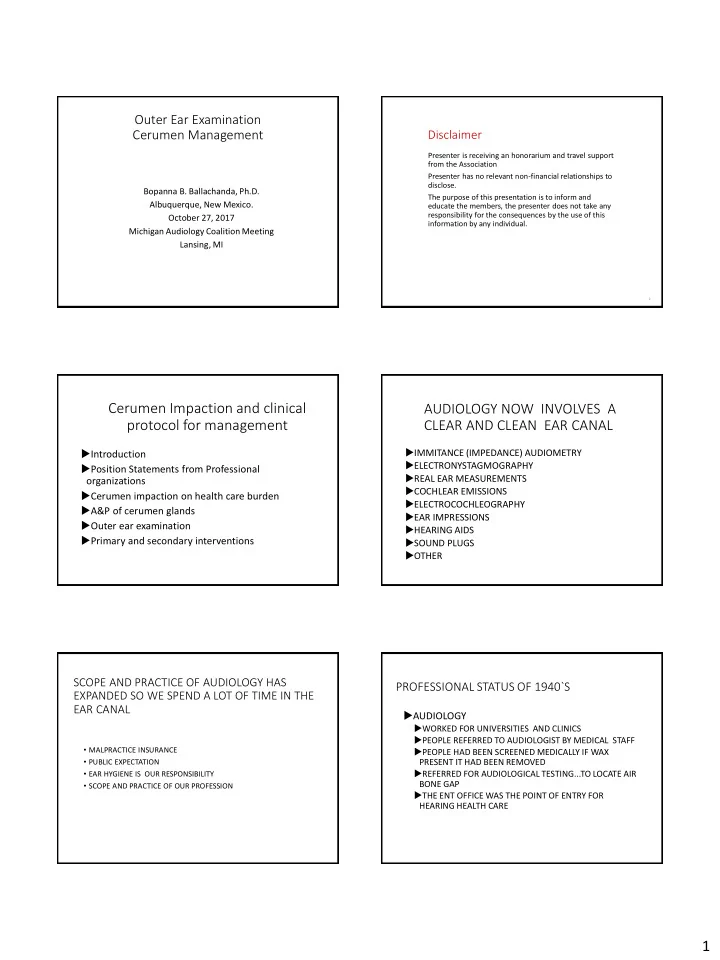
Outer Ear Examination Cerumen Management

Bopanna B. Ballachanda, Ph.D. Albuquerque, New Mexico. October 27, 2017 Michigan Audiology Coalition Meeting Lansing, MI

Presenter is receiving an honorarium and travel support from the Association Presenter has no relevant non-financial relationships to disclose. The purpose of this presentation is to inform and educate the members, the presenter does not take any responsibility for the consequences by the use of this information by any individual.

2

Disclaimer

Cerumen Impaction and clinical protocol for management

Introduction Position Statements from Professional

  • rganizations

Cerumen impaction on health care burden A&P of cerumen glands Outer ear examination Primary and secondary interventions

AUDIOLOGY NOW INVOLVES A CLEAR AND CLEAN EAR CANAL

IMMITANCE (IMPEDANCE) AUDIOMETRY ELECTRONYSTAGMOGRAPHY REAL EAR MEASUREMENTS COCHLEAR EMISSIONS ELECTROCOCHLEOGRAPHY EAR IMPRESSIONS HEARING AIDS SOUND PLUGS OTHER

SCOPE AND PRACTICE OF AUDIOLOGY HAS EXPANDED SO WE SPEND A LOT OF TIME IN THE EAR CANAL

  • MALPRACTICE INSURANCE
  • PUBLIC EXPECTATION
  • EAR HYGIENE IS OUR RESPONSIBILITY
  • SCOPE AND PRACTICE OF OUR PROFESSION

PROFESSIONAL STATUS OF 1940`S

AUDIOLOGY

WORKED FOR UNIVERSITIES AND CLINICS PEOPLE REFERRED TO AUDIOLOGIST BY MEDICAL STAFF PEOPLE HAD BEEN SCREENED MEDICALLY IF WAX PRESENT IT HAD BEEN REMOVED REFERRED FOR AUDIOLOGICAL TESTING...TO LOCATE AIR BONE GAP THE ENT OFFICE WAS THE POINT OF ENTRY FOR HEARING HEALTH CARE

slide-2
SLIDE 2

2

A NEW AND GROWING PROFESSION

  • AUDIOLOGY 1950`S
  • AUDIOLOGY 1960`S
  • AUDIOLOGY 1970`S
  • AUDIOLOGY 1980`S
  • AUDIOLOGY 1990`S
  • AUDIOLOGY 2000`S
  • AUDIOLOGY 2010`S

AUDIOLOGY NOW INVOLVES A CLEAR AND CLEAN EAR CANAL

IMMITANCE (IMPEDANCE) AUDIOMETRY ELECTRONYSTAGMOGRAPHY REAL EAR MEASUREMENTS COCHLEAR EMISSIONS ELECTROCOCHLEOGRAPHY EAR IMPRESSIONS HEARING AIDS SOUND PLUGS OTHER

SCOPE AND PRACTICE OF AUDIOLOGY HAS EXPANDED SO WE SPEND A LOT OF TIME IN THE EAR CANAL

  • MALPRACTICE INSURANCE...? EAR CANAL?
  • PUBLIC EXPECTATION
  • EAR HYGIENE IS OUR RESPONSIBILITY
  • SCOPE AND PRACTICE OF OUR PROFESSION
  • PROFESSIONS DISAGREE

AMERICAN SPEECH-LANGUAGE HEARING ASSOC.

It is the position of the American Speech-Language Hearing Association that otoscopic inspection of the external auditory canal and tympanic membrane, as well as limited management of occluding cerumen, is well within the scope of practice of audiologist. This area of practice requires that audiologists possess sufficient knowledge and skills in the use of pneumatic

  • toscopy, recognition of the canal and tympanic

membrane condition, and removal of cerumen when it can be performed comfortably and safely, not requiring direct contact with the TM.

ASHA POSITION CONTINUED

Audiologist should have knowledge of the medical conditions of the pinna, external ear canal and tympanic membrane, and of how these potentially could have an impact on the examination and the audiological procedures. Practical, supervised experience along with efficiency (skill) in the inspection of the pinna and external auditory canal, tympanic membrane integrity and cerumen management are required. (Nov 1991)

AMERICAN ACADEMY OF AUDIOLOGY

…defined by the training and

knowledge base of licensed and certified Audiologist. Areas of competency include assessment and rehabilitation of individuals with auditory disorders. Audiologists conduct otoscopic examinations, clean ear canals, take ear impressions...

slide-3
SLIDE 3

3

ACADEMY OF DISPENSING AUDIOLOGIST

...cerumen management

is considered within the scope of practice of the dispensing audiologist….

AMERICAN ACADEMY OF OTOLARYNGOLOGY

Whereas: Cerumen removal requires mechanical

  • r chemical manipulation of the external auditory

canal, and Whereas: Such manipulation may result in traumatic and/or inflammatory lesions to the external auditory canal, tympanic membrane, and/or middle ear conducting mechanism, be it therefore Resolved:

Why audiologists don’t perform cerumen management

  • Potential for patient injury
  • Inadequacy of training
  • Liability for injury
  • Exposure to and transmission of pathogens
  • Transmission of pathogens
  • State laws – Texas law

Knowledge and skills required to perform cerumen management

  • Knowledge of anatomy and physiology
  • Knowledge of pathophysiology
  • Skill in otoscopy
  • Training
  • Supervised experience

Ques Questio ion

What is health care burden due to cerumen impaction?

Ques Questio ion

What is health care burden due to cerumen impaction?

Answer: 2 to 6 % of the general population suffer from cerumen impaction in the UK. Applying this to US population: 12 to 18 Million CMS report: Cost of disimpaction is around 46.9 Million – Yang et al. 2016 JAMA

slide-4
SLIDE 4

4

Cerumen

  • Physiology
  • Pathophysiology
  • Prevalence of Cerumen Impaction

Exocrine Glands of the Ear Canal

Gland Type Secretion Sebaceous Holocrine Sebum Apocrine Mixed “Sweat” (Ceruminous) (Eccrine- Aprocrine- Holocrine)

  • Secrections of the Sebaceous and Apocrine glands

together form cerumen

slide-5
SLIDE 5

5

Qus Qustio ion

Which glands are responsible for the production of Cerumen?

Ans nswer

  • Sebaceous
  • Apocrine

Freshly formed Cerumen Changes due to time

Dry cerumen

slide-6
SLIDE 6

6

Wet type of cerumen Chemical composition of Cerumen

Cerumen Composition

Cerotic Acid Cholesterol Hexos Bases Neurostaric Acid a “Bitter Substance” Acid C17H34NO2 Substances C8H14NO2 Argimon Cystine Histindine Lysine Protein Fyrosine Amino Acids: Lucine, Esoleucine, Valine, Alanine, Theronine, Serive, Guitamin Acid, Aspiratic Acid, Glycine, Amino Butyric Acid Fatty Acids: L-Elestearic, Arachidic, Behenic, Ligonoceric Stearic, Cerotic, Erucid, Myristic and Palmitic. Copper/Iron

Functions of Cerumen

  • Lubricate
  • Cleanse
  • Protect*

*antibacterial/antifungal action

CLEANSING FUNCTION

slide-7
SLIDE 7

7

Protective Function of Cerumen

Perry (1955)- cerumen has no significant antibacterial or

antifungal properties.

Chail and Chai (1980)- cerumen has a bactericide activity

against some stains of bacteria tested. Cerumen functions to kill certain foreign organisms that enter the earcanal.

Stone and Fulghum (1984)- bacteria were reduced 17-99%

by treatment with a 3% suspension of human cerumen or the soft or “wet” type

Innervation of External Ear Canal

Nerve Area Supplied

Auriculotemporal Branch Anterior and Superior

  • f Mandibular Division

Walls

  • f Trigeminal (V)

Posterior Auricular Branch Concha and Outer Portion

  • f Facial (VII)
  • f Canal

Auricular Branch Inferior and Posterior

  • f Vagus (X)

Walls

Unusual Complications of Excessive/Impacted Cerumen

  • Cardiac Depression (Prasad, 1984)
  • Chronic Cough (Ramen, 1986)
  • Pseudodementia (Myers & Pueschel, 1987)

Complications of Excessive/Impacted Cerumen

  • Tinnitus
  • Vertigo
  • Itching
  • Earache
  • Otitis Externa
  • Hearing Loss
slide-8
SLIDE 8

8 Cerumen Fact

The amount of cerumen found in earcanals varies widely from individual to individual and among different populations Cerumen Impaction By Age

Age Range (In Years) Impaction Percentage 26-44 5 45-54 15 55-64 25 65-75 34 75-84 22

75-84

Incidence of Excessive/Impacted Cerumen in Normal Populations

Children

Roche, et al (1978) 10% (n=224) Briscco (1985) 10% (n=349)

Adults

Lebensohn (1943) 3% (n=794) Perry (1957) 17% (n=111) Hopkinson (1981) 4% (n=500) Foltner (1984) 9% (n=100) Cooper (1985) 5% (n=587)

Incidence of Excessive/Impacted Cerumen in Special Populations

Mentally Retarded Adolescents Nudo (1965) 36% (n=494) Fulton & Griffen (1967) 28% (n=191) Brister, et al (1986) 22% (n=88) Crandall & Roeser (1993) 28% (n=121) Geriatric Population Mahoney (in Press) 34% (n=104)

slide-9
SLIDE 9

9

Cerumen Fact

  • Certain drugs, increased emotional states, and mechanical “milking”

increase the production of cerumen

Cerumen Fact

  • There are marked racial tendencies in the consistency and color of

cerumen

Dry cerumen Wet type of cerumen

Cerumen Facts

  • Cerumen topic of interest for anthropologists
  • Cerumen topic of study for Breast cancer specialists
  • Cerumen and Otitis externa

Asteatosis

  • Diminished or arrested action of the sebaceous glands
  • Etiological Factors
  • Eczema
  • Cleaning
  • Old Age
  • Treatment
  • Skin lubricant (mineral oil)
slide-10
SLIDE 10

10

Qu Questi tion

Cerumen impaction is more common in what type of patient population?

Answ swer

Higher propensity in: 1. Elderly 2. Patients with cognitive impairment 3. Hearing aid users 4. All of the above

Hearing Aids ??? Insert Hearing Protection ???

Outer Ear Examination

➢Rationale for examination

  • 1. Identification of Pathologies
  • 2. Cerumen management
  • 3. Identify contraindications
  • 4. Precautions
  • 5. Impact on hearing aid fitting/habilitation
  • a. Ear canal movement

b.Fit, Comfort, and Feedback

Historical Overview

Otoscopy Interest since 14th Century Illumination

Artificial Light Candles-Shine through a Flask or Water Glass to Concentrate Light Light Boxes Water Glass Concentrate Light with Concave Mirror Mineral Oil Lamps in Late 19th Century

slide-11
SLIDE 11

11

The Ear Canal Introduction: Historical Overview

  • Ear canal Examination
  • Northern Perspective
  • Not in Winter
  • Only on Sunny Days
  • 11 a.m.. - 3 p.m..
  • Thomas Edison- Electric Lights

Ear Canal

(External Auditory Meatus)

External Ear

Age related changes

HAIRY TRA RAGUS HAIRY TRA RAGUS

Pinna Examination

slide-12
SLIDE 12

12

The Ear Canal Anatomy & Pathology

  • Aging
  • Stretching/elongation due to loss of elastic and reliance in the epithelial layer of the pinna

(Fowler, 1944)

  • Scaliness, dryness, rough appearance and loss of rebound epithelium noted by (Johnson

and Hadley, 1964)

  • Hair growth (Hull, 1978)
  • Collapsing Canals

Collapsing Canals: Aging

  • Schow & Goldbaum: 41% of all nursing home patients (80+)
  • Jerger & Jerger: 1/3 of patients over 65 years of age
  • Schow & Randolf: 36% of those 60-79 years of age

Threshold Differences (Collapsed Canal)

Study Year N 250 500 1000 2000 4000 8000 Ventry, et al 1961 2 17.5 22.5 27.5 25 * * Hildyard & Valintine 1962 48 * 6.2 7.3 11.4 6.9 * Creston And Tice 1964 4 25 20 25 30 18.5 22.5 Creston 1965 10 21.9 22.5 28.1 32.5 26.2 25 Ross & Tucker 1965 1 10 12.5 20 22.5 30 20 Stark 1966 1 10 20 25 25 5 10 Coles 1967 2 5 10 20 20 35 45 Bess 1971 2 22.5 30 32.5 35 27.5 20 Chaiklin & McClellan 1971 12 12.9 9.7 15.4 24.3 25.8 * Overall Mean ** 10.6 13.7 18.2 14.2 ** Range 6.2-30 7.2-32.5 11.4-35 5-35

Ear Canal Examination Ear Canal Examination

Hong Kong, China: A visitor peers into US artist John Baldessari's "Beethoven's Trumpet (With Ear) Opus # 133" at the Art Basel fair on March 15, 2015. Hong Kong's biggest art fair, Art Basel, opened its doors with thousands of visitors expected for a city-wide canvas of creativity and commerce.

Ear Canal Examination Instruments

Head Mirror Head Lamp – Ear Loupe Otoscopes Microscopes Video Otoscopes

slide-13
SLIDE 13

13

Innervation of External Ear Canal

Nerve Area Supplied

Auriculotemporal Branch Anterior and Superior

  • f Mandibular Division

Walls

  • f Trigeminal (V)

Posterior Auricular Branch Concha and Outer Portion

  • f Facial (VII)
  • f Canal

Auricular Branch Inferior and Posterior

  • f Vagus (X)

Walls

Out uter Ear Nerve Su Supp pply

The Ear Canal Anatomy & Pathology

Reflexes

 Cough Reflex  Sneezing Gagging Coughing Vomiting Fainting/Unconsciousness/Cardiac Depression Dizziness

slide-14
SLIDE 14

14

Etiology of Ear Canal Reflexes

  • Reflexes
  • Posterior Auricular branch of Facial (VII)
  • Auriculotemporal-Branch of the Mandibular Decision of Trigeminal (V)
  • Auricular Branch of the Vagus Nerve (X)

Outer Ear Examination

  • Pathologies of the Outer Ear

Foreign Bodies

slide-15
SLIDE 15

15

Diagnosi sis of

  • f Cerumen Imp

mpacti tion

Question When should a clinician diagnose cerumen impaction?

Diagnosi sis of

  • f Cerumen Impacti

tion

Answer

  • 1. Presence of cerumen is

associated with symptoms

  • 2. Prevents needed assessment

What does this mean? A Comprehensive Approach to Cerumen Management

Instruments and Procedures

Plugged Ear Canal

slide-16
SLIDE 16

16

Outline

  • Ear Canal Examination
  • Case History
  • Contraindications
  • Precautions
  • Techniques to Extract Cerumen
  • Post Extraction Evaluation

Ear Canal Examination

Identify Pathological Conditions Cerumen Management Contraindications Precautions Other Complications

Ear Canal Examination Instruments

Head Mirror Head Lamp Otoscopes Microscopes Video Otoscope

Case History

❖Ear Infections ❖Perforation of Tympanic Membrane ❖Cardiac Problems ❖Dizziness ❖Age ❖Infectious Diseases

Contra Indications

A Decision Process Conditions that might restrict, inhibit, or complicate extraction

Mod

  • dify

ifying Fac actor

  • rs for
  • r ceru

erumen mana management

  • Anticoagulant therapy
  • Immunocompramised State
  • Diabetic mellitus
  • Prior radiation therapy of the head and neck
  • Ear canal stenosis
  • Exostoses
  • Non intact tympanic membrane
slide-17
SLIDE 17

17

Precautions

  • Information to the Patient
  • Use Clean Instruments
  • Personal Protective Barriers
  • No Forced Removal
  • Documentation
  • Medical Assistance
  • Follow up Guidelines

Need eed for

  • r int

nterv rvention n if Impa pacted

  • Clinician Should Treat
  • Refer to another clinician who can

treat.

Need eed for

  • r int

nterv rvention n if NOT Impa pacted

  • Observation
  • Patient education on ear hygiene

Cerumen Softening

Use Cerumenolytics Two Approaches 15 - 45 Minutes 3 - 5 Days

Cerumen Extraction Procedures

Mechanical Removal Aural Suctioning Aural Irrigation

Cerumen Extraction Procedures

Mechanical Removal

  • Instruments
  • Forceps
  • Loops
  • Curettes
  • Other
slide-18
SLIDE 18

18

Cerumen Extraction Procedures Mechanical

Removal

➢Procedures

➢Instruction to the Patient ➢Seat the Patient Comfortably ➢Adequate Lighting ➢Insert the instrument gently ➢Dislodge the cerumen ➢Gently Retract Using the Instrument

Cerumen Extraction Procedures

Mechanical Removal

Advantages

Injury is Extremely Low Direct Control of the Situation

Limitations

Requires Skills Patience, Practice, & Time Cooperative Patient

slide-19
SLIDE 19

19

Cerumen Extraction Procedures

Suctioning ❖Instruments

❖ Suction Unit ❖ Suction Tip

Cerumen Extraction Procedures Suctioning

Procedures

  • Instruction
  • Seat the Patient Comfortably
  • Adequate Illumination
  • Gently Insert the Suction tip
  • Suction the cerumen

Cerumen Extraction Procedures

Suctioning

Advantages

Easy to suction Suction can reduce damage Simple and easy

Limitations

May damage the tympanic

membrane Cerumen Extraction Procedures

Irrigation

Instruments

Syringe Water PiK-Oral Irrigator Special tip Illumination

slide-20
SLIDE 20

20

Cerumen Extraction Procedures

Irrigation

Procedure

Instruction to the Patient Seat Patient Comfortably Place a towel and aural basin Place the tip at the entrance of the canal Introduce water gently

Cerumen Extraction Procedure

Irrigation

Advantages

Easy to remove cerumen Requires minimal practice Complete removal without complications

Cerumen Extraction Procedure

Irrigation

Limitations

 Uncontrolled Pressure or Pulse  Water Temperature  TM Perforation - Ear Canal Infections Dizziness, Diabetes, Cardiac Problems

Post Extraction Evaluation

✓Ear Canal Examination ✓ Documentation ✓ Medical Referral

slide-21
SLIDE 21

21

Cerumen Management Protocol FlowChart

Start

Ear Canal Inspection Impaction? Otological & Medical history Contra- indications? Instruments Suction Irrigation Precautions Is softening Required? Extraction Evaluation Complications ?

Is Cerumen Removed? Test Medical Facility Soften Cerumen 15-45 min 3-5 days Is cerumen soft?

YES YES NO NO

Select Procedure/s

YES NO YES NO NO YES YES NO

Secondar ary Int nterv rvention

Ear hygiene Counseling on cerumen impaction and hearing aids Cost analysis Health care burden Quality of life assessment Suggested intervention: Periodic evaluation by qualified clinician, cleaning hearing aids, over cleaning, use of external items for cleaning, self management

slide-22
SLIDE 22

22

Rese search Nee Needs

Universal definition of impaction Assess the natural history of cerumen impaction Evaluate the efficacy of various methods in a randomized study Conduct to study to evaluate the financial analysis

Infection Control

  • Sterilization
  • Disinfection
  • Protective Barriers
  • Waste Management

Ceruminologists Ceruminectomy

Blan lank slide slide