
SLIDE 1
Interpre'ng and Compiling Intex
CS251 Programming Languages
Spring 2019, Lyn Turbak
Department of Computer Science Wellesley College
A New Mini-Language: Intex
Intex programs are simple arithme'c expressions on integers that can refer to integer arguments. Intex is the first in a sequence of mini-languages that can be extended to culminate in something that is similar to Racket. At each step along the way, we can add features that allow us to study different programming language dimensions.
- Intex: integer expressions, posi'onal program arguments
- Bindex: Intex + named arguments & local naming
- Valex: Bindex + condi'onals, mul'ple kinds of values
(booleans, strings, lists), dynamic type checking, and syntac'c sugar
- HOFL (Racket-like language): Valex + first-class func'ons
- HOILEC: HOFL + SML-like explicit mutable cells
- HOILIC: HOFL + Racket-like implicit mutable cells
Intex 2
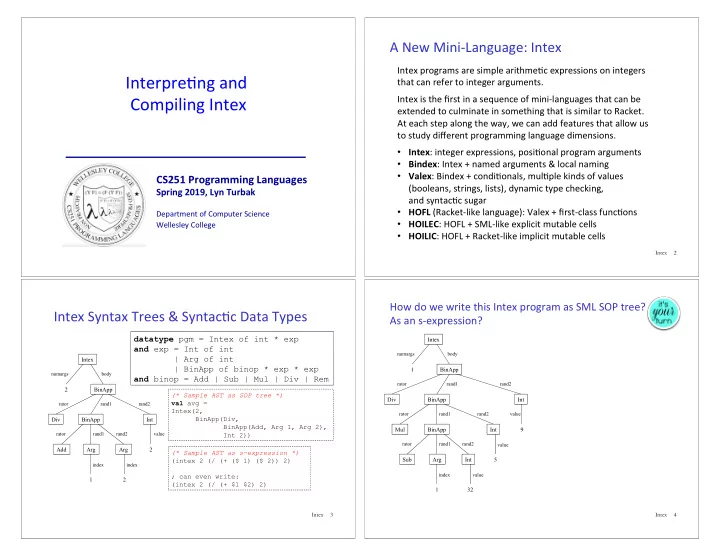
Intex Syntax Trees & Syntac'c Data Types
(* Sample AST as SOP tree *) val avg = Intex(2, BinApp(Div, BinApp(Add, Arg 1, Arg 2), Int 2))
Intex 3 Intex BinApp Div BinApp Int Arg Arg Add 2 2 2 1
numargs body rator rand1 rand2 rator rand1 rand2 index index value
datatype pgm = Intex of int * exp and exp = Int of int | Arg of int | BinApp of binop * exp * exp and binop = Add | Sub | Mul | Div | Rem
(* Sample AST as s-expression *) (intex 2 (/ (+ ($ 1) ($ 2)) 2) ; can even write: (intex 2 (/ (+ $1 $2) 2)
How do we write this Intex program as SML SOP tree? As an s-expression?
Intex 4 Intex BinApp Div BinApp Int Int Mul 1 9 5
numargs body rator rand1 rand2 rator rand1 rand2 value value
BinApp Arg Int Sub 32 1
rator rand1 rand2 index value