Internationalization of Australian schools: Sister school - - PowerPoint PPT Presentation

internationalization of australian schools sister school
SMART_READER_LITE
LIVE PREVIEW

Internationalization of Australian schools: Sister school - - PowerPoint PPT Presentation

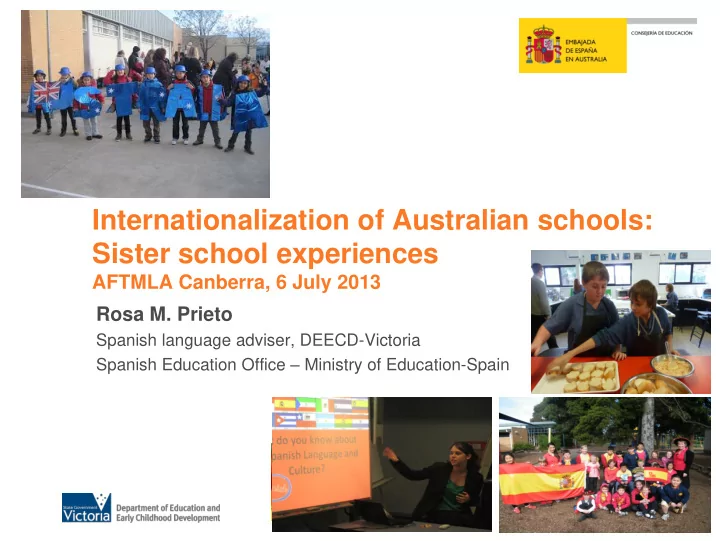
Internationalization of Australian schools: Sister school experiences AFTMLA Canberra, 6 July 2013 Rosa M. Prieto Spanish language adviser, DEECD-Victoria Spanish Education Office Ministry of Education-Spain Index What are sister


slide-1
SLIDE 1

Internationalization of Australian schools: Sister school experiences

AFTMLA Canberra, 6 July 2013 Rosa M. Prieto

Spanish language adviser, DEECD-Victoria Spanish Education Office – Ministry of Education-Spain

slide-2
SLIDE 2

Index

  • What are sister schools?
  • Projects: Examples in

Australia

  • Examples of school etwinning
  • verseas
  • Research
slide-3
SLIDE 3

Sister school projects

slide-4
SLIDE 4

Overseas learning experiences

  • language immersion programs
  • curriculum-focused programs
  • cultural study programs
  • overseas service and community engagement

projects

  • sporting and arts programs
  • individual student exchange programs
  • exchange programs with sister schools
slide-5
SLIDE 5

Background

Australian students

Active interaction Globalised world Internationalizing education Sisterschool relationships

slide-6
SLIDE 6

Definition

  • A sister school relationship is the development of a

positive association intrastate, interstate or

  • verseas through the establishment of links

between schools and school communities.

  • The opportunity to participate in a sister school

relationship is open to any school with a desire to learn more about a culture other than their own.

slide-7
SLIDE 7

Sister schools

  • Sister schools provide a wide range of
  • pportunities for all involved. Students, teachers,

administrators, parents and communities all stand to benefit from international links.

slide-8
SLIDE 8

Aims

  • Preparing students in Australia for active

interaction in an interdependent, globalised world, providing them with 21st century skills so that they can think critically, embrace technology and value diversity.

slide-9
SLIDE 9

Internationalization

  • International partnerships develop cultural

awareness and sensitivity and an appreciation of a different way of life.

  • Networks are established and new

perspectives developed.

  • Sister schools encourage a global outlook on

life and have the flow-on effect of internationalising the ethos of the whole school community.

slide-10
SLIDE 10

Language skills

  • Intercultural exchanges encourage greater

competency and confidence in language learning and communication skills.

  • Information communication and technology

skills are also enhanced as students interact through wikis, blogs and Skype.

slide-11
SLIDE 11

Cross-cultural communication

  • Sister schools illustrate the concept of global

interconnectedness in a tangible way.

  • By incorporating collaborative learning activities,

partnerships encourage students to locate and explore common ground and bring about a unique intercultural element to collaborative learning activities.

  • Students also develop cross-cultural

communication and diplomacy skills, a deeper understanding of international issues and a respect for differences in other cultures.

slide-12
SLIDE 12

Sample Sister School Activities

  • Exchange of student work (blogs, wikis, shared spaces), email,

letters, photos, student newspapers, etc. to promote mutual understanding

  • Organizing groups of students in both countries to collaborate in

curriculum areas such as English, art/design etc. through ICT- mediated communication.

  • Both schools will endeavour to maintain student, teacher and

administrator exchange programs to provide the opportunity to study, work and live in the sister school community

  • Exchange of leadership development information between principals.
  • Exchanges of information: curriculum, school policy and school

events

  • Exchange of teaching resources, course materials and teaching

strategies

  • Involving the community through newsletters and websites and

inviting parents to meet with the visiting teachers.

slide-13
SLIDE 13

Sample Sister School Activities

  • Start a club for organizing a trip overseas and fundraising.
  • Start an E Pen Pals sister school Club
  • Convene a Working Party with representation across other

curriculum areas to increase involvement across the school and to progress the program.

  • Use the school’s interactive portal (eg. Wall-e) to enable students to

post work, display and discuss their work and communicate with students from their sister school.

  • Provide video conferencing facilities which should be used for the

development of electronically supported relationships between both

  • schools. This can include class interaction and PD sessions.
  • Prepare a professional development program for the staff from your

sister school on subjects of interest eg. student engagement, etc and

  • Investigate best practice in your sister school’s areas of expertise eg.

Maths, Science, bilingual education.

slide-14
SLIDE 14

Projects

  • http://oursisterschool.wikispaces.com/home

Ascot Vale Primary

School, Melbourne, Australia San Fulgencio Primary School, Albacete, Spain

slide-15
SLIDE 15

Projects

slide-16
SLIDE 16

Project

  • Our City and Our School
  • wiki
slide-17
SLIDE 17

Music and Culture

  • Waltzing Matilda: a dramatization
slide-18
SLIDE 18

Geography

  • Location and mapping
  • Google maps
slide-19
SLIDE 19

Maths: Measuring Time

http://www.timeanddate.com/

slide-20
SLIDE 20

The Lunchbox project

  • Video recording of lunch box contents. Explain

contents.

  • Photographs and Powerpoint
  • Spanish students
slide-21
SLIDE 21

A blog: From the Other Side of the World

  • From Australia to Spain

Bethal Primary School, Meadow Heights, VIC Concepcion Arenal Primary School, Potes, Spain

slide-22
SLIDE 22

A Principal´s visit

  • Regency Park y Eduardo

Palomo

  • Desde Wantirna a Toledo
  • Sister schools established in 2012-13

(Spain-Victoria): 25

  • Principals visiting Spain: 3
  • Australian teachers visiting Spain: 4
  • Spanish teachers visiting Australia: 8
slide-23
SLIDE 23

Celebrations

  • blog
  • Hampton Primary School,

Hampton, VIC and

  • Jose Antonio Labordeta

Primary School, Zaragoza, Spain

slide-24
SLIDE 24

Student Exchange

  • McKinnon Secondary College, Melbourne, Australia.
  • IES Fernando Zóbel, Cuenca, Spain.

Teachers meeting in Cuenca, Spain, 11-12 April

  • City tour
  • Workings sessions to

plan activities for semester 2 and next year.

Students exchanges planned to visit Spain in 2014:

  • Methodist Ladies College
  • Mckinnon SC
  • Wantirna SC
  • Waikirie SC
  • Mount Barry Station P-10
slide-25
SLIDE 25

Edmodo

slide-26
SLIDE 26

Project: Architecture and Design

slide-27
SLIDE 27

A model: E-twinning

Primary workspace: www.etwinning.net

slide-28
SLIDE 28

History: E twinning

  • European Commission: 2005
  • European Union's e-Learning programme
  • Lifelong Learning Programme: 2007.
  • eTwinning is part of Comenius
  • Schools to collaborate using ICT by providing the necessary infrastructure

(online tools, services, support).

  • Teachers form partnerships and develop collaborative, pedagogical school

projects in any subject area with the sole requirements to employ ICT to develop their project and collaborate with teachers from other countries (at least two teachers from two different countries are needed)

  • Objectives:
  • promote sister school relationships as an opportunity for all students to

learn and practice ICT skills and,

  • to promote awareness of the multicultural model of society.
slide-29
SLIDE 29

ICT you and me

  • Project information
slide-30
SLIDE 30

ICT you and me

  • Introductions
  • Our schools
  • Surveys
  • Logo
  • My hometown
  • Our countries
  • Christmas / Easter
  • Free time activities
  • Healthy lifestyle
  • Statistics and me
  • Fun corner
  • Maths and me
  • Valentine's Day
  • Summer holidays
  • Evaluation
  • Chats

The story of Europe: average Etwinner reflection

slide-31
SLIDE 31

Involvement

10000 20000 30000 40000 50000 60000 70000 80000 90000 100000 2005 2008 2012

Schools

Schools 5000 10000 15000 20000 25000 2008 2012

Projects

Projects 20000 40000 60000 80000 100000 120000 140000 160000 180000 2008 2009 2012

Teachers

Teachers

slide-32
SLIDE 32

Impact

Since 2005, over 54,000 projects have been registered involving more than 30,000 schools. If a simple 25:1 ratio of students per school per project –assuming, in the simplest scenario, that there are only two schools involved – is applied to this figure, it is estimated that the number of students touched by eTwinning projects is in the region of 750,000.”

Students in eTwinning: case studies on student participation. Ed. by Patricia Wastiau, Christina Crawley, Anne Gilleran. Brussels, European Schoolnet, November 2011.

slide-33
SLIDE 33

Impact on students

  • Students’ teamwork and social skills

(65%)

  • Students’ ICT skills (64%)
  • Students’ language skills (63%)
  • Sister school relationships motivated

students to learn (61%)

  • Students’ understanding and

knowledge of the subject(s) improved (58%)

slide-34
SLIDE 34

Impact on teachers

  • making new friends and

networking across other countries (64%)

  • the acquisition of new or

improved ICT skills (60%)

  • making a positive impact on

their students’ skills or motivation to learn (55%)

  • sense of being involved in an

international teaching community (55%)

  • improved foreign language

skills (54%)

slide-35
SLIDE 35

Impact

  • Decreased isolation of students and teachers

in some countries and remote regions

  • Greater awareness and understanding of the

lives of others in different countries and peer connections through shared achievements

  • Determination on the part of teachers and

students to build on and retain contacts and friendships made through collaboration

slide-36
SLIDE 36

Research

DEECD - International Education Division

commissioned research into sister school relationships across Victorian schools in 2012.

slide-37
SLIDE 37

Recommendations

  • Focus on quality of the sister school experience
  • Set challenging expectations
  • Introduce learning outcomes for projects
  • Impact on the whole school:

– Embed sister schools more effectively into the school curriculum for sustainable and school-wide impact.

  • Focus on the student:

– Provide more and better guidance for teachers on how to engage – Empower students since levels of empowerment and autonomy are associated with positive outcomes for students from projects – Include students in tests for new tools; invite students to represent their peers on user groups and focus groups in order to find out more about their perceptions of the projects and its impact.

slide-38
SLIDE 38

Identification of Effective Practice

  • The program is a priority within the school

– Full support of the leadership team – High level of support right across the school

  • Matched expectations and objectives
  • Clear common goals
  • A coordinator on each side but with shared

responsibility across the school and succession planning in place

slide-39
SLIDE 39

Key Findings

Benefits of Sister School Relationships

  • Intercultural understanding within the school

community

  • Increased global awareness and

internationalisation within the school community

  • Opportunities to better understand one’s own

culture/country

  • Personal development of the student e.g.

leadership, maturity & independence

slide-40
SLIDE 40

Key Findings

Benefits of Sister School Relationships – contd.

  • Improved ability of students to adjust to different

situations

  • Opportunities for sharing pedagogies and engage in

joint curriculum development

  • Opportunities for professional development
  • Opportunities for reciprocal travel
  • Enhancing the reputation of the school
  • Improved competence and confidence in the use of

technology by teachers involved in the program

slide-41
SLIDE 41

Important Factors for Sustaining Relationships

  • High level of leadership support
  • Commitment to the partnership by both schools
  • The program being a priority within the school
  • Clear goals and objectives agreed upon upfront
  • A team approach to supporting the relationship
  • Adequate funding and resources
  • Ongoing and regular communication
  • A focus on planning of activities and collaboration
  • The primary communicators on both sides should

share a common language.

slide-42
SLIDE 42

How to establish a sisterschool relationship

  • Find the school (Consulates, Departments
  • f Education, Education offices)
  • Discuss agreement
  • Start planning
slide-43
SLIDE 43

Next steps

  • Expand sister school relationships
  • Include outcomes and performance

indicators in the projects

  • Include strategies to achieve quality

language practice and information exchanges

slide-44
SLIDE 44
  • Thank you for your

attention

  • Muchas gracias por

su atención

Rosa M. Prieto rosa.prieto@mecd.es www.mecd.gob.es/australia/ Spanish language adviser, DEECD-Victoria Spanish Education Office – Ministry of Education-Spain