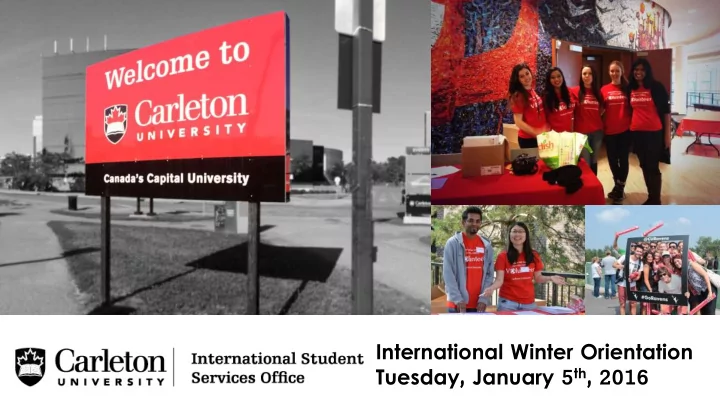
SLIDE 1
International Winter Orientation Tuesday, January 5th, 2016
SLIDE 2 University Centre, room 128 carleton.ca/ISSO facebook.com/CarletonISSO @CarletonISSO
Stay connected to the ISSO!
Welcome to Carleton!
Margaret Higgs, Manager (International Student Services Office) Jennifer Maybank, Program Coordinator (International Student Services Office)
Welcome messages
SLIDE 3
The ISSO, Carleton, and Ottawa Health care and UHIP (University Health Insurance Plan) Immigration compliance Exchange and Study Abroad administration Break time! (Return at 2:25pm) Settling in! Campus tour (Departing from this location at 3:05pm)
Agenda
The Canadian classroom and academic support services
SLIDE 4 The ISSO
We’re here to help!
Support services: UHIP & immigration support Peer mentoring Connecting you to campus resources and services Social and cultural events Volunteer and leadership
Read our e-newsletter, follow us on social media, attend
- ur events, get to know our
staff and volunteers
SLIDE 5 What’s going on at the ISSO?
Visit carleton.ca/isso/events to see a complete schedule of upcoming programs and events Drop by the ISSO to register for events Upcoming 2016 events include:
Tenant rights information session Snowshoeing in Gatineau Park Cross Country Skiing Tour of Parliament Through a Global Lens photo competition Take advantage of winter by borrowing ice skates from the ISSO Winterlude Concert Series And more!
SLIDE 6 Get Involved at Carleton!
Carleton University Students’ Association (undergraduate) 401 University Centre cusaonline.ca CUSA International Students’ Centre – 129B University Centre facebook.com/cusaisc Student Experience Office 430 Tory Building carleton.ca/seo Graduate Students’ Association 600 University Centre gsacarleton.ca
Check out these campus departments and organizations for more information on events, clubs, societies, and other ways to get involved! Exchange students can also get involved with CUEx. (Facebook: CUEx 2015-2016) Grad students: Don’t forget the Graduate Student Orientation January 15th!
SLIDE 7 Living in Ottawa
OTTAWA, PROVINCE OF ONTARIO
- Located in the Province of Ontario
- Ottawa is the capital of Canada and the Ottawa region
comprises the fourth-largest city in the country
- Ottawa has a population of close to 1,000,000 residents
- Ottawa is known for its high quality of life
- Both English and French are commonly spoken in Ottawa
- 1 in 4 Ottawa residents is an immigrant
- Carleton University has students from over 140 countries!
Local news: Ottawa Citizen National news: CBC.ca Public Transportation:
Buses to campus: 4, 7, 104, 111 and O-Train
SLIDE 8 Don’t forget to pick up your U-PASS
Campus Card Office 407 University Centre (same office for your Carleton ID card)
- Full-time students and exchange students
- Access to OC Transpo buses and O-Train
during the academic year
- Part of your student fees
- carleton.ca/upass for terms and conditions
SLIDE 9 Take time to explore Ottawa!
www.ottawatourism.ca www.ottawa.ca/visitors
Shopping & Food (Neighbourhoods)
- China Town
- Little Italy
- Glebe
- Byward Market
- Westboro
Museums, Art & Culture
- National Gallery of Canada
- National Arts Centre
- Museum of History
- Museum of Nature, and more!
Tip! Many museums offer free admission on Thursday evenings. Festivals & Outdoor Recreation
- Over 100 festivals a year in Ottawa
- Bluesfest, CityFolk, Tulip Festival
- 170 kms of recreational pathways
Enjoy the Winter Season!
- Winterlude Festival
- Senators (NHL) or 67s (OHL) games
- Carleton Ravens hockey or basketball
- Ice skating on the Rideau Canal
- Sledding at Mooney’s Bay park
- Beaver Tail and hot chocolate in
Byward Market
SLIDE 10 Winter in Ottawa
January is usually the coldest month of the year:
Avg. high temperature of -6.1 degrees Celsius Avg. low temperature of -15.3 degrees Celsius BUT it can feel much colder. The wind chill means that it might be -20 degrees Celsius it could feel like -28. Always dress for the colder temperature.
Ottawa experiences snowy winters. Most snow will fall between December and March but it is normal to have snow on the ground until April. Environment Canada and The Weather Network are good sources for weather updates.
Ottawa experiences four seasons. Summer in Ottawa in sunny, warm, and humid. In June, July, and August the avg. high temperature is around 25 degrees Celcius but may feel warmer due to humidity.
SLIDE 11 Tips for Winter
It is normal for snow and ice to cause travel delays; plan ahead and allow extra time for travel. Use the tunnels to get around campus! Dress in layers. You can add or remove layers depending on the weather and your activity. Shop for a winter coat, hat, mittens, scarf, and boots. Look for items that are wind and water resistant. Boots should have a rubber sole. Try second hand stores like the Salvation Army or Value Village for used
- clothing. The ISSO also has a small
supply. It is normal to experience some changes to feelings, diet, energy levels and sleep patterns in Winter. You can learn more at Health and Counselling Services. Have fun and stay active! Eat well, maintain a consistent sleep schedule, and exercise regularly.
SLIDE 12 University Health Insurance Plan
Lynn Murphy
UHIP and Office Administrator
SLIDE 13 UHIP – What Is It?
UHIP is a mandatory health insurance plan for all international students at Carleton University. It provides you with basic medical insurance to cover the cost of doctor’s visits, prescribed tests and treatments, and emergency hospital services. Fees for UHIP are automatically added to your student account after you register for courses. If no UHIP fees appear, please visit the ISSO immediately. If you are paying domestic tuition fees, no UHIP fees will be added to your
- account. Please check with ISSO for more info.
If you have OHIP (Ontario Health Insurance Plan) you are exempt from UHIP. Visit the ISSO with proof to have your UHIP fees removed.
SLIDE 14
How Much Does UHIP Cost?
Registered exchange and special students: $204 (single coverage) for the period from January 1 – April 30, 2016 If you are registered as SPEC for summer 2016, an additional $204 will be charged to your account for May 1 – August 31, 2016 Degree students (undergraduate and graduate): $408 (single coverage) for the period from January 1 – August 31, 2016 UHIP coverage is active while you are registered as a student. If you withdraw from classes, your UHIP will be terminated.
SLIDE 15
Enroll any dependents (spouse and/or children) in UHIP within 30 days of their arrival in Canada. Sun Life (the insurance provider) will impose a $500 late fee after 30 days. Members with dependents must visit the ISSO to enroll their family members. The additional fees will be added to your student account.
What If I Want to Add Family Members?
SLIDE 16 What Does UHIP Cover?
Emergency Hospital Visit
Annual Check Up
Diagnosis (X-Rays, Blood Tests, Etc.)
Injury
Doctor Visits
Pre and Post Natal Care
Visit www.uhip.ca for more information on what is (and what is not) covered by UHIP
SLIDE 17
Prescription drugs, dental care, acupuncture, massage therapy, sports therapy, orthotics, etc. are NOT covered by UHIP. A supplemental drug/dental plan is administered by CUSA (Carleton University Students Association) for undergraduate students (4th floor, University Centre) and by the GSA (Graduate Students’ Association) for graduate students (6th floor, University Centre). For students beginning their studies in the Winter term, (dependents can also be added). you must OPT IN to the drug/dental plan There are deadlines to opt in. Visit CUSA/GSA for more details.
What Is Not Covered By UHIP?
SLIDE 18 Sponsored students (e.g. Saudi Cultural Bureau, CBIE, WUSC, etc.) or students who have OHIP are not required to have UHIP. If you believe you are exempt under this category, visit the ISSO. Exchange students: UHIP is mandatory for all international students. If you have purchased health insurance from a provider in your home country, you can apply to see if you qualify for a UHIP exemption. Visit www.uhip.ca and select the ‘Can I Be Exempted’ link. Complete and submit the form to Sun Life with all the details of your plan. If approved, you and the UHIP administrator will be notified and UHIP fees will be removed from your account. You must submit your exemption required to Sun Life within 30 days of the start of the academic term.
Can I Be Exempted From UHIP?
SLIDE 19 Health and Counselling Services (HCS) on campus should be your first choice in health care provider. HCS is a full service medical clinic and they will bill Sun Life directly (you will not have to pay out of pocket for services). Dependents (spouse and/or children) cannot visit HCS. You will have to find a health clinic that best suits your needs. For example:
- Health Services at the University of Ottawa (www.uottawa.ca/health) to
access their walk-in clinic
- Appletree Health Clinics
- Find a Preferred Provider (Preferred Providers bill Sun Life directly) using
www.internationalhealthcarenetwork.com
Where Do I Go To See A Doctor?
SLIDE 20
Ottawa Hospital has two main campuses: The General Hospital is located on Smyth Road The Civic Hospital is located on Carling Avenue Both hospitals will accept your UHIP card as proof of insurance and bill Sun Life directly Visits to the hospital emergency room should only be used in the case of a true emergency, accident, or sudden serious illness The emergency number in Ottawa for police, fire, and ambulance is 9-1-1 Hospitals: Where And When To Go
SLIDE 21 You are responsible for printing your UHIP card. Register at mysunlife.ca and follow the instructions outlined on
- ur website: www.carleton.ca/isso/uhip
Be prepared! Print off your card and carry it with you at all times. If you do not have it with you, you may be charged for medical services. How Do I Get My UHIP Card?
SLIDE 22
If you do not visit a Preferred Provider, you will have to pay for medical services out of pocket. To get a refund, you will have to submit a claim form (by mail) along with original receipts to Sun Life Claim forms: At the ISSO or www.uhip.ca Keep a copy of your receipts and claim form When you register at mysunlife.ca, sign up for direct deposit so that refunds can be deposited directly to your bank account How Do I Submit A Claim?
SLIDE 23 Any change in your status as a student could affect UHIP. Please keep us informed. If you withdraw completely, your UHIP will be terminated
- immediately. Notify the ISSO if you withdraw from Carleton so the
appropriate UHIP fee adjustment can be made. Any other changes should be reported to the ISSO to see if they impact your UHIP coverage. We are here to help! If you have any questions, feel free to ask.
Change In Status Wishing you good health and success during your stay at Carleton!
SLIDE 24 Immigration Compliance
Sarah Lanoue
Coordinator – Immigration
Study Abroad and Special Projects Coordinator
SLIDE 25
Immigration 101
Passports
No immigration document will be issued to you with a validity date beyond the expiry date of your passport. Take note of your passport expiry date. Be sure you know how to renew your passport if needed. Many countries have embassies in Ottawa.
SLIDE 26 Study Permit
Your study permit is the document that authorizes you to be in Canada and to study. You must have a valid study permit the entire time you are in Canada. Exception: Exchange and study abroad students studying for a duration of less than 6 months do not require a study permit. Most students will have to extend their study permit at some
- point. Take note of your study permit expiry date. Applications
for extensions should be made approximately 2 months before that date.
SLIDE 27 Study Permit
Your UCI (Universal Client ID number) is located on your study permit. Formated as xxxx-xxxx. This is the number that CIC uses to identify you for any inquiry or application you make. Applications (study permit, work permit, TRV, etc.) are made online through your MyCIC account. You can create an account at www.cic.gc.ca A lost passport or study permit can be replaced but you want to do everything you can to avoid that! Scan or take a picture of your passport ID page and your study permit. Do not carry your passport with you as ID. If your study permit is stapled in your passport, remove it and keep it in a safe place. Apply for an Ontario Photo ID Card for identification. An Ontario Photo Identification Card is a wallet sized card that provides government-issued photo ID to those living in Ontario who do not have a driver’s license. http://www.ontario.ca/page/ontario-photo-card
SLIDE 28 Working On or Off Campus
If you have a valid study permit AND you are registered as a full time student, you are authorized to work: On campus Off campus – A condition stating that you are allowed to work
- ff campus should appear on your study permit. If the
condition does not appear, you need to apply for an amendment to your study permit. You may work up to 20 hours per week during the academic
- year. During summer months and school breaks (reading weeks,
winter break, etc.) you may work full time.
SLIDE 29 Co-Op Work Permit
If a co-op placement is a requirement of your degree program, you will need to obtain a co-op work permit from CIC. Apply through your MyCIC account (there is no fee). Provide a letter from the co-op office stating the placement is required for your program of study. Only students who are in the co-op program can obtain this
- permit. International students are not authorized to complete
independent internships during the regular academic year (*see previous slide for information on working off campus).
SLIDE 30 Temporary Resident Visa (TRV)
A TRV (or visitor/re-entry visa) is required to enter Canada for citizens of many, but not all, countries. If required, it was issued in your passport when you applied for your study permit. Your TRV is laminated in your passport. Please take note of the expiry date on your TRV. Unlike your study permit, it is okay to let your TRV expire. You are
- nly required to have a valid TRV if you will be travelling outside
- f Canada and the USA.
If you plan to travel home, ensure that you have a valid TRV and that you allow at least 3 months to apply for one before your scheduled departure date.
SLIDE 31 Electronic Travel Authorizations (eTAs)
As of March 2016, if you are from a visa exempt country you will need to apply for an eTA in order to enter Canada. This is a simple online application and only needs to be done once. US citizens are exempt. Students from visa exempt countries who were issued their study permit on or after August 1, 2015 were automatically issued an
- eTA. If you received your study permit before this date, you will
need to apply for an eTA if you plan to leave Canada and return by air (beginning March 2016).
SLIDE 32
Travelling to the USA
If you require a TRV to enter Canada you will need a US visa to enter the United States. You can apply for a US visa online (an interview will also be required at the US embassy in Ottawa). For more information visit the ISSO or http://canada.usembassy.gov/visas/visas.html You will need to demonstrate evidence that you have established yourself in Canada before you will be approved. New students or short-term visiting students are unlikely to be approved. If you are travelling solely to the US and returning directly to Canada, a Canadian TRV is not required to re-enter Canada.
SLIDE 33 International Student Compliance
CIC expects all international students to be studying full time during the fall and winter semesters (1.5 credits per term for undergraduate students). Studying in the summer is optional. Non-attendance or part time studies can impact your status in
- Canada. If you become a part time student or cannot attend
during any given semester, please consult the ISSO. Poor academic performance can impact your ability to renew your study permit. Be pro-active. If you are struggling for any reason, please consult the ISSO for resources and support.
SLIDE 34
International Student Compliance
It is very important to pay your tuition fees in full and on time. Unpaid fees result in a “hold” being placed on your account and this can prevent you from obtaining documents you might need for immigration applications. After a period of time, unpaid fees can also prevent you from registering in courses. International students who are not registered are considered to be non-compliant by CIC. Important dates: carleton.ca/registrar/registration/dates-and-deadlines/ Fee payment: carleton.ca/studentaccounts/fee-payment/
SLIDE 35 Exchange & Study Abroad Processes
Nancy Leslie
Exchange Program Coordinator
SLIDE 36 Exchange students come to Carleton from
- ne of our partner institutions.
Study abroad students are from universities with which Carleton does not have formal exchange agreements. The ISSO provides support to both groups
- f students and should be your first point
- f contact for any questions or concerns
that you may have.
SLIDE 37 Exchange students do not pay tuition fees to Carleton. Study abroad students do. However, both groups must pay the following: Residence fees (if applicable) University Health Insurance Plan (unless exempt) U-PASS Accident, dental and drug plan* (CUSA or GSA) *optional for exchange students only
Note: An unpaid balance on your student account may result in a hold on your account and the University may withhold official documents including your transcript.
Exchange & Study Abroad: Student Accounts and Fees
SLIDE 38 Check the balance on your account by logging on to Carleton Central and going to Student Account Summary: http://central.carleton.ca Payment methods (payment is not accepted in person, by cash, or by credit): Online banking (must have a Canadian bank account*) International wire transfer (be aware of hidden bank fees that may apply) International currency transfer (GlobalPay for Students – This is the preferred method for international payments) *
Method of Payment
*Certain documents may be required to open a Canadian bank account (e.g. a valid study permit). Scotiabank is conveniently located on campus (Paterson Hall) if you have questions.
carleton.ca/studentaccounts/fee-payment/
This information is useful to all new international students!
SLIDE 39 Exchange & Study Abroad: Registration in Courses
Exchange students must be registered as a full-time student. Undergraduate students should be registered in 2.0 to 2.5 credits (4-5 courses) per semester; minimum of 1.5 credits for visa purposes Graduate students must register in the minimum number of credits required to maintain full-time status as a graduate
- student. You must consult with your home institution on the
minimum number and type of required courses for approval of transfer credits Study abroad students do not have a minimum registration requirement but generally register in 1.5 – 2.5 credits per term.
SLIDE 40 This information is useful to all new international students!
Carleton Central
www.central.carleton.ca Enter User ID (Carleton student number) Enter PIN
View timetable, search courses, add/drop courses, etc. Last day to change course or sections for Winter term 2016 is January 19th. If course is full, apply to be on the waitlist or submit an
- verride request through Carleton
SLIDE 41 Exchange & Study Abroad: Contacts
Exchange students: Nancy Leslie Exchange Program Coordinator exchange@carleton.ca or isso@carleton.ca (general inquiries) Study abroad students: Sarah Lanoue Study Abroad and Special Projects Administrator isso@carleton.ca For Science Without Borders (SWB) students, CBIE should be your point of contact for scholarship or health insurance related questions.
The ISSO is here to help! Visit us in room 128 of the University Centre. carleton.ca/isso
SLIDE 42 Settling In
Setareh Najmi
Mentoring Program Assistant
SLIDE 43 A Different Culture?
Consider what you know or what you have heard about Canada and Canadian culture. Some differences you might notice include:
- Greetings
- Dinner times
- Customs when it
comes to arrival times for events or appointments
affection
SLIDE 44 Cultural Adaptation
Culture shock is a sense of confusion and uncertainty, sometimes accompanied by feelings of anxiety, that commonly affects people exposed to a foreign
It is completely normal to experience some of the symptoms
- f culture shock. They will pass in
time. Not everyone will experience culture shock in the same way. You may experience this process both when arriving in a new country and when returning back home.
Graphic: The “W” curve – based on Oberg (1960) and Gallanhorn & Gallanhorn (1963)
Moving to new country for school is a big adjustment and adapting to a new cultural environment can come with its own challenges.
SLIDE 45 Culture Shock
Feeling irritable or even feeling very angry about little things Withdrawal from people who are different from you Sadness and longing for home Sudden intense feeling
Overeating or loss of appetite Loss of ability to work or study effectively Headaches Stomach upset Loss of confidence Depression Needing to sleep a lot Unexplainabl e crying Marital or relationship stress Exaggerated cleanliness Feeling sick much of the time
Symptoms of Culture Shock
Remember that it is normal to have ups and downs! Reflect on how you normally deal with differences Focus on your goals and remember why you came to Carleton Eat healthy. Stay
routine sleep. Have flexible expectations and keep an open mind Learn about Canadian history and culture. Keep up with current issues. Ask questions and for clarification when something isn’t clear. Remember that differences can be fascinating, not just
respectful of others and their perspective. Be a tourist – travel, visit attractions, eat at local restaurants, etc. Connect with people, make friends, join clubs,
home for yourself in Canada. Share information about where you come from with those around you. Talk to someone! Book an appointment with the International Student Counsellor (carleton.ca/health) or visit the ISSO.
Tips & Strategies As you navigate Carleton and Canada it is important to seek support and ask for help – the ISSO can help you find resources.
SLIDE 46 The Canadian Classroom
Jennifer Maybank
Program Coordinator
SLIDE 47 Useful Resources
Syllabus: Each course will have a syllabus. This document includes important information about your Professor, Teaching Assistant, required textbooks, assigned readings, deadlines, and more. Read it carefully and mark important dates in your agenda. Your professor will expect you to be familiar with the syllabus and it is your responsibility to remember to submit assignments on time. CU Learn: This is an online tool used by many professors for submitting assignments, sharing readings, posting grades, and more. Each course may have a different set up. Log in at www.carleton.ca/culearn using your Carleton username and password (the same as for your email account). Professors and Teaching Assistants: Your professor and TAs will let you know what their office hours are and how they prefer you set an appoint (by email in advance, drop in, etc.). Make sure you review assignment instructions early so that you have time to meet with a TA
- r Professor if you have questions. If you leave it to the last minute, the Professor/TA may not
be available to meet.
SLIDE 48 Academic Integrity
http://carleton.ca/studentaffairs/academic-integrity/
“Plagiarism is presenting, whether intentional or not, the ideas, expression of ideas or work of others as one’s own” – Carleton Undergraduate Calendar You must acknowledge the sources you use in your academic work (e.g. direct quotes, paraphrasing ideas, statistics, etc.) Plagiarism is taken seriously at Carleton. If you are unsure what your professor expects when it comes to citation, ask. The Library Research Helpdesk also has resources on citation styles. Visit them
- n the main floor of the Library or online at
https://library.carleton.ca/services/research-help Tip: The Librarians at the Research Helpdesk can help you locate journal articles in databases, locate specialized resources, identify citation styles, and more.
SLIDE 49 Advice From Your Peers!
Adjusting to a new academic environment can be challenging. This advice comes from fellow students based on their own experiences! Attend your classes (even the first ones!). Be an engaged student – observe, listen, speak. Be honest. Set realistic expectations. Ask for help when you need it.
- Connect. It can be intimidating, but take the time to meet your classmates, TAs, and Profs.
Find your voice. Express confidence and authority in your research and essays. Be flexible. It is normal to experience some setbacks. Plan ahead. Don’t leave everything to the last minute.
SLIDE 50 Ask For Help
When in doubt, visit the ISSO (128 University Centre)! We can help connect you to resources and support services across campus.
Student Academic Success Centre (SASC) 302 Tory Building carleton.ca/sasc Writing Tutorial Service Writing Labs for International and Exchange Students Peer Assisted Study Sessions Learning Support Services 4th floor, MacOdrum Library carleton.ca/lss Study Skills Workshops English Conversation Sessions Science Student Success Centre 3431 Herzberg Laboratories sssc.carleton.ca Grad Navigate (Faculty of Graduate and Postdoctoral Affairs) 512 Tory Building gradstudents.carleton.ca International Graduate Student Learning Community (International Teaching Assistant Mentor) carleton.ca/tasupport
Co-op & Career Services 401 Tory Building carleton.ca/cc “I want a job in Canada. Where do I start?” Workshop Series Counselling Services International Student Counsellor 613-520-2600 ext. 6521 carleton.ca/health *Check out the ISSO website for information on stress management workshops