International shipping temperatures and their effects on perceived - - PDF document

international shipping temperatures and their effects on
SMART_READER_LITE
LIVE PREVIEW

International shipping temperatures and their effects on perceived - - PDF document

International shipping temperatures International shipping temperatures and their effects on perceived wine quality John J. Bartholdi III Alejandro F. Mac Cawley amac@ing.puc.cl May 2014 Alejandro Mac Cawley Nov 2014 International


slide-1
SLIDE 1

1

Alejandro Mac Cawley – Nov 2014 International shipping temperatures

International shipping temperatures and their effects on perceived wine quality

John J. Bartholdi III Alejandro F. Mac Cawley amac@ing.puc.cl

May 2014

Alejandro Mac Cawley – Nov 2014 International shipping temperatures

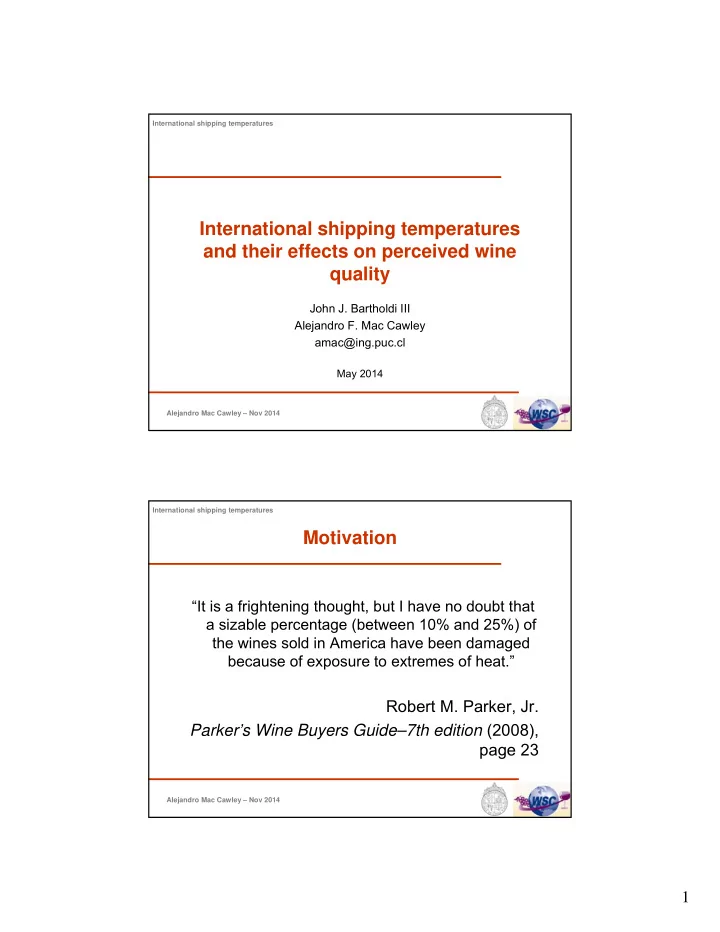
Motivation

“It is a frightening thought, but I have no doubt that a sizable percentage (between 10% and 25%) of the wines sold in America have been damaged because of exposure to extremes of heat.”

Robert M. Parker, Jr. Parker’s Wine Buyers Guide–7th edition (2008), page 23

slide-2
SLIDE 2

2

Alejandro Mac Cawley – Nov 2014 International shipping temperatures

Wine SC & temperature danger

Alejandro Mac Cawley – Nov 2014 International shipping temperatures

How tracked

slide-3
SLIDE 3

3

Alejandro Mac Cawley – Nov 2014 International shipping temperatures

Tracked routes to the US

Alejandro Mac Cawley – Nov 2014 International shipping temperatures

Tracked routes to the US

slide-4
SLIDE 4

4

Alejandro Mac Cawley – Nov 2014 International shipping temperatures

Tracked routes to the US

Alejandro Mac Cawley – Nov 2014 International shipping temperatures

Prior studies

  • Effects of temperature, humidity, vibration, light on wine chemistry:

– (Hasnip et al, 2004; Ough, 1985 and Ough et al, 1960; Lopes et al, 2006; Chung et al, 2008; Maury et al, 2010; Dozon & Noble, 1989

  • Analysed stable storage/transport temperature:

– Makhotkina et al (2012), Robinson et al (2010), Wicks et al (2009), Perez-Coello et al (2003), Sivertsen (2001) and De La Presa-Owens & Noble (1997).

  • Butzke (2012) recorded temperatures during truck transport within

the US.

  • Robinson et al (2010) and Wicks et al (2009) studied effects of

stable temperatures on wine.

None used “actual” temperature patterns or judged effect on quality by trade.
slide-5
SLIDE 5

5

Alejandro Mac Cawley – Nov 2014 International shipping temperatures

Contribution

  • Analyzed the effect of shipping temperatures in the quality

as perceived by consumers.

– Largest DB of documented international shipping temperatures. – Quantified the danger and generated recommendations. – Thermal liner effect. – “Physical simulation” and the effect of SC conditions. Consumer/Buyer.

  • Practitioner:

– Measure the danger. Best practices and recommendations. – Should we be concerned? – Cost of mitigating v/s effect over the product. Perception Consumer/Buyer.

Alejandro Mac Cawley – Nov 2014 International shipping temperatures

Temperature danger measures and analysis

  • Exposure: Percentage of shipments that had
  • ne reading above threshold.
  • Level: Time.
  • Cumulative effect: Arrhenius equation.
slide-6
SLIDE 6

6

Alejandro Mac Cawley – Nov 2014 International shipping temperatures

Temperature effect: speed of chemical reactions

Alejandro Mac Cawley – Nov 2014 International shipping temperatures

Temperature danger measures and analysis

  • Exposure: Percentage of shipments that had
  • ne reading above threshold.
  • Level: Time.
  • Cumulative effect: Arrhenius equation.
  • Analysis: Location and time.
slide-7
SLIDE 7

7

Alejandro Mac Cawley – Nov 2014 International shipping temperatures

Results - Exposure

Alejandro Mac Cawley – Nov 2014 International shipping temperatures

Results - Exposure

99.6 % ≥ 70°F

slide-8
SLIDE 8

8

Alejandro Mac Cawley – Nov 2014 International shipping temperatures

Results - Exposure

99.6 % ≥ 70°F 66 % ≥ 87°F

Alejandro Mac Cawley – Nov 2014 International shipping temperatures

Results - Exposure

99.6 % ≥ 70°F 66 % ≥ 87°F 12.2 % ≥ 104°F

slide-9
SLIDE 9

9

Alejandro Mac Cawley – Nov 2014 International shipping temperatures

Results - Exposure

99.6 % ≥ 70°F 66 % ≥ 87°F 12.2 % ≥ 104°F

Cooked! Chemical Reaction Speed + 76.2% Q [58.4%,94.7%]

Alejandro Mac Cawley – Nov 2014 International shipping temperatures

Results - Level

slide-10
SLIDE 10

10

Alejandro Mac Cawley – Nov 2014 International shipping temperatures

Results - Level

112 hrs. ≥ 87°F 19 hrs. ≥ 104°F

Alejandro Mac Cawley – Nov 2014 International shipping temperatures

Results - Port of Transshipment

slide-11
SLIDE 11

11

Alejandro Mac Cawley – Nov 2014 International shipping temperatures

Results - Port of Transshipment

Alejandro Mac Cawley – Nov 2014 International shipping temperatures

Results - Destination port to importer / period

slide-12
SLIDE 12

12

Alejandro Mac Cawley – Nov 2014 International shipping temperatures

Results - Destination port to importer / period 72 % ≥ 87°F

Alejandro Mac Cawley – Nov 2014 International shipping temperatures

Port destination - Time & speed

138 hrs.≥ 87°F 110 hrs. ≥ 87°F

slide-13
SLIDE 13

13

Alejandro Mac Cawley – Nov 2014 International shipping temperatures

Port destination - Time & speed

Alejandro Mac Cawley – Nov 2014 International shipping temperatures

Thermal liner

slide-14
SLIDE 14

14

Alejandro Mac Cawley – Nov 2014 International shipping temperatures

Liner Effect

Alejandro Mac Cawley – Nov 2014 International shipping temperatures

Liner Effect

9 °F at 104°F 77% range buffer

slide-15
SLIDE 15

15

Alejandro Mac Cawley – Nov 2014 International shipping temperatures

Issues

So the wine cooks…

Does the buyer/consumer notice?

Alejandro Mac Cawley – Nov 2014 International shipping temperatures

Replicating temperature histories

slide-16
SLIDE 16

16

Alejandro Mac Cawley – Nov 2014 International shipping temperatures

Experiment

  • 8 equally likely patterns of pour.
  • Most of the wines were from California to avoid “pre

cook”.

Glass # 1 Glass # 2 Glass # 3 Treated Un-Treated

Alejandro Mac Cawley – Nov 2014 International shipping temperatures

Questions

  • Which glass, if any, tastes different from the others?
  • Which glass(es) tastes better?
  • In your opinion, which glass(es), if any, hold wine that

was subjected to shipping temperatures?

  • Compared results with random choice.
slide-17
SLIDE 17

17

Alejandro Mac Cawley – Nov 2014 International shipping temperatures

Results

1. Detect difference: White wine Yes. Red: No. 2. Preference: White wines: Improved. Red: Did not like cooked high-end red wines. 3. Detect shipped wine: Both No. 4. Aging: increased the preference towards treated wines (Low end). Temperature:

– White wines tend to have a positive effect. – Red wines has a negative/positive effect. Could not detect differences.

Alejandro Mac Cawley – Nov 2014 International shipping temperatures

General findings

  • When: At sea, during transshipment and upon arrival to

the US in summer.

  • Where: The northern hemisphere in summer. NE ports.
  • Practical applications.
  • Should we use a liner?
  • Temperature effect?
slide-18
SLIDE 18

18

Alejandro Mac Cawley – Nov 2014 International shipping temperatures

Wine shipping “best practices”

International Wine Shipping

Alejandro Mac Cawley – Nov 2014 International shipping temperatures

Wine shipping “best practices”

International Wine Shipping

Avoid

slide-19
SLIDE 19

19

Alejandro Mac Cawley – Nov 2014 International shipping temperatures

Wine shipping “best practices”

International Wine Shipping

Speed Avoid

Alejandro Mac Cawley – Nov 2014 International shipping temperatures

Wine shipping “best practices”

International Wine Shipping

Speed Decide Avoid

slide-20
SLIDE 20

20

Alejandro Mac Cawley – Nov 2014 International shipping temperatures

Contribution

  • Analyzed the effect of shipping temperatures in the quality

as perceived by consumers.

– Largest DB of documented international shipping temperatures. – Quantified the danger and generated recommendations. – Thermal liner effect. – “Physical simulation” and the effect of SC conditions. Consumer/Buyer.

  • Practitioner:

– Measure the danger. Best practices and recommendations. – Should we be concerned? – Cost of mitigating v/s effect over the product. Perception Consumer/Buyer.

Alejandro Mac Cawley – Nov 2014 International shipping temperatures

So what…

  • Implications and lessons for international shipping of

temperature sensitive products.

  • Quantified risk.
  • Cost of mitigating v/s effect over the product. Perception.
  • “Physical simulation” and the effect of SC conditions.
  • Decision support. Include temperature in the equation.
slide-21
SLIDE 21

21

Alejandro Mac Cawley – Nov 2014 International shipping temperatures

Further research

  • Continue enhancing the analysis of temperature danger in

international supply chains. Support from industry.

  • Simulation of other factors and cork displacement.
  • Using information of air temperature and shipping routes

and schedules.

– Developing a temperature/time/location network to determine best route/service to minimize temperature risks.

  • Effect of temperature over quality in the case of significant

aging.