SLIDE 1
QUESTIONNAIRE ON METHODOLOGY OF COMPILING CONSUMER PRICE INDICES (CPI)
International Labour Organization Department of Statistics Food and Agriculture Organization of the United Nations Statistics Division
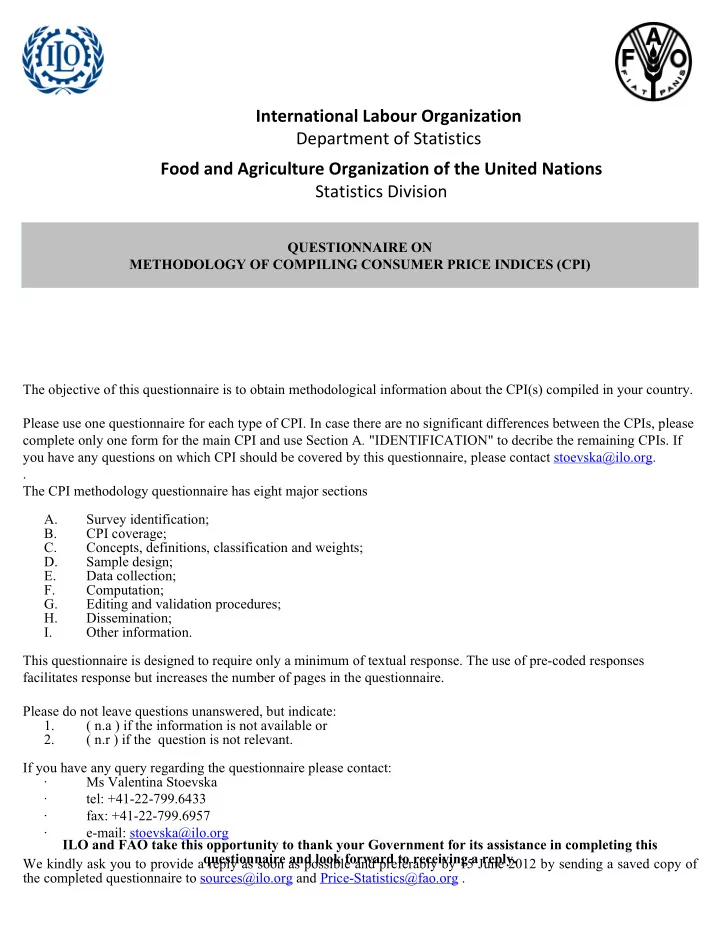
The objective of this questionnaire is to obtain methodological information about the CPI(s) compiled in your country. Please use one questionnaire for each type of CPI. In case there are no significant differences between the CPIs, please complete only one form for the main CPI and use Section A. "IDENTIFICATION" to decribe the remaining CPIs. If you have any questions on which CPI should be covered by this questionnaire, please contact stoevska@ilo.org. . The CPI methodology questionnaire has eight major sections A. Survey identification; B. CPI coverage; C. Concepts, definitions, classification and weights; D. Sample design; E. Data collection; F. Computation; G. Editing and validation procedures; H. Dissemination; I. Other information. This questionnaire is designed to require only a minimum of textual response. The use of pre-coded responses facilitates response but increases the number of pages in the questionnaire. Please do not leave questions unanswered, but indicate: 1. ( n.a ) if the information is not available or 2. ( n.r ) if the question is not relevant. If you have any query regarding the questionnaire please contact: · Ms Valentina Stoevska · tel: +41-22-799.6433 · fax: +41-22-799.6957 · e-mail: stoevska@ilo.org We kindly ask you to provide a reply as soon as possible and preferably by 15 June 2012 by sending a saved copy of the completed questionnaire to sources@ilo.org and Price-Statistics@fao.org . ILO and FAO take this opportunity to thank your Government for its assistance in completing this questionnaire and look forward to receiving a reply.
SLIDE 2
1. Please indicate the name of your country. 2. Please indicate the title of the CPI. 3. Please indicate the organisation responsible for planning and conducting the underlying price survey(s). 4. Please indicate the name of the person completing this questionnaire. 5. Please provide the email and/or other contact information. 6. Please indicate the date of completion of this questionnaire. 7. Please indicate the periodicity of publication of the CPI index Monthly Quarterly Other frequency, please specify: 8. Please indicate the index base period (year and/or month=100):
- a. For the computation
- b. For the publication
9. Please indicate the reference period of the current weights 10. Please indicate the main uses of the CPI (select all that apply) Indexation of wages, pensions and/or social security payment Indexation of rents, contracts and/or other payments Main inflation indicator used for monetary policy Deflate household expenditures in National Accounts Computation of purchasing power of households Macroeconomic modelling and other analytic uses Other (please specify)
SLIDE 3
B. CPI COVERAGE
11. Geographic coverage of weights and price collection: Weights Price collection Nation-wide Urban areas Rural areas Main city (can include surrounding areas) Main cities/metropolitan areas/regions Other geogra- phical coverage (please specify): 12. Population coverage (more than one option may be selected): Resident households of nationals Households of nationals located abroad Resident households of foreigners in the country Temporary visitors Other (please specify) 13. Population groups excluded from the index population (Tick the box for those population groups that are excluded from the index population. For each group indicate its percentage weight as a proportion of total population. ……….%). Population groups Excluded Proportion of total population (%) Institutional households Low income households High income households One-person households Other population groups (please specify):
SLIDE 4
14. Coverage of consumption expenditure (Indicate by “Yes” or “No” if the value of the following types of items is included in the CPI weights).
Item
Covered (Yes/No) Foods produced for own final consumption Other goods produced for own final consumption Services produced for own final consumption Food consumed away from home Income in-kind receipts of goods Income in-kind receipts of services In-kind goods received as gifts In-kind services received as gifts Purchase of owner-occupied housing Mortgage repayments Mortgage interest Housing maintenance, minor repairs Major repairs, conversions and extensions to owner occupied housing Purchase of gifts of goods and services given to others outside the household Second hand goods purchased Luxury goods Financial services (including fees for financial advice, brokerage fees) Interest payments (excluding mortgage interest payments) Non-life insurance premiums (e.g. vehicle, housing, other property, medical), gross of claims Life insurance premiums Licences and fees (e.g. driver's licence, hunting licence, vehicle registration) Gambling expenditure, gross of winnings Investment-related expenditures (e.g. purchase of shares/stocks) Occupational expenditures Other business-related expenditures Social transfers in-kind of goods and services from government and non-profit institutions serving households Expenditures abroad
SLIDE 5
C. CONCEPTS, DEFINITIONS, CLASSIFICATION AND WEIGHTS
15. Please provide a brief definition of the CPI and its objectives. 16. Please provide the definition of consumption expenditures used and whether consumption is defined in terms of “acquisition”, “use”, or “payment”. 17. Classifications (Indicate the name of the national or international classification(s) used for classifying the consumption expenditures; whether links to the COICOP have been established; and if so, at which level.) Please provide the correspondence table in the annex, if available. Major Group Weight Number of basic items in the Major Group
1 2 3 4 5 6 7 8 9 10 11 12
18. Please give (i) the names of the major groups, (ii) their current weights and (iii) the number of items in each major group.
SLIDE 6 19. Please give (i) the names of the food, beverages (non-alcoholic and alcoholic) and tobacco (including narcotics if applicable) classes, (ii) their current weights and (iii) the number of items in each class at the most disaggregated level
- possible. If weights are available by income groups and/or by region please also provide a copy in annex.
Class Weight Number of basic items in the Class Major Group Food Non-alcoholic beverages Alcoholic beverages Tobacco 20. Do weights provided in question 18 include value of consumption from own production? Yes No 21. Please provide in annex the historical CPI weights, if available. 22. Please indicate the sources of weights (more than one option may be selected): Household expenditure surveys National accounts Consumer surveys Other (please specify)
SLIDE 7 23. Please indicate the frequency of weights updates: Annual Every two years Every 3-5 years With less frequency 24. Please indicate if you adjust the weights from the weight reference period to the index reference period (e.g. if weights are based on an expenditure survey carried out in 2005 and the reference period used for the index is 2010, the weights are adjusted to take account of the time lag between two periods ). If so, please indicate briefly the methodology used (e.g. update based on national accounts data, price updating of weights). 25. Please indicate if you compile weights for different population groups or regions (e.g. urban areas/rural areas, income groups, etc.). 26. Please indicate the sampling method(s) used for the CPI surveys. Localities Outlets Products Probability sampling Simple random Stratified sampling with simple random sampling in each stratum Sampling with probability proportional to size (PPS) Stratified sampling with PPS sampling in each stratum Non-probability sampling Judgmental sampling Cut-off sampling (the elements with the highest sales or value
- f other auxiliary variable are included into the sample)
Quota sampling (a priori fixing of the number of elements) Other, specify:
D. SAMPLE DESIGN
SLIDE 8 27. Please indicate the frequency of sample updates. Localities Outlets Products Annual Continuous (on a rotating basis) Other frequency, specify: If the samples are not regularly updated, please indicate when the last updates were introduced. 28. Please indicate the criteria used for determining the optimal sample sizes and the coverage of items of the localities, outlets, items and variety samples for the all-items CPI. 29. Describe the criteria and method used for selecting an item variety in the outlet in case of loose specifications provided by the central office.
E. DATA COLLECTION
30. Please indicate the approximate number of localities, outlets and price observations that are collected each month/quarter. Localities Outlets Price
Number 31. Please indicate the frequency with which prices are collected for different broad groups of goods and services (e.g. food items- weekly, furniture-quarterly, rents-annually).
SLIDE 9 32. Please indicate the reference period for data collection for different groups
- f items (specific week, a full
month, a specific date). Describe any particular arrangement for specified items such as daily averages of fruits and vegetables 33. Please indicate the method of price data collection used and specify the types of items for which they are used. Method used (Yes/No) Type of items concerned Personal data collection Mailed questionnaires Telephone interviews Scanner data Internet Official tariffs Other, specify: 34. Please indicate briefly how are the following treated in the price collection and the estimating of average prices.
a.
Discounts and sales prices
b.
Black market prices
c.
Second hand purchases
SLIDE 10 Please indicate briefly how are the following treated: 35. Missing or faulty prices (omission, carrying forward the previous observation, extrapolation by using the change of the other prices for the same item, re-weighting of the non-missing prices, other). Please indicate for how long imputing a missing price is allowed, and explane the prodedure for selecting a replacement item. 36. Disappearance of a given type or quality from the market (replacement of item/variety). 37. Quality differences (Please indicate what kind of adjustments are made for quality changes). 38. Appearance of new items.
Seasonal items and seasonality (Please attach relevant methodological document)
39. Please indicate what kind
character (e.g. fresh fruit and vegetables, clothing) and how are they are treated. If available, please provide the methodological document on the treatment of the seasonal items in annex 40. Please indicate how seasonal food items are included in the CPI Fixed weights approach: the weights are kept constant over the year, while prices of
- ut-of season products are estimated or imputed
Variable weights approach: the weights vary over the year Other (please specify):
SLIDE 11 41. Please indicate how seasonal clothing items are included in the CPI Fixed weights approach: the weights are kept constant over the year, while prices on
- ut-of season products are estimated or imputed
Variable weights approach: the weights vary over the year Other (please specify): 42. If fixed weights are applied, please indicate the method used to impute the price development in out-of season periods Carry forward the last observed price Impute the price by using price development of in-season products Other (please specify): 43. Please describe the treatment of owner-occupied housing in the index. Describe the types of dwellings covered by the rent data and the method and frequency for data collection of rents.
F. COMPUTATION
44. Please indicate the formula used for calculation of elementary indices (a direct index compares prices in the current period with those in the base period; a chained index compares prices in the current period with those of the previous period and links the monthly changes into a long-term series). Direct form Chained form The arithmetic average of the price ratios (Carli index) The ratio of arithmetic mean prices (Dutot index) The ratio of geometric mean prices (Jevons index) Other (please specify): Housing
SLIDE 12 45. Please provide the formula used to aggregate elementary indices into higher level indices 46. Please provide the formula
- r describe the process of
aggregating regional/population group indices into national index. 47. If average prices (national
- r regional) are calculated,
please describe the method or provide the formula for calculating monthly and annual average prices). 48. Please indicate if the compiled results are regularly adjusted for seasonal
- variations. If so, please
describe the procedure used for seasonal adjustment (e.g. X11, X12, TRAMO). 49. Please indicate the software you use for calculating the CPI.
G. EDITING AND VALIDATION PROCEDURES
50. Please describe the control procedures used to ensure the quality of data:
- a. collected
- b. processed
SLIDE 13 51. Please indicate the timeliness of dissemination of the CPI data. (The lapsed time between the end of the field
- peration and the first publication of the index).
52. Please indicate at what level of detail the CPI is published. (Tick all the relevant boxes) All items CPI Division-level (12 divisions*) Group-level (app. 40 groups*) Class-level (app. 100 classes*) Basic items Average prices Paper publications Online dissemination Restricted access 53. Please indicate if there are separate indices published for specific population groups, and if so, indicate which. 54. Please indicate the type of products (e.g. food products, energy, gasoline) for which average prices are calculated and disseminated. 55. Please give the title(s) of the key national publications and the website where the indices can be found. Main national publication sources: 56. Please give the title(s) of the latest publication and the website where CPI methodological information can be found.
I. OTHER INFORMATION
57. Please attach to this questionnaire a copy of your current price survey form(s). 58. Please attach to this questionnaire a copy of the methodological document(s) about the design of your CPI. 59. Additional comments regarding this questionnaire:
THANK YOU FOR COMPLETING THIS QUESTIONNAIRE
*The number of divisions/groups/classes are provided as an example and are based on the COICOP classification.
H. DISSEMINATION