Interior Spacecraft Charging of the Van Allen Probes Andrew - - PowerPoint PPT Presentation

interior spacecraft charging of the van allen probes
SMART_READER_LITE
LIVE PREVIEW

Interior Spacecraft Charging of the Van Allen Probes Andrew - - PowerPoint PPT Presentation

Interior Spacecraft Charging of the Van Allen Probes Andrew Gerrard Louis Lanzerotti NJIT-CSTR Thomas Sotirelis, John Goldsten, Barry Mauk JHU-APL Joe Mazur Lanzerotti and Baker [2017] Aerospace Corp. Full ERM Data Oct 2012 Dec


slide-1
SLIDE 1

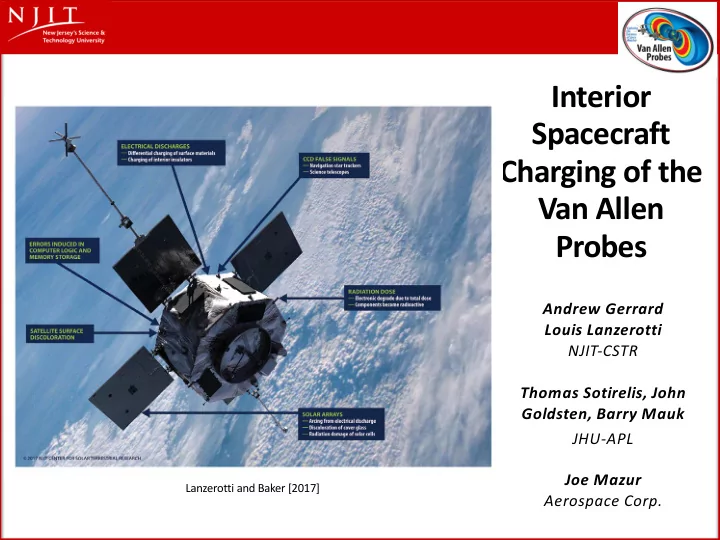
Interior Spacecraft Charging of the Van Allen Probes

Andrew Gerrard Louis Lanzerotti NJIT-CSTR Thomas Sotirelis, John Goldsten, Barry Mauk JHU-APL Joe Mazur Aerospace Corp.

Lanzerotti and Baker [2017]
slide-2
SLIDE 2

Full ERM Data

Oct 2012 – Dec 2017 CM1 and CM2, each 38-mm in diameter and under different thicknesses of aluminum (1-mm and 3.8-mm, respectively). CMs detect penetrating electrons of >0.7-MeV and >2.0-MeV, respectively, and protons of >15-MeV and >30-MeV, respectively.

slide-3
SLIDE 3

Zoom of Previous Data: Interior Spacecraft Charging of the Van Allen Probes in Relation to Transient Interplanetary Structures

CME-associated CIR-associated

slide-4
SLIDE 4

First Full Orbit

Oct 2012 – Aug 2014

  • Persistent

“background charging” of ~6- fA/cm2

  • Reduction of

charging in the slot region

slide-5
SLIDE 5

Full ERM Data

Oct 2012 – Dec 2017

slide-6
SLIDE 6
slide-7
SLIDE 7

Dst as a Nowcast of Charging

slide-8
SLIDE 8

Solar Wind Dynamic Pressure as a Predictor of Charging

Relative Solar Wind Dynamic Pressure

slide-9
SLIDE 9

Synoptics (September 2017 Storm)

slide-10
SLIDE 10

Synoptics (September 2017 Storm)

slide-11
SLIDE 11
  • Non-scientific satellites, such as commercial or national defense, normally do not

carry instrumentation that provide data

  • n

the radiation environmental conditions in which the

  • spacecraft are flying.
  • The flight of scientific instrumentation, such as the RBSPICE and REPT

instrumentation, can be costly.

  • This work demonstrates that simple, low cost and low impact charge monitors

can provide synoptic space weather measurements and some science results.

  • Such information can give 1) real time monitoring of the radiation environment

around a satellite, and 2) be used for real-time or post facto anomaly analyses.

  • Considerable consideration should be made to incorporate such monitoring

packages on future spacecraft.

Conclusions