
SLIDE 1
Interfaces
Savitch ch. 8.4
Relatedness of types
Consider the task of writing classes to represent
2D shapes such as Circle, Rectangle, and Triangle.
There are certain attributes or operations that are
common to all shapes:
perimeter,area
By being a Shape, you promise that you can
compute those attributes, but each shape computes them differently.
Interface as a contract
Analogous to the idea of roles or certifications in real life: "I'm certified as a CPA accountant. The certification
assures you that I know how to do taxes, perform audits.” Compare to:
"I'm certified as a Shape. That means you can be
sure that I know how to compute my area and perimeter.”
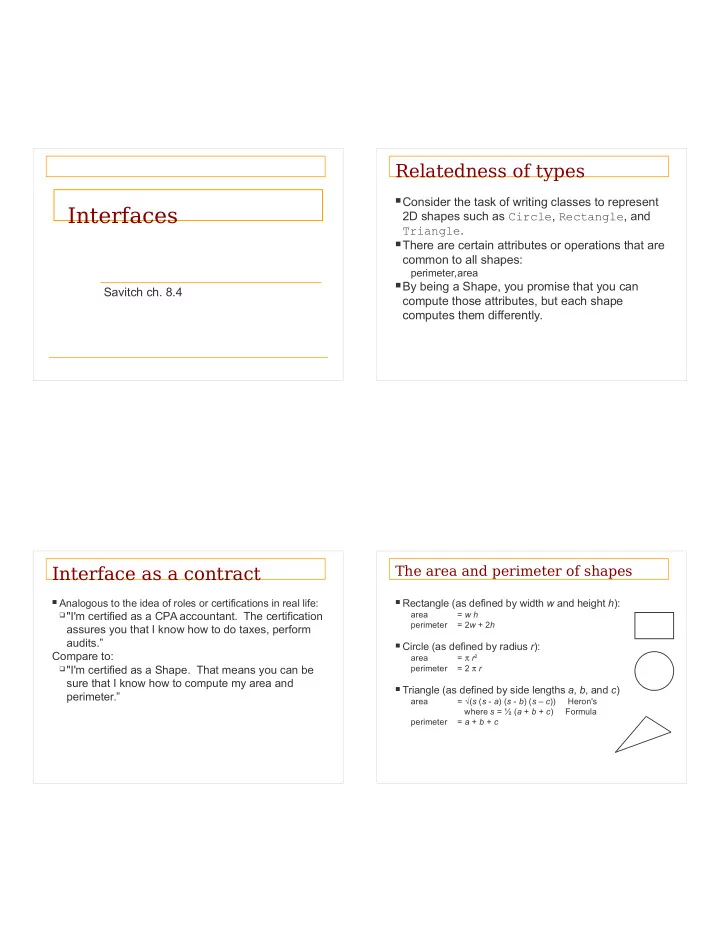
The area and perimeter of shapes
Rectangle (as defined by width w and height h):
area = w h perimeter = 2w + 2h
Circle (as defined by radius r):
area = π r2 perimeter = 2 π r
Triangle (as defined by side lengths a, b, and c)
area = √(s (s - a) (s - b) (s – c)) Heron's where s = ½ (a + b + c) Formula perimeter = a + b + c