Interdomain Routing Policies in the Wild Ruwaifa Anwar 1 , Haseeb - - PowerPoint PPT Presentation

interdomain routing
SMART_READER_LITE
LIVE PREVIEW

Interdomain Routing Policies in the Wild Ruwaifa Anwar 1 , Haseeb - - PowerPoint PPT Presentation

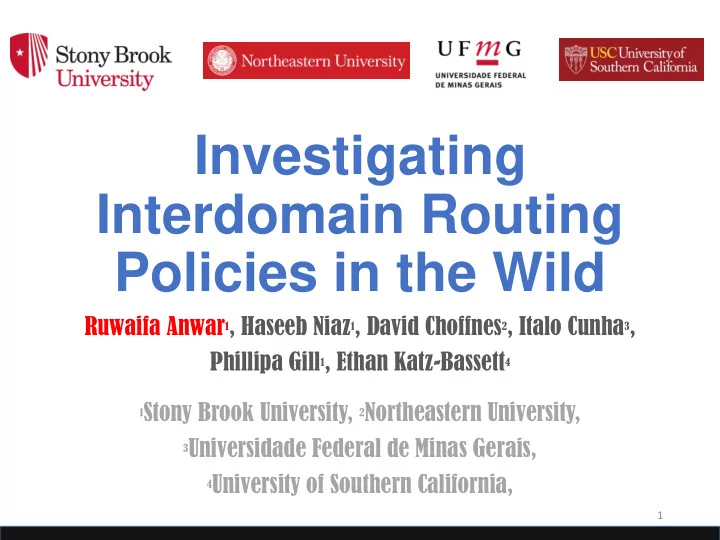
Investigating Interdomain Routing Policies in the Wild Ruwaifa Anwar 1 , Haseeb Niaz 1 , David Choffnes 2 , Italo Cunha 3 , Phillipa Gill 1 , Ethan Katz-Bassett 4 1 Stony Brook University, 2 Northeastern University, 3 Universidade Federal de Minas


slide-1
SLIDE 1

Investigating Interdomain Routing Policies in the Wild

Ruwaifa Anwar1, Haseeb Niaz1, David Choffnes2, Italo Cunha3, Phillipa Gill1, Ethan Katz-Bassett4

1Stony Brook University, 2Northeastern University, 3Universidade Federal de Minas Gerais, 4University of Southern California,

1

slide-2
SLIDE 2

Ruwaifa Anwar, NRG, Stony Brook University

  • How do we innovate in the Internet?
  • Building new protocols, playing what-if scenarios
  • Can’t test the ideas straight on the Internet
  • Might require Internet-wide changes, cause disruptions
  • Restricts research to today’s Internet deployments

2

slide-3
SLIDE 3

Ruwaifa Anwar, NRG, Stony Brook University

  • How do we innovate in the Internet?
  • Building new protocols, playing what-if scenarios
  • Can’t test the ideas straight on the Internet
  • Might require Internet-wide changes, cause disruptions
  • Restricts research to today’s Internet deployments
  • Solution?
  • Use Internet models to evaluate what would happen

3

slide-4
SLIDE 4

Ruwaifa Anwar, NRG, Stony Brook University

  • How do we innovate in the Internet?
  • Building new protocols, playing what-if scenarios
  • Can’t test the ideas straight on the Internet
  • Might require Internet-wide changes, cause disruptions
  • Restricts research to today’s Internet deployments
  • Solution?
  • Use Internet models to evaluate what would happen

4

Problem solved?

slide-5
SLIDE 5

Ruwaifa Anwar, NRG, Stony Brook University

  • How do we innovate in the Internet?
  • Building new protocols, playing what-if scenarios
  • Can’t test the ideas straight on the Internet
  • Might require Internet-wide changes, cause disruptions
  • Restricts research to today’s Internet deployments
  • Solution?
  • Use Internet models to evaluate what would happen
  • Gao Rexford (GR) Model
  • ASes connect based on business relationships
  • Prefer customer > peer > provider path
  • Pick the one with shortest path length
  • Export customer paths to all neighbours
  • Export provider or peer paths to customers only

5

Problem solved?

slide-6
SLIDE 6

Ruwaifa Anwar, NRG, Stony Brook University

  • How do we innovate in the Internet?
  • Building new protocols, playing what-if scenarios
  • Can’t test the ideas straight on the Internet
  • Might require Internet-wide changes, cause disruptions
  • Restricts research to today’s Internet deployments
  • Solution?
  • Use Internet models to evaluate what would happen
  • Gao Rexford (GR) Model
  • ASes connect based on business relationships
  • Prefer customer > peer > provider path
  • Pick the one with shortest path length
  • Export customer paths to all neighbours
  • Export provider or peer paths to customers only

6

Problem solved? But how well this model hold?

slide-7
SLIDE 7

Ruwaifa Anwar, NRG, Stony Brook University

  • Methodology
  • Ripe Atlas probes from different countries and Ases
  • Traceroutes towards popular content providers
  • Compare AS paths with CAIDA’s AS topologies
  • How many decisions followed GR model?

7

slide-8
SLIDE 8

Ruwaifa Anwar, NRG, Stony Brook University

  • Methodology
  • Ripe Atlas probes from different countries and Ases
  • Traceroutes towards popular content providers
  • Compare AS paths with CAIDA’s AS topologies
  • How many decisions followed GR model?

8

64.7% of total decisions followed Gao-Rexford

slide-9
SLIDE 9

Ruwaifa Anwar, NRG, Stony Brook University

  • Methodology
  • Ripe Atlas probes from different countries and ASes
  • Traceroutes towards popular content providers
  • Compare AS paths with CAIDA’s AS topologies
  • How many decisions followed GR model?
  • Causes of limitations
  • Siblings
  • Prefix specific policies
  • Undersea cables
  • Improvement?

9

64.7% of total decisions followed Gao-Rexford

slide-10
SLIDE 10

Ruwaifa Anwar, NRG, Stony Brook University

  • Methodology
  • Ripe Atlas probes from different countries and ASes
  • Traceroutes towards popular content providers
  • Compare AS paths with CAIDA’s AS topologies
  • How many decisions followed GR model?
  • Causes of limitations
  • Siblings
  • Prefix specific policies
  • Undersea cables
  • Improvement?
  • Takeaways
  • Future models can take into account limitations we observed

10

64.7% of total decisions followed Gao-Rexford 20% more of the total decisions followed GR

slide-11
SLIDE 11

Ruwaifa Anwar, NRG, Stony Brook University

  • Methodology
  • Ripe Atlas probes from different countries and Ases
  • Traceroutes towards popular content providers
  • Compare AS paths with CAIDA’s AS topologies
  • How many decisions followed GR model?
  • Causes of limitations
  • Siblings
  • Prefix specific policies
  • Undersea cables
  • Improvement?
  • Takeaways
  • Future models can take into account limitations we observed

11

64.7% of total decisions followed Gao-Rexford 20% more of the total decisions followed GR

For more details, refer to our paper: “Investigating Interdomain Policies in the Wild” (IMC’15) Ruwaifa Anwar manwar@cs.stonybrook.edu Networking Research Group, Stony Brook University, New York www.nrg.cs.stonybrook.edu