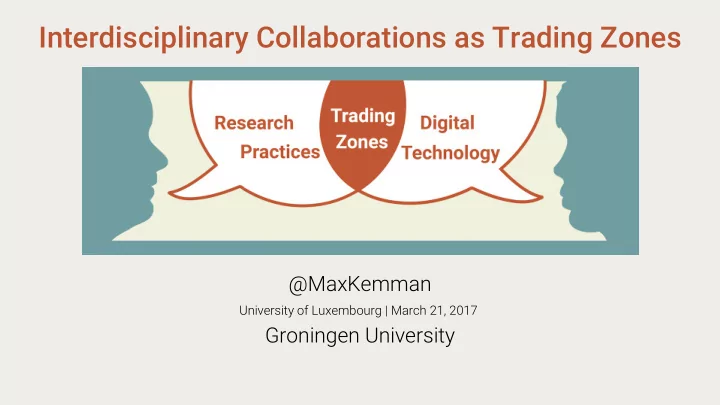
SLIDE 1 Interdisciplinary Collaborations as Trading Zones
@MaxKemman
University of Luxembourg | March 21, 2017
Groningen University
SLIDE 2 Today
About me
- What is an academic discipline
- What is interdisciplinarity
- Trading zones
- Practicing trading zones
- Conclusions
SLIDE 3 About me
Twitter: @MaxKemman Blog: www.maxkemman.nl
BSc Cognitive Artificial Intelligence (Utrecht University 2006-2009)
- MSc Information Science (Utrecht University 2009-2011)
- Junior researcher History department (Erasmus University Rotterdam 2011-2014)
- PhD Candidate History department/Centre for Contemporary and Digital History
(University of Luxembourg 2014-present)
SLIDE 4 About my PhD
Digital History as methodological interdisciplinarity: using tools, methods, and concepts from other disciplines to the benefit of historical research (Klein 2014) Alignment of scholarly values with digital technology as two-way street:
The tool needs to fit the practices (social shaping)
- The practices need to fit the tools (technological determinism)
SLIDE 5 Other interests
Google Scholar
- Open access, open data
- Digital libraries: linked data
- Artificial Intelligence
SLIDE 6
What is an academic discipline?
What makes your discipline a discipline? How is it different from Computer Science? Why did you choose this discipline?
SLIDE 7
Becher & Parry (2005) The Endurance of the Disciplines
Disciplines can be described according to 2 aspects: cognitive & social
SLIDE 8 Cognitive aspect
Subject - 'a particular, restricted aspect of reality' (Whitley 1974)
- Techniques of enquiry
- Methods
- Resources
- "Sustain an active and reasonably well-organised research frontier or pattern of
conceptual development"
SLIDE 9 Social aspect
Incorporation within a typical academic organisation
- Shared set of cultural values
- Recognition by the Academy at large
- Journals, conferences, associations
SLIDE 10 Sugimoto & Weingart (2015) The kaleidoscope of disciplinarity
Cognitive
- Social
- Communicative (discourse)
- Separatedness (boundary work)
- Tradition
- Institutional
SLIDE 11 Communicative Technical terminology per field:
Hermeneutics
SLIDE 12 Communicative Becher (1987) Disciplinary discourse Praising peers Criticising peers
History: scholarly, original, rigorous, stimulating, well-written
- Sociology: rigorous, stimulating, persuasive, powerful, perceptive
- Physics: elegant, economical, productive
- History: thin, 'sound', sloppy, jargon-ridden
- Sociology: Anecdotal, contentious
- Physics: sloppy, 'accurate', 'rigorous'
SLIDE 13 Separatedness Gieryn (1983) Boundary-Work and the Demarcation of Science from Non- Science Boundary work: defining a disciplinary field by contrasting it with other fields Just as readers come to know Holmes better through contrasts to his foil Watson, so does the public better learn about "science" through contrasts to "non-science."
SLIDE 14 Limitations of concept of 'discipline'
Is Digital History a disciplinary activity?
No room for different practices within a single department
- No room for people from outside university
SLIDE 15 Communities of Practice
(Wenger, 1998)
Limitations:
Mutual engagement (involving regular interaction).
- Joint negotiated enterprise (mutual goal and accountability).
- Shared repertoire of negotiable resources (such as jargon and practices).
- No room for non-human engagement
SLIDE 16 Epistemic Cultures
[T]hose sets of practices, arrangements and mechanisms bound together by necessity, affinity and historical coincidence which, in a given area of professional expertise, make up how we know what we know
Knorr Cetina (2007)
SLIDE 17 Conclusions
Disciplines demarcate a group of peers, concerned with specific techniques, and subjects More flexible concepts are "community of practice" or "epistemic culture" Why would we want to be interdisciplinary? Wanneer er reden is om verschillende disciplines te onderscheiden ... is er tevens reden ze niet met elkaar te vermengen
Ankersmit (1983)
SLIDE 18
What is interdisciplinarity?
Did any of you follow courses from other disciplines? Why? What are limitations of your discipline?
SLIDE 19 Multi, Inter, Trans
Choi & Pak (2006) Multidisciplinarity, interdisciplinarity and transdisciplinarity in health research, services, education and policy
Multi-: "draws on knowledge from different disciplines but stays within the boundaries of those fields" (additive)
- Inter-: "analyzes, synthesizes and harmonizes links between disciplines into a
coordinated and coherent whole" (interactive)
- Trans-: "integrates the natural, social, and health sciences in a humanities context, and in
so doing transcends each of their traditional boundaries" (holistic)
SLIDE 20 A case for transdisciplinarity
Gibbons (1994) The New Production of Knowledge Mode 1: complex of ideas, methods, values, norms, and ensure "compliance with what is considered sound scientific practice"
Mode 1 Mode 2
Problems are solved within academic context and interests of the community
- Disciplinary
- Homogeneous
- Hierarchical, tends to preserve its form
- Problems are solved within
context of application
- Transdisciplinary
- Heterogeneous
- Heterarchical and transient
- + More socially accountable
and reflexive
SLIDE 21
Challenges to practicing interdisciplinarity
Let's view interdisciplinary per the typology of Becher & Parry (2005)
SLIDE 22 Cognitive challenges
Subject - 'a particular, restricted aspect of reality' (Whitley 1974)
- Techniques of enquiry
- Methods
- Resources
- "Sustain an active and reasonably well-organised research frontier or pattern of
conceptual development"
SLIDE 23 Social challenges
Incorporation within a typical academic organisation
- Shared set of cultural values
- Recognition by the Academy at large
- Journals, conferences, associations
SLIDE 24 "What do you call a grad student without a supervisor: Interdisciplinary." - @ChadGaffield
(via @AcademicsSay)
SLIDE 25
Conclusions
Interdisciplinarity is interesting, but not the easiest route to take To be truly interdisciplinary, need coordination
SLIDE 26 Trading Zones
[A]n arena in which radically different activities could be locally, but not globally, coordinated
Galison (1996)
SLIDE 27 Local vs global?
The assumption is that the different communities in this 'arena' cannot coordinate actions on a global scale Why not? For example, why can't history and computer science do that?
Ideas of what is interesting
- Values of what is important
- Jargon
- Communication (e.g., publications)
SLIDE 28
Global incommensurability
Cannot judge one discipline in the terminology of another No neutral ground on which to compare the two
SLIDE 29
Local coordination
Define common goals Create a shared language: pidgin/creole Establish shared practices?
SLIDE 30 Acculturation & Dimensions
[T]he process by which the beliefs and practices of one community diffuse across the boundaries of another and subsequently alter the second community's practices and interpretations
Barley (1988)
Contact & Participation
- Cultural maintenance
- Coercion
SLIDE 31
Collins et al (2007) Trading zones and interactional expertise
SLIDE 32 What kind of trading zones do we see with Digital History?
Homogeneous Heterogeneous Collaboration Coercion Digital History as inter-language
- A new discipline?
- McCarty (2005)
Digital History as fractioned trading zone
- A dual citizenship for practioners and research
- bjects?
- Svensson, Klein, Hunter, Rieder & Röhle
Digital History as subversive
- Historians assuming the practice
- f Computer Science, but not the expertise (or
vice versa)? Digital History as enforced
- A power struggle of who decides what the digital
technology will do?
Problem: DH discussed as a homogeneous phenomenon, a single trading zone
SLIDE 33
Fractioned trading zones Commonly assumed the category of digital humanities TZ Two different types: boundary objects and interactional expertise
SLIDE 34 Boundary objects [O]bjects which are both plastic enough to adapt to local needs and the constraints of the several parties employing them, yet robust enough to maintain a common identity across sites. They are weakly structured in common use, and become strongly structured in individual site use.
Star & Griesemer (1989)
Related to the earlier mentioned pidgin
SLIDE 35 Interactional expertise Evans & Collins (2010) describe 3 forms of expertise: Both types of experts share the same social environment Interactional experts can share the discussion, but not add in practice Imitation Game
No expertise
1.
Interactional expertise
2.
Contributory expertise
3.
SLIDE 36 Contact & Participation
Digital History as collaboration with (a.o.) computer scientists
- Digital History as end-users of tools
- Digital History as building tools independently
- Project
- Lab
- International network
- THATCamp
SLIDE 37 Different forms of interdisciplinarity Interdisciplinarity can then occur on several levels:
Contact between different disciplines
- Individuals taking methods, concepts, tools from other disciplines
- Within a discipline focused around a subject, with different methods/concepts around it
When is a discipline?
SLIDE 38
Conclusions
Global incommensurability between disciplines Within trading zones: local coordination Acculturation: what happens when you are long enough in a TZ?
SLIDE 39 Practicing Trading Zones
Sit in groups of 4, with people from different backgrounds Discuss the following questions
What do you understand by data?
- What is evidence?
- Can research be objective?
- What are questions you can ask to distinguish an expert from non-expert in your
discipline?
SLIDE 40 Conclusions (last time)
Academia structured into disciplines Interdisciplinary research promising for engaging with a subject from different perspectives, but not easy Within interdisciplinary contact, trading zones form to coordinate language and practices Trading zones can either take the form of:
A new field/discipline
- A fractioned zone with people from different disciplines collaborating
- One disciplines assuming the practices of another
- A power struggle of who gets to decide what to do
SLIDE 41 References
Ankersmit, F. R. (1983). Denken Over Geschiedenis Een Overzicht van Moderne Geschiedfilosofische Opvattingen. Groningen: Wolters/Noordhoff
- Barley, S. R., Gordon, W. M., & Gash, D. C. (1988). Cultures of Culture: Academics, Practitioners and the Pragmatics of Normative Control. Administrative
Science Quarterly, 33(1), 24–60.
- Becher, T. (1987). Disciplinary discourse. Studies in Higher Education, 12(March 2015), 261–274.
- Becher, T., & Parry, S. (2005). The Endurance of the Disciplines. In I. Bleiklie & M. Henkel (Eds.), Governing Knowledge (Vol. 9, pp. 133–144). Springer.
- Berry, J. W. (2005). Acculturation: Living successfully in two cultures. International Journal of Intercultural Relations, 29, 697–712.
- Choi, B. C., & Pak, A. W. (2006). Multidisciplinarity, interdisciplinarity and transdisciplinarity in health research, services, education and policy: 1. Definitions,
- bjectives, and evidence of effectiveness. Clinical and investigative medicine, 29(6), 351.
- Collins, H., Evans, R., & Gorman, M. (2007). Trading zones and interactional expertise. Studies in History and Philosophy of Science Part A, 38(4), 657–666.
- Evans, R., & Collins, H. (2010). Interactional expertise and the imitation game. Trading Zones and Interactional Expertise, 53-70.
- Galison, P. (1996). Computer simulations and the trading zone. In The Disunity of Science: Boundaries, Contexts, And Power (pp. 118–157). Stanford
University Press.
- Gibbons, M., Limoges, C., Nowotny, H., Schwartzman, S., Scott, P., & Trow, M. (1994). The new production of knowledge: The dynamics of science and
research in contemporary societies. Sage.
- Gieryn, T. F. (1983). Boundary-work and the demarcation of science from non-science: Strains and interests in professional ideologies of scientists.
American sociological review, 781-795.
SLIDE 42 Hunter, A. (2014). Digital humanities as third culture. MedieKultur: Journal of Media and Communication Research, 30(57):18–33.
- Klein, J. T. (2014). Interdisciplining Digital Humanities: Boundary Work in an Emerging Field. University of Michigan Press.
- McCarty, W. (2005). Humanities computing. Palgrave Macmillan.
- Mounier, P. (2015). Une utopie politique pour les humanités numeriqués ? Socio, 4:97–112.
- Knorr-Cetina, K. (2007). Culture in global knowledge societies: Knowledge cultures and epistemic cultures. Interdisciplinary science reviews, 32(4), 361-375.
- Rieder, B. and Röhle, T. (2012). Digital methods: Five challenges. In Berry, D., editor, Understanding Digital Humanities, chapter 4, pages 67–84. Pal- grave
Macmillan.
- Sugimoto, C. R., & Weingart, S. (2015). The kaleidoscope of disciplinarity. Journal of Documentation, 71(4), 775-794.
- Svensson, P. (2012b). Envisioning the digital humanities. DHQ: Digital Humanities Quarterly, 6(1).
- Star, S. L., & Griesemer, J. R. (1989). Institutional ecology,translations' and boundary objects: Amateurs and professionals in Berkeley's Museum of
Vertebrate Zoology, 1907-39. Social studies of science, 19(3), 387-420.
- Wenger, E. (1998). Communities of practice: Learning, meaning, and identity. Cambridge university press.
- Whitley, R. (1974). Cognitive and social institutionalization of scientific specialties and research areas.