Interactions in Young Stars & Related Systems Marina Romanova, - - PowerPoint PPT Presentation

interactions in young stars related
SMART_READER_LITE
LIVE PREVIEW

Interactions in Young Stars & Related Systems Marina Romanova, - - PowerPoint PPT Presentation

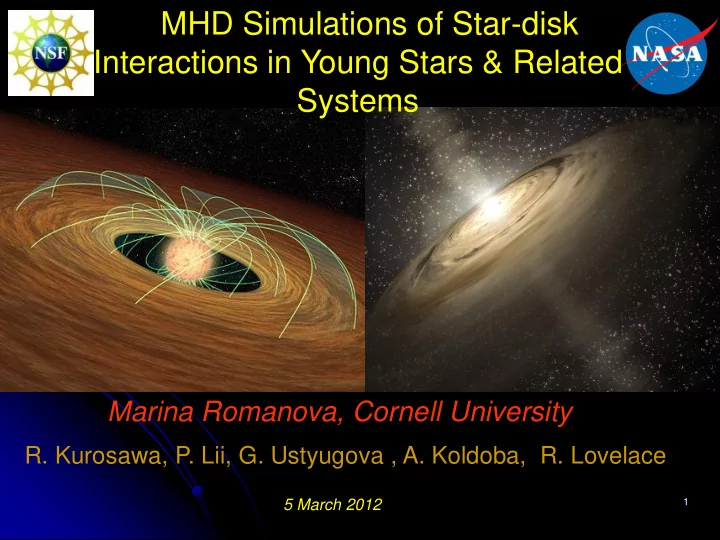
MHD Simulations of Star-disk Interactions in Young Stars & Related Systems Marina Romanova, Cornell University R. Kurosawa, P. Lii, G. Ustyugova , A. Koldoba, R. Lovelace 1 5 March 2012 Accreting Magnetized Objects 1. Young stars 2.


slide-1
SLIDE 1

Marina Romanova, Cornell University MHD Simulations of Star-disk

Interactions in Young Stars & Related Systems

5 March 2012

1

  • R. Kurosawa, P. Lii, G. Ustyugova , A. Koldoba, R. Lovelace
slide-2
SLIDE 2
  • 1. Young stars
  • 2. Brown dwarfs
  • 3. Neutron stars
  • 4. White dwarfs
  • 5. BH - possibly

Accreting Magnetized Objects

Different scales, similar physics

2

slide-3
SLIDE 3

Disk-magnetosphere interaction

By: Megan Comins

  • 1. Accretion through funnel streams (Ghosh & Lamb 1978)
  • 2. Disk wind (Blandford & Payne 1982) – centrifugally driven
  • 3. X-wind (Shu et al. 1994) – centrifugally-driven
  • 4. Conical winds (Romanova et al. 2009; Lii et al. 2011) - magnetically-driven

(Lovelace et al. 1991)

  • 5. Stellar winds (Matt & Pudritz 2005)

3

slide-4
SLIDE 4

4

Outline:

  • 1. Simulations of magnetospheric accretion
  • 2. Simulations of outflows from the disk-

magnetosphere boundary

  • 3. Spectral analysis and comparisons with
  • bservations
slide-5
SLIDE 5

Different MHD codes: 2.5D, 3D, ideal, non-ideal, Godunov-type (Koldoba, Ustyugova 2002-2012) Grids: spherical, cylindrical, “cubed sphere” Disk: a- disks (avis , adif) or MRI-driven disks Spectrum calculations: 3D radiative transfer code TORUS with restructuring grid (Harries et al. 2002), He – Kurosawa et al. 2011

Numerical Models:

5

slide-6
SLIDE 6

Accretion “Propeller” regime rcr > rm rcr < rm

rcr rm rm rcr

Magnetospheric Accretion

6

slide-7
SLIDE 7

3D simulations of accretion onto tilted dipoles

Romanova, Ustyugova, Koldoba & Lovelace 2003,2004

  • Small part of the region
  • One of density levels

7

  • Slice of density distribution
  • Selected field lines

Laminar, non-turbulent, a-type disk, , a=0.02

slide-8
SLIDE 8

Romanova, Ustyugova, Koldoba, Lovelace 2011

MRI-driven Accretion onto Magnetized Stars

  • Magnetized star
  • High grid resolution: 270x432
  • Axisymmetric & 3D MHD

MRI-driven accretion: Balbus & Hawley 1991 + > 20 years of modeling

Hawley, Stone, Gammie – non-magnetized object

8

slide-9
SLIDE 9

2.5D simulations of MRI-driven accretion

Romanova et al. 2011

Long simulations. For T Tauri stars:

  • 1 min = 60 days

No viscosity or diffusivity in the code MRI turbulence provides avis=0.02-0.06

9

slide-10
SLIDE 10

Summary of 2D and 3D Simulations :

Romanova, Ustyugova, Koldoba, Lovelace 2002-2012

The disk stops where stresses are equal: P+rv2=B2/8p

3D MHD, a-disk, Romanova et al. 2004 2D, MRI disk Romanova et al. 2011 From : Zanni et al. 2007 3D MHD, MRI disk, Romanova et al. 2012

10

slide-11
SLIDE 11

11

Kurosawa, Romanova, Harries 2008, 2011; TORUS -Tim Harries

Testing the Magnetospheric Accretion

  • 1. Perform MHD simulations
  • 2. Project our MHD data to the

TORUS grid

  • 3. Spectrum in H and He lines
  • 4. Compare with observations

11

Ryuichi Kurosawa

slide-12
SLIDE 12

Magnetic Field of V2129 Oph

Long et al. 2010 Romanova et al. 2010

The magnetic field of the young star V2129 Oph 3D field of V2129 modeled with 1.2 kG octupole and 0.35 kG dipole fields

Donati et al. 2007

12

slide-13
SLIDE 13

13

Application of model to T Tau star V2129 Oph

Dipole and octupole components Density map and B field lines on X-Z plane

Calculated 3D MHD flow

Calculate spectrum in Hydrogen lines using 3D code TORUS

Compared spectrum with observations

slide-14
SLIDE 14

14

Modeling of T Tauri V2129 Oph: Spectrum We have a 3D+3D tool !

Flux map in Hβ Calculated spectrum Hβ Profiles Observed spectrum Hβ Profiles

0.00 0.25 0.50 0.75 0.00 0.25 0.50 0.75 red absorption

Kurosawa et al. 2008 Alencar et al. 2011 Alencar et al. 2011

slide-15
SLIDE 15

T Tauri Jets and Outflows: DG Tau

DG Tau in [O I] 6300 A line CFH telescope (Dougados et al. 2000) DG Tau in [Fe II] 1.64 mm VLT telescope Resolution: 0.15” HV component – 200 km/s, low collimation component traces H2~2.212 mm, velocity 50 km/s

15

CTTS – a good laboratory to study launching of outflows

slide-16
SLIDE 16

T Tauri Jets and Outflows: HL Tau

The high-resolution images of the CTTS HL Tau show that the outflow is well-collimated in the [Fe II] 1.64 μm line (two middle panels), and is less collimated H2 2.122 μm (two left panels). A conical shaped emission is

  • bserved in the continuum at 1.64 μm (two right panels). Takami et al.

(2007).

  • Fast component is collimated at R < 10AU
  • 10AU – molecular gas
  • Onion-skin structure at small distances

16

slide-17
SLIDE 17

Evidence of Winds in He I l10830 line

Edwards et al. (2003, 2006); Kwan et al. (2007)

  • Strong P-Cyg like profile –

possibly stellar wind. Usually high accretion rate.

  • Narrow blue-shifted feature –

some type of disk wind

  • No outflows – no disk

Diskless TTS No accretion – no wind

17

  • T Tau stars: can probe accretion very close to the star
  • A good laboratory to investigate outflows
slide-18
SLIDE 18

avis >> adif

Shu et al. 1994 Matter inflows faster than the field diffuses out

  • utflows

18

Formation of Winds: Conical Winds

Inspired by X-wind Model

slide-19
SLIDE 19

T=3 years

Conical Winds

19

  • Compression of the magnetosphere – matter flows inward faster than

the field lines diffuse outward

  • 10-30 % of matter flows to the wind
  • Somewhat similar to X-winds , but many differences
slide-20
SLIDE 20

Magnetic force and poloidal current: Ip=rBf

Magnetic pressure force

B-lines

3D rendering: azimuthal component Magnetic force: Lovelace et al. 1991

20

Magnetic force determines both: acceleration and collimation

slide-21
SLIDE 21

21

Modeling of Spectrum from Conical Winds

 Axisymmetric MHD

simulations

 Both – funnel and winds  Calculate He and H lines  X-ray from the star, Lx

Kurosawa & Romanova (2012)

Poster # P23

  • R. Kurosawa
slide-22
SLIDE 22

22

Comparison with Observations: He I λ10830

Examples for 3 T Tauri stars

Varied inclination angles and Lx

Blue absorption – conical winds

Observations

(Edwards et al. 2006)

Model:

blue absorption blue absorption

slide-23
SLIDE 23

23

Modeling of Spectrum from Disk Winds

 Schematic disk wind  Inner part of the disk is really important  He I spectrum shows the disk feature like in conical winds

Kurosawa, Romanova Harries (2012)

slide-24
SLIDE 24

Collimation – can be different

Lii, Romanova & Lovelace 2011; FU Ori: Konigl, Romanova, Lovelace 2011

Patrick Lii, Romanova & Lovelace 2011

24

Analysis of forces – collimation by magnetic hoop-stress Stronger compression – stronger collimation

slide-25
SLIDE 25

Application to EXOrs & FUOri

Konigl, Romanova, Lovelace 2011

The B-light curve of V1057 Cyg (Herbig 1977) Exor EX Lup (Herbig 1977)

25

Brittain (2007)

slide-26
SLIDE 26

Modeling of Winds in FU Ori

Konigl, Romanova, Lovelace 2011

Ha-line, Reipurth 1990

Calvet, Hartman, Kenyon 1995 – spectral model

26

slide-27
SLIDE 27

Illarionov & Sunyaev 1975; Lovelace, Romanova and Bisnovatyi-Kogan (1999)

Fc > FG

Disk

Propeller Regime

27

  • Protostars –rotate rapidly
  • Can be at the propeller

regime

  • Any other star can be when

accretion rate decreases

  • Most of matter may flow out
slide-28
SLIDE 28

Poynting Jet

  • Conical Winds + Polar Jet
  • Matter flows from the inner disk-

centrifugally-driven

  • Energy & angular momentum flow

along stellar field lines

  • Magnetically-driven
  • Can spin-down protostar

Romanova et al. 2005; Ustyugova et al. 2006 Lower speed, higher density Higher speed lower density

Propeller regime

Onion-skin structure

Bacciotti et al. 2009

28

slide-29
SLIDE 29

29

HST

Observations: Cycle of inflation

Simulations: 7 years Major outbursts: 2 months HH30

Propeller Case

Ustyugova et al. 2006

29

slide-30
SLIDE 30

Outflows: Episodic

Most of matter can go to outflows

30

7 years

slide-31
SLIDE 31

Accretion – Ejection, quasi-period

n QPO=(0.02 – 0.2) n*

Example for CTTS: PQPO = 10 - 100 days

Fourier spectrum

31

slide-32
SLIDE 32

32

Outflows are observed!

Ustyugova, Lii, Romanova et al. 2012 (in prep)

Propeller regime: 2D MRI simulations

Poster # P26 Patrick Lii

32

slide-33
SLIDE 33

33

Winds from Stars with Complex Fields

Lovelace, Romanova, Ustyugova, Koldoba 2010

  • Example of dipole + quadrupole field
  • Not symmetric about equatorial plane
  • Wind can be persistently one-sided

33

slide-34
SLIDE 34

34

Flip-flop Outflows – Dipole Field

Lovelace, Romanova, Ustyugova, Koldoba 2010

34

slide-35
SLIDE 35
  • 1. Young stars (T Tau) - Yes
  • 2. Brown dwarfs -Yes
  • 3. Neutron stars - Yes
  • 4. White dwarfs -Yes
  • 5. Black Holes – a number of

similarities

Accreting Magnetized Objects

35

slide-36
SLIDE 36

Rapidly Spinning BHs: Analog of Propeller

Krolik, Hawley, Hirose 2004 a/M=0.5 a/M=0.998 Hirose, Krolik, De Villiers, Hawley 2004 The strength of Poynting flux jet increases with angular momentum of BH (a/M) Poloidal current increases with a/M

36

slide-37
SLIDE 37
  • 3D MHD + 3D RT tool for probing magnetospheric flow and
  • utflows. Tested – V2129 Oph
  • Enhanced accretion leads to formation of Conical Winds

which are magnetically-driven.

  • Outbursts - viscouse time-scale of the inner disk

replenishment – years to 100s of years (FU Ori)

  • Propeller regime – centrifugally-driven
  • Propeller regime – outbursts on the time-scale of the inner

disk accretion/diffusion – weeks-years

  • Angular momentum and energy flows from the star to

corona – rapid spin-down of protostars

  • Outflows can be systematically or episodically one-sided !

Conclusions:

37

slide-38
SLIDE 38

Rapidly Spinning BHs: Analog of Propeller

McKinney, Tchekhovskoi, Blandford 2012

38

slide-39
SLIDE 39

The “rotor problem” test for the ideal block of the 2D MHD Godunov code

Lines are density contours Color background- density Lines are the magnetic field lines 100x100 200x200 400x400 Comparisons show grid convergence

Viscosity and diffusivity blocks are switched-off

Romanova, Ustyugova, Koldoba, Lovelace 2009

39

slide-40
SLIDE 40

3D simulations of MRI-driven accretion, Q=30o

Large-scale turbulence is observed like in case of non- magnetic star (e.g., Hawley 2000) Low-m spiral modes B=0 B=0

40

slide-41
SLIDE 41

3D view of MRI-driven Accretion

Matter accretes in funnel streams Funnels form episodically Variability is higher than in case of the laminar flow

41