SLIDE 1
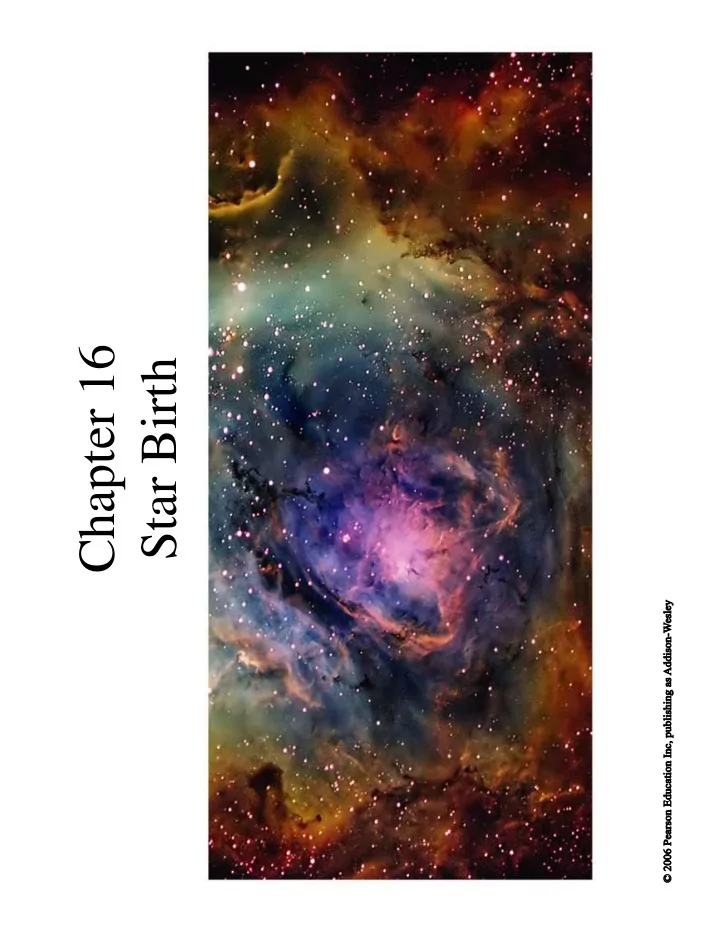
Chapter 16 Star Birth
SLIDE 2 16.1 Stellar Nurseries
- Our goals for learning
- Where do stars form?
- Why do stars form?
SLIDE 3
Where do stars form?
SLIDE 4 Star-Forming Clouds
clouds of dusty gas in interstellar space
stars is called the interstellar medium
SLIDE 5 Composition of Clouds
the composition of interstellar gas from its absorption lines in the spectra of stars
2% heavier elements in our region of Milky Way
SLIDE 6 Molecular Clouds
- Most of the matter in star-forming clouds
is in the form of molecules (H2, CO,…)
- These molecular clouds have a
temperature of 10-30 K and a density of about 300 molecules per cubic cm
SLIDE 7 Molecular Clouds
- Most of what we know about molecular
clouds comes from observing the emission lines of carbon monoxide (CO)
SLIDE 8 Interstellar Dust
- Tiny solid particles
- f interstellar dust
block our view of stars on the other side of a cloud
micrometer in size and made of elements like C, O, Si, and Fe
SLIDE 9 Interstellar Reddening
through the edges of the cloud look redder because dust blocks (shorter- wavelength) blue light more effectively than (longer-wavelength) red light
SLIDE 10 Interstellar Reddening
infrared light passes through a cloud more easily than visible light
infrared light reveal stars on the other side of the cloud
SLIDE 11 Observing Newborn Stars
newborn star is
the dark, dusty gas clouds where the star formed
SLIDE 12 Observing Newborn Stars
infrared light from a cloud can reveal the newborn star embedded inside it
SLIDE 13 Glowing Dust Grains
absorb visible light heat up and emit infrared light of even longer wavelength
SLIDE 14 Glowing Dust Grains
infrared light is brightest from regions where many stars are currently forming
SLIDE 15
Why do stars form?
SLIDE 16 Gravity versus Pressure
- Gravity can create stars only if it can overcome
the force of thermal pressure in a cloud
- Emission lines from molecules in a cloud can
prevent a pressure buildup by converting thermal energy into infrared and radio photons
SLIDE 17 Mass of a Star-Forming Cloud
- A typical molecular cloud (T~ 30 K, n ~ 300
particles/cm3) must contain at least a few hundred solar masses for gravity to overcome pressure
- Emission lines from molecules in a cloud can prevent
a pressure buildup by converting thermal energy into infrared and radio photons that escape the cloud
SLIDE 18 Resistance to Gravity
even more mass to begin contracting if there are additional forces opposing gravity
and turbulent gas motions increase resistance to gravity
SLIDE 19 Fragmentation of a Cloud
- Gravity within a contracting gas cloud
becomes stronger as the gas becomes denser
- Gravity can therefore overcome pressure in
smaller pieces of the cloud, causing it to break apart into multiple fragments, each of which may go on to form a star
SLIDE 20 Fragmentation of a Cloud
begins with a turbulent cloud containing 50 solar masses of gas
SLIDE 21 Fragmentation of a Cloud
- The random motions
- f different sections
- f the cloud cause it
to become lumpy
SLIDE 22 Fragmentation of a Cloud
cloud in which gravity can
can go on to become a star
make a whole cluster of stars
SLIDE 23 Isolated Star Formation
- Gravity can
- vercome pressure
in a relatively small cloud if the cloud is unusually dense
make only a single star
SLIDE 24 The First Stars
- Elements like carbon and oxygen had not yet been
made when the first stars formed
- Without CO molecules to provide cooling, the clouds
that formed the first stars had to be considerably warmer than today’s molecular clouds
- The first stars must therefore have been more massive
than most of today’s stars, for gravity to overcome pressure
SLIDE 25 Simulation of the First Star
- Simulations of early star formation suggest
the first molecular clouds never cooled below 100 K, making stars of ~100MSun
SLIDE 26 What have we learned?
– Stars form in dark, dusty clouds of molecular gas with temperatures of 10-30 K – These clouds are made mostly of molecular hydrogen (H2) but stay cool because of emission by carbon monoxide (CO)
– Stars form in clouds that are massive enough for gravity to overcome thermal pressure (and any other forms of resistance) – Such a cloud contracts and breaks up into pieces that go on to form stars
SLIDE 27 16.2 Stages of Star Birth
- Our goals for learning
- What slows the contraction of a star-
forming cloud?
- How does a cloud’s rotation affect star
birth?
- How does nuclear fusion begin in a
newborn star?
SLIDE 28
What slows the contraction of a star-forming cloud?
SLIDE 29 Trapping of Thermal Energy
- As contraction packs the molecules and dust particles
- f a cloud fragment closer together, it becomes harder
for infrared and radio photons to escape
- Thermal energy then begins to build up inside,
increasing the internal pressure
- Contraction slows down, and the center of the cloud
fragment becomes a protostar
SLIDE 30 Growth of a Protostar
cloud continues to fall onto the protostar until either the protostar or a neighboring star blows the surrounding gas away
SLIDE 31
How does a cloud’s rotation affect star birth?
SLIDE 32 Evidence from the Solar System
- The nebular theory
- f solar system
formation illustrates the importance of rotation
SLIDE 33 Conservation of Angular Momentum
- The rotation speed
- f the cloud from
which a star forms increases as the cloud contracts
SLIDE 34
Rotation of a contracting cloud speeds up for the same reason a skater speeds up as she pulls in her arms
SLIDE 35
particles in the cloud cause it to flatten into a disk
Flattening
SLIDE 36
Collisions between gas particles in cloud gradually reduce random motions
SLIDE 37
Collisions between gas particles also reduce up and down motions
SLIDE 38
Spinning cloud flattens as it shrinks
SLIDE 39 Formation of Jets
causes jets of matter to shoot out along the rotation axis
SLIDE 40 Jets are
coming from the centers of disks around protostars
SLIDE 41
SLIDE 42
How does nuclear fusion begin in a newborn star?
SLIDE 43 From Protostar to Main Sequence
- Protostar looks starlike after the surrounding gas is
blown away, but its thermal energy comes from gravitational contraction, not fusion
- Contraction must continue until the core becomes hot
enough for nuclear fusion
- Contraction stops when the energy released by core
fusion balances energy radiated from the surface—the star is now a main-sequence star
SLIDE 44 Birth Stages on a Life Track
- Life track illustrates star’s surface
temperature and luminosity at different moments in time
SLIDE 45 Assembly of a Protostar
- Luminosity and temperature grow as
matter collects into a protostar
SLIDE 46 Convective Contraction
- Surface temperature remains near 3,000 K
while convection is main energy transport mechanism
SLIDE 47 Radiative Contraction
- Luminosity remains nearly constant during
late stages of contraction, while radiation is transporting energy through star
SLIDE 48 Self-Sustaining Fusion
- Core temperature continues to rise until
star arrives on the main sequence
SLIDE 49 Life Tracks for Different Masses
Sun required about 30 million years to go from protostar to main sequence
form faster
form more slowly
SLIDE 50 What have we learned?
- What slows the contraction of a star-
forming cloud?
– The contraction of a cloud fragment slows when thermal pressure builds up because infrared and radio photons can no longer escape
- How does a cloud’s rotation affect star
birth?
– Conservation of angular momentum leads to the formation of disks around protostars
SLIDE 51 What have we learned?
- How does nuclear fusion begin in a
newborn star?
– Nuclear fusion begins when contraction causes the star’s core to grow hot enough for fusion
SLIDE 52 16.3 Masses of Newborn Stars
- Our goals for learning
- What is the smallest mass a newborn star
can have?
- What is the greatest mass a newborn star
can have?
- What are the typical masses of newborn
stars?
SLIDE 53
What is the smallest mass a newborn star can have?
SLIDE 54 Fusion and Contraction
- Fusion will not begin in a contracting cloud if some
sort of force stops contraction before the core temperature rises above 107 K.
- Thermal pressure cannot stop contraction because the
star is constantly losing thermal energy from its surface through radiation
- Is there another form of pressure that can stop
contraction?
SLIDE 55
Degeneracy Pressure: Laws of quantum mechanics prohibit two electrons from occupying same state in same place
SLIDE 56
Thermal Pressure: Depends on heat content The main form of pressure in most stars Degeneracy Pressure: Particles can’t be in same state in same place Doesn’t depend on heat content
SLIDE 57 Brown Dwarfs
halts the contraction
<0.08MSun before core temperature become hot enough for fusion
massive enough to start fusion are brown dwarfs
SLIDE 58 Brown Dwarfs
emits infrared light because of heat left
contraction
gradually declines with time as it loses thermal energy
SLIDE 59 Brown Dwarfs in Orion
reveal recently formed brown dwarfs because they are still relatively warm and luminous
SLIDE 60
What is the greatest mass a newborn star can have?
SLIDE 61 Radiation Pressure
slight amount of pressure when they strike matter
are so luminous that the collective pressure of photons drives their matter into space
SLIDE 62 Upper Limit on a Star’s Mass
suggest that radiation pressure limits how massive a star can be without blowing itself apart
not found stars more massive than about 150MSun
SLIDE 63
Temperature Luminosity
Stars more massive than 150MSun would blow apart Stars less massive than 0.08MSun can’t sustain fusion
SLIDE 64
What are the typical masses of newborn stars?
SLIDE 65 Demographics of Stars
- Observations of star clusters show that star formation
makes many more low-mass stars than high-mass stars
SLIDE 66 What have we learned?
- What is the smallest mass a newborn star
can have?
– Degeneracy pressure stops the contraction of
- bjects <0.08MSun before fusion starts
- What is the greatest mass a newborn star
can have?
– Stars greater than about 150MSun would be so luminous that radiation pressure would blow them apart
SLIDE 67 What have we learned?
- What are the typical masses of newborn
stars?
– Star formation makes many more low-mass stars than high-mass stars