
SLIDE 1
Measuring accretion rates
- f Herbig Ae/Be stars
Ignacio Mendigutía
The UX Ori type stars and related topics Saint Petersburg, Oct 2019
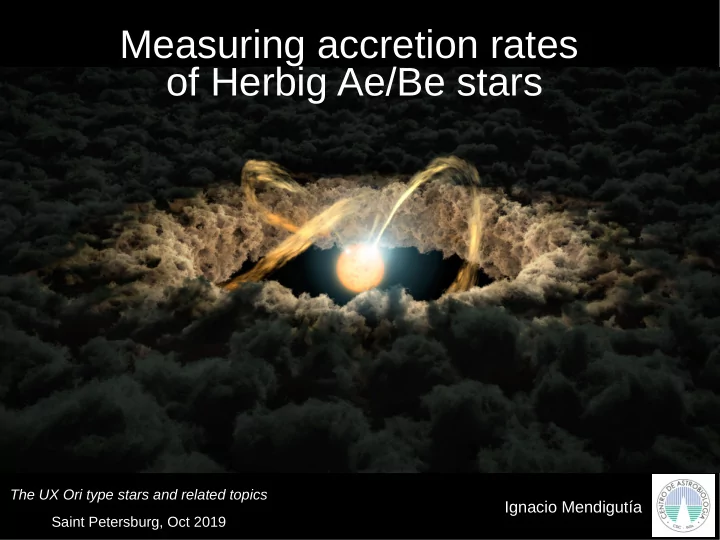
Measuring accretion rates of Herbig Ae/Be stars The UX Ori type - - PowerPoint PPT Presentation
Measuring accretion rates of Herbig Ae/Be stars The UX Ori type stars and related topics Ignacio Mendiguta Saint Petersburg, Oct 2019 Why accretion? Hartmann (2009) - acc traces the evolution of YSOs (Hartmann+1998; Fedele+2010,
Ignacio Mendigutía
The UX Ori type stars and related topics Saint Petersburg, Oct 2019
Hartmann (2009)
Bfield ~ M*
5/6 x Ṁacc 1/2 x vrot*
TTs need kG, HAeBes need ≤ 100 x G Small B field → small disk truncation radius (~ 5R* for TTs; ~ 2.5R* for HAeBes) Earliest suggestions that MA could work at least in HAes (not in HBes): Vink+(2002); Eisner+(2004) Nn Boundary Layer (BL)
(Muzerolle et al. 2004) Accretion rates can be inferred from spectral line and accretion shock (ΔDB) modelling Calibration valid only for UX Ori!
(see also Calvet+2004; Garcia-Lopez+2006 for IMTTs)
Mendigutía et al. 2011: Macc for 38 northern HAe(Bes); ~ 10-7 M⊙/yr , but depends on M* Depends on the star!
TTs TTs TTs HAeBes HAeBes HAeBes <±0.5 dex accuracy ±1 dex accuracy
(see also Donehew & Brittain 2011, Pogodin+2011)
ΔDB
Hα 10% width valid for TTs (Natta+2004), not for HAeBes (large v sini ). First suggested by Boley+2009 for a HBe star. Same for spectroscopic line veiling (Muzerolle+ 2004: Tshock ~ T* ~ 10000 K) Accretion & line variabilities decoupled! → Careful spectro-photometric monitoring needed (e.g. Dupree+2012, 2013) RR Tau HK Ori
ΔDB = K ΔDB
LHα LHα TTs HAeBes
Fairlamb et al. 2015: Ṁacc for 91 southern HAeBes from ΔDB modelling based on X-Shooter spectra → stellar parameters Near-UV/Optical Optical/Near-IR Fairlamb et al. (2017): Lacc from ΔDB and Lline from X-Shooter spectra (TTs, Alcalá+2014; HAeBes, Fairlamb+2015) log Lline/L
⊙
log Lacc/L
⊙ = A + B x log Lline/L ⊙ (~ ±1 dex accuracy)
Near-IR log Lacc/L
⊙
1) Accretion variability (from ΔDB) generally decoupled from simultaneous spectral line variations 2) The main Brγ & Hα emitting regions are larger than the accreting region in many HAeBes (Kraus+2008; Garcia Lopez+2015, 2016; Mendigutía+2015, 2017; Tambovtseva+2016; Kurosawa+2016; Kreplin+2018...) 3) The physical origin of some lines is not related to accretion (e.g. [OI]6300 comes from the disk in HAeBes, Acke +2005; Acke & van den Ancker 2006)
Lacc-Lstar Lacc-Lline Caution: Lacc correlates with Lline regardless of its physical origin, because of the correlation with L* (Mendigutía et al. 2015) ...Thus, L* can also be used to estimate Lacc (~ ±1 dex accuracy)
Gaia distances to re-determine stellar parameters of HAeBes: > 200 known to date (Vioque+2018), and increasing (Vioque+, in prep.) Arun et al. (2019): Ṁacc for 106 HAeBes from LHα (and increasing; 163 HAeBes from LHα in Wichittanakom+, poster 10) <--IMTTs MYSOs-->
Guzmán-Díaz+, in prep: homogeneous stellar parameters from SED fitting, Mdisk, Macc...for 221 HAeBes
Salpeter’s IMF
MA works in HAes
Johns-Krull 2015, 2014)
Costigan+2014; Mendigutía+2011a)
Fairlamb+2015; Mendigutía+2011b; Muzerolle+2004...)
Mottram+2007, Vink+2002, 2003, 2005)
MA does not work in HAes
and 59 non-magnetic HAeBes)
39 F & A stars)
Preliminary test MA and BL estimates of HAe stars differ ≤ ± 1 dex (best case scenario) In general Ṁacc (BL) > Ṁacc (MA)
Fairlamb+2015 & Mendigutía+2011 Blondel & Tjin A Djie 2006
What if MA estimates are wrong?
Mendigutía+(2011) and Fairlamb+(2015) identified > 20 HBes for which MA shock modelling hardly reproduces the observed ΔDB (covering fractions ≥ 50-100%) HAes and HBes behave differently (e.g. Oudmaijer, SFNewsletter, Jan 2019), moreover:
“Non-magnetospheric” HBes
VY Mon R Mon PDS 133 HD 85567 HD 305298 DG Cir HD 141926 VV Ser LkHa 234 HD 53367 V380 Ori V590 Mon GU Cma Z Cma (A4) PDS 27 PDS 281 PDS 286 PDS 37 HD 94509 HD 96042 PDS 69 MWC 297 AS 442
BL?
1) GRAVITY/VLTI data of 6 “non-magnetospheric” HBe stars under analysis (Marcos-Arenal+, in prep.)
2) UV spectra could be key to disentangle between MA and BL (IUE, Hubble, WSO...) BL MA
Flux Diff phase Vis²
HD 94509, Herbig Be, 12000 K, 11M⊙
λ/2B ~ 2 mas, R ~ 4000, 4 UTs
BL
* Accuracy < ± 0.5 dex from direct estimates (near-UV excess) * Accuracy ~ ± 1 dex from indirect estimates (correlations with Lline or L*) * Emission line modelling strongly depends on relatively free parameters