Inter-professional palliative care simulation: from diagnosis to - - PowerPoint PPT Presentation

inter professional palliative care
SMART_READER_LITE
LIVE PREVIEW

Inter-professional palliative care simulation: from diagnosis to - - PowerPoint PPT Presentation

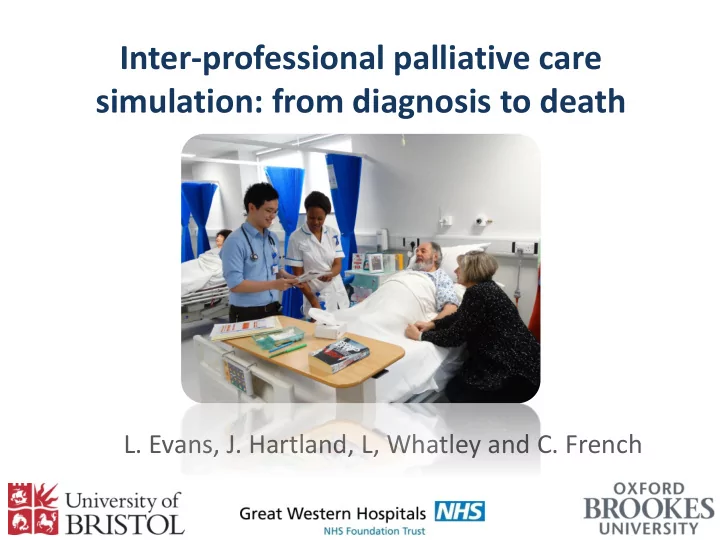
Inter-professional palliative care simulation: from diagnosis to death L. Evans, J. Hartland, L, Whatley and C. French Introduction Aim This session aims to raise awareness of the use of simulation as a method to teach inter-professional

slide-1
SLIDE 1
  • L. Evans, J. Hartland, L, Whatley and C. French

Inter-professional palliative care simulation: from diagnosis to death

slide-2
SLIDE 2

Introduction

Aim

  • This session aims to raise awareness of the use of

simulation as a method to teach inter-professional end of life care to pre-registration student nurses and doctors. Objectives

  • Describe the format of the simulation
  • Describe the research project undertaken.
  • Critically explain the methodology employed.
  • Discuss the expected results, based on pilot data.
  • Consider future implications for educational practice.
slide-3
SLIDE 3

Outline of the day

Introduction Coffee, ground rules and introduction to day Scenario 1 Tutorial : Breaking bad news – SPIKES model Introduction to the patient Fishbowl breaking bad news scenario Debrief (within fishbowl) Scenario 2 Tutorial :Identifying the dying patient and end of life prescribing Scenario: Identifying the dying patient Debrief Scenario 3 Tutorial: Confirming death and care after death Scenario: Confirming death and discussion with relative Debrief Closing Final thoughts as group Break away session

slide-4
SLIDE 4
  • Students to meet the patient before the sim starts

and ask any questions/gather any extra information

  • George Sanders, painless jaundice presenting rapid

access jaundice clinic for urgent USS with his wife

  • Need to explain result of USS and next steps
  • Fishbowl simulation - Faculty do a ‘how not to BBN’

example with students giving us feedback

  • Medical and nursing student swap in, able to pause,

rewind, swap in and out with debrief in situ

Breaking bad news scenario

slide-5
SLIDE 5

Outline of the day

Introduction Coffee, ground rules and introduction to day Scenario 1 Tutorial : Breaking bad news – SPIKES model Introduction to the patient Fishbowl breaking bad news scenario Debrief (within fishbowl) Scenario 2 Tutorial :Identifying the dying patient and end of life prescribing Scenario: Identifying the dying patient Debrief Scenario 3 Tutorial: Confirming death and care after death Scenario: Confirming death and discussion with relative Debrief Closing Final thoughts as group Break away session

slide-6
SLIDE 6
  • ….Admitted to hospital with general deterioration

and increasing pain. Reversible causes excluded, no benefit from antibiotics. Team documented if further deterioration – for care and comfort.

  • Vomiting and unable to keep down medications
  • Wife very anxious
  • Nurse assesses and calls doctor
  • Identify and discuss likely EOL and prescribe

symptom control medications

Identifying dying patient scenario

slide-7
SLIDE 7

Outline of the day

Introduction Coffee, ground rules and introduction to day Scenario 1 Tutorial : Breaking bad news – SPIKES model Introduction to the patient Fishbowl breaking bad news scenario Debrief (within fishbowl) Scenario 2 Tutorial :Identifying the dying patient and end of life prescribing Scenario: Identifying the dying patient Debrief Scenario 3 Tutorial: Confirming death and care after death Scenario: Confirming death and discussion with relative Debrief Closing Final thoughts as group Break away session

slide-8
SLIDE 8
  • Wife calls nurse as she thinks George (sim man) isn’t

breathing

  • Nurse to assess, communicate with wife and call

doctor

  • Doctor to confirm death
  • Inform wife and answer any questions “What do I do

now?”

Confirming death scenario

slide-9
SLIDE 9

End of life moulage

slide-10
SLIDE 10

Adding personal effects

slide-11
SLIDE 11

Challenges

  • Resource intensive: Staff, rooms and

equipment

  • Expensive: actors
  • Requires expert facilitators
  • Emotive and challenging for students
  • Inter-professional logistics
  • Staff attitudes
  • Balancing different learning needs
slide-12
SLIDE 12

Project outline

‘Does undergraduate inter-professional simulation in palliative care promote positive changes in team working, understanding and behaviour when caring for patients nearing the end of their life?’ Part 1 – anonymous online survey with free text boxes Part 2 – observational study of behaviour and attitudes displayed by students

slide-13
SLIDE 13

Results

0.5 1 1.5 2 2.5 3 3.5 4 4.5 5 Breaking bad news Identifying the dying patient Controlling symptoms Communicaion with family Care after death

Average self assess confidence scores (n=49)

Before After

slide-14
SLIDE 14

How might the teaching today change or influence your future practice? Primary themes

  • 1. Preparedness: students discussed feeling more

prepared for graduation and working on the wards

“Even though you get exposure to these sensitive situations you are

  • ften protected by your mentor

and often only observer. Really nice to be able to take the lead in a protected environment.” Student Nurse “I think it's really good to experience these scenarios before we start work to give us an experience to work off.” Medical Student

slide-15
SLIDE 15

How might the teaching today change or influence your future practice? Primary themes

  • 2. Care of the dying/deceased: students discussed

practical knowledge and skill acquisition

“Great to know about the practicalities of care after death” Medical Student

“More aware of the dying process” Nursing Student

slide-16
SLIDE 16

How might the teaching today change or influence your future practice? Primary themes

  • 3. Challenging Communication: students reflected
  • n experience and acquisition of skills

communication in difficult circumstances (e.g. breaking bad news)

“Not filling the silences…” Medical student

“Much greater confidence and knowledge about breaking bad news, identifying and explaining the dying process, and dealing with a patient who has died.” Nursing Student

slide-17
SLIDE 17

How might the teaching today change or influence your future practice? Secondary themes

  • 1. Supporting your colleagues: reflections on need

for and confidence in supporting colleagues of both professions

“I'm more prepare to deal with the situation and more engage with doctors feelings and need for support” Nursing student

“Greater understanding of the nurses perspective” Medical student

slide-18
SLIDE 18

How might the teaching today change or influence your future practice? Secondary themes

  • 2. Roles: where students reflected on greater

understanding not only of each other’s roles but also their own role in a team and in EOL care

“Better awareness of medical practices” Nursing student

“It has given me an excellent understanding of the role I will play in my career as a doctor &the role of my nurse colleagues” Medical student

slide-19
SLIDE 19

How might the teaching today change or influence your future practice? Secondary themes

  • 3. Importance of the MDT: students place emphasis
  • n the need to work in an MDT or use inter-

professional skills and communication

“Give confidence in my

  • wn skills and engaging

with medical students and Jr doctors” Nursing Student

“Days like today are really important and I think that we should have more of these. It brings up real life problems and is very beneficial to do it as part of an MDT” Medical student

slide-20
SLIDE 20

Shared student themes:

  • Supporting colleagues: recurrent theme in both nursing and medical

student reflections “Knowing the roles of each profession & how best to communicate and support each other. It has been an invaluable experience. Thank you!” Medical student

  • Own role in MDT: reflections from students gain better

understanding of their own role “I was able to see how I fitted in within the grand scheme of things and it made me appreciate other professionals and their roles” Nursing student

Did you gain a better understanding of other professionals role in End of Life care, and if so in what way?

slide-21
SLIDE 21

Nursing students:

  • Skills of the doctor: reflections on greater

understanding of specific jobs of the doctor

  • “Doctors certifying death”
  • Pressures on the doctors: insights into the

pressures around decision making in EOL unique to medical staff

  • “Their training and their experiences,

their decisions and dilemmas”

  • Breaking hierarchy: students more

comfortable interacting with each other

  • “It humanised the medical

professionals, I have a greater empathy for their fears and insecurities.” Medical students:

  • Practical skills: students comment on greater

knowledge of nursing skills and abilities

  • “The role of the nurse as the first

assessor of patient needs and their role before, during and after a patient’s death”

  • Care after death: medical students improved

knowledge of nursing care after death (previously not exposed to this)

  • “The after death care that nurses

perform”

  • Role of the nurse in EOL: students reflect on

integral role of the nurse throughout the EOL journey, especially in regards to patient support

  • “Just understanding how much they do

when we aren’t there”

Did you gain a better understanding of other professionals role in End of Life care, and if so in what way?

slide-22
SLIDE 22

Results

Observational study –

  • Analysis is on-going (first round complete)
  • Current themes agree with student identified

learning outcomes

  • Additional themes emerging from non-formal

discussions

– Career – Curriculum

slide-23
SLIDE 23

What next?

  • 6 month follow up

– Telephone interviews and focus groups – Reflect on your first 6 months of working – How has the teaching impacted your working?

slide-24
SLIDE 24

Thank you

Questions?