Intelligibility in SE Asian Student : pardon? English Interviewer - - PDF document

intelligibility in se asian
SMART_READER_LITE
LIVE PREVIEW

Intelligibility in SE Asian Student : pardon? English Interviewer - - PDF document

ESEA-18 Keynote 16 November 2015 Interviewer : what did you do in your last vacation /vken/ Intelligibility in SE Asian Student : pardon? English Interviewer : what did you do in your last vacation /veken/ oh, i went to


slide-1
SLIDE 1

ESEA-18 Keynote 16 November 2015 1

Intelligibility in SE Asian English

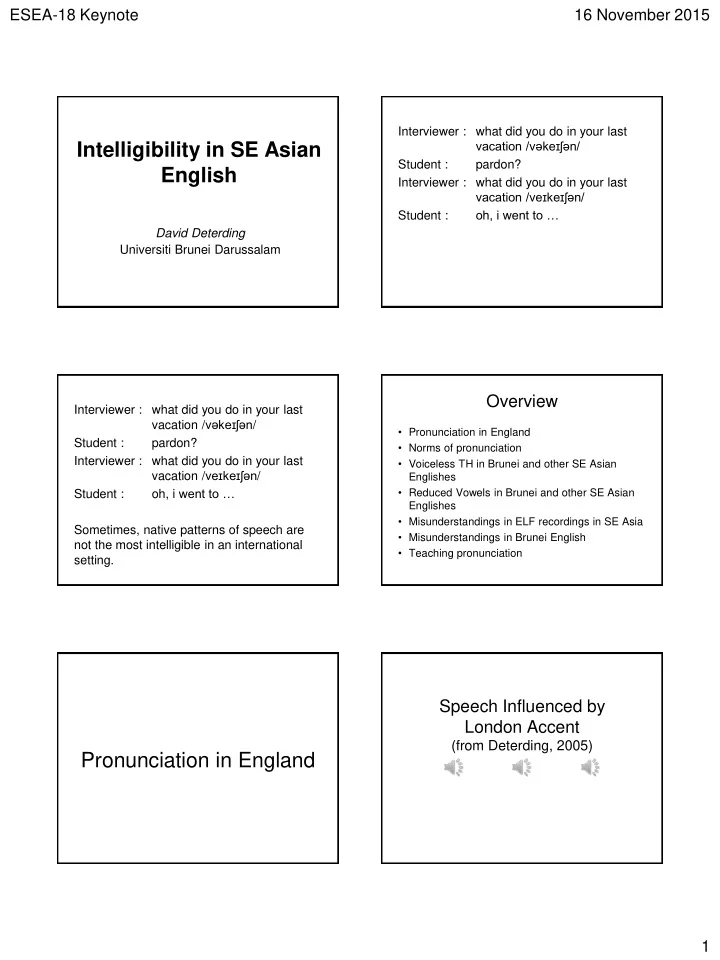
David Deterding Universiti Brunei Darussalam Interviewer : what did you do in your last vacation /vəkeɪʃən/ Student : pardon? Interviewer : what did you do in your last vacation /veɪkeɪʃən/ Student :

  • h, i went to …

Interviewer : what did you do in your last vacation /vəkeɪʃən/ Student : pardon? Interviewer : what did you do in your last vacation /veɪkeɪʃən/ Student :

  • h, i went to …

Sometimes, native patterns of speech are not the most intelligible in an international setting.

Overview

  • Pronunciation in England
  • Norms of pronunciation
  • Voiceless TH in Brunei and other SE Asian

Englishes

  • Reduced Vowels in Brunei and other SE Asian

Englishes

  • Misunderstandings in ELF recordings in SE Asia
  • Misunderstandings in Brunei English
  • Teaching pronunciation

Pronunciation in England

Speech Influenced by London Accent

(from Deterding, 2005)

slide-2
SLIDE 2

ESEA-18 Keynote 16 November 2015 2 we went out a few times we were

  • nly there for three nights

we were only there for three nights

R1 : we don’t have enough free nights R2 : what I really don’t have free life R3 : ??? R4 : we don’t have free licence R5 : we were only there for three nights R6 : we don’t have free life.

voiceless TH in Britain (Oliver, aged 4;7) three lollipops three lollipops

We get our pronunciation from our friends, not from our parents.

Is voiceless TH as [f] permanent? (Oliver, aged 7;5)

slide-3
SLIDE 3

ESEA-18 Keynote 16 November 2015 3

three bears (Elsie, aged 4;8) She even uses ‘f’ in writing Goldilocks and the three bears

Reduced Vowels in England

a wolf that had just escaped from the zoo proceed/precede

from Wells (2014, p. 12): “Every now and again my students would reveal they were confused by the words proceed and precede …” Most speakers in SE Asia would not confuse these words.

slide-4
SLIDE 4

ESEA-18 Keynote 16 November 2015 4

could of

  • People in England and the USA often write

‘could of’ instead of ‘could have’.

Corpus of Contemporary American English (COCA)

have

  • f

could 43,508 176 should 31,747 76 would 110,263 212

http://corpus.byu.edu/coca/

could of

Some of these are grammatical: But some should be ‘could have’:

Elsie’s writing aged 5;8

slide-5
SLIDE 5

ESEA-18 Keynote 16 November 2015 5

familiar

Norms of Pronunciation

Norms in English: Kachru

Kachru (1992) suggests

  • Outer Circle countries should develop their
  • wn norms.
  • Expanding Circle countries should still

refer to the Inner Circle for their norms.

Norms in ELF: Seidlhofer

Seidlhofer (2011) argues

  • Norms of English should

be based on English as a Lingua Franca (ELF).

  • Speakers from the

Expanding Circle are just as important as those from the Outer Circle.

The Lingua Franca Core (LFC)

(Jenkins, 2000)

  • Only some features of

English pronunciation are essential for intelligibility.

  • These constitute the LFC.
  • Features excluded from the

LFC do not need to be taught.

slide-6
SLIDE 6

ESEA-18 Keynote 16 November 2015 6

LFC : Some Excluded Features

  • /θ/ and /ð/
  • reduced vowels

Questions

  • How is voiceless TH pronounced in Brunei

and the rest of SE Asia?

  • Do reduced vowels occur in Brunei and

SE Asia?

  • Which features of pronunciation in South-

East Asia cause problems for intelligibility?

Voiceless TH in Brunei, Singapore, and the rest of SE Asia

Deterding, D., & Salbrina, S. (2013). Brunei English: A New Variety in a Multilingual Society. Dordrecht: Springer

UBDCSBE

  • 53 undergraduates

– 38 female – 15 male

  • 2 kinds of data

– reading a short passage: the Wolf passage – 5 minute conversation

Educated Speech

  • The data is educated Brunei English.
  • Many speakers do not have good English,

and there is a wide divide (Jones, 2007).

  • Students from unfashionable rural schools

may only have rudimentary skills in English when they leave school (Wood et al, 2011).

slide-7
SLIDE 7

ESEA-18 Keynote 16 November 2015 7

Voiceless TH

Voiceless TH

  • voiceless TH is sometimes pronounced as

[t]

  • influenced by Malay: terapi, teater, tema,

termos, atlet, Katolik…

  • These words are pronounced with [t] in

Malay; it is hardly suprising if they are also pronounced with [t] in English. car booth sale instead of the standard car boot sale reflects the lack of a distinction between /t/ and /θ/

Voiceless TH in the passage

  • he thought up a good plan
  • and began to threaten the sheep
  • he was trying to fool them a third time

Results for Voiceless TH

(Deterding & Salbrina 2013: 25)

[θ] [t]

thought

28 25

threaten

23 30

third

24 29

Total

75 (47%) 84 (53%)

slide-8
SLIDE 8

ESEA-18 Keynote 16 November 2015 8

Voiceless TH in the interview

i didn’t (0.5) think [tɪŋk] of it at first but (0.6) now, now that i’ve (0.6) worked there, i think [θɪŋk] it’s something that i might (1.1) go into after (.) university

Voiceless TH in SE Asian

(Deterding & Kirkpatrick 2006) FSingI : and i think [tɪŋk] er anyway you all may er join in the … celebration FLao : new many thing [tɪŋ] from Singapore FViet : i don't have to teach theories [tɪrɪz] FMyan : er three [triː] times

CAA Radiotelephony Manual Voiceless TH

  • If pilots are required to have [t] at the start
  • f three and thousand, why should we

insist on our students having [θ]?

Avoiding Vowel Reduction

Avoiding Reduced Vowels

In the UBDCSBE read passage, every single speaker has a full vowel in that and also had in: a wolf that had just escaped from the zoo

slide-9
SLIDE 9

ESEA-18 Keynote 16 November 2015 9

Japan (F35)

(Deterding & Salbrina, 2013, p. 40)

erm (0.5) i would want to go to japan [dʒæpæn] first

Japan (M4)

err anime soundtrack … er from japan

Japan (F24)

Interviewer : if you if you could travel anywhere in the world, where would you like to go to F24 : mmm … japan /dʒepæn/ Interviewer : why japan /dʒəpæn/ F24 : i wanted to see the sakura

Japanese

currently i’m taking Japanese (from Nur Raihan, forthcoming)

solidity / terminology

The transcription of students can indicate their pronunciation.

solidity & terminology transcriptions by 50 students

/ə/ /ɒ/ /ɔː/ /ɔ/ /ʊ/ /ʌ/

solidity

43 3 1 1 1 1 /ə/ /ɒ/ /ɔː/ /e/ /ɑ/

terminology 35

11 1 2 1

slide-10
SLIDE 10

ESEA-18 Keynote 16 November 2015 10

sociology

i would love to teach um (.) sociology

anthropology / sociology

i want to be a (.) an anthropologist or a sociologist

sociology / anthropology

sociology (.) and anthropology

phonology

is it phonology (from Nur Raihan, forthcoming)

continuously

and then continuously the next day we went to labuan

comparisons

we only care about the price comparisons (from Nur Raihan, forthcoming)

slide-11
SLIDE 11

ESEA-18 Keynote 16 November 2015 11

purple or violet

(Brunei Child Aged 3;11, Nurhana 2015)

Reduced Vowels in Brunei

  • Some speakers have reduced vowels in the

unstressed syllables of polysyllabic words such as japan, computer, advice …

  • Almost nobody has reduced vowels in function

words such as of, as, than, to, that had

  • Does the absence of reduced vowels enhance
  • r reduce intelligibility?
  • If you avoid vowel reduction, vacation would not

be misunderstood as vocation.

Reduced Vowels and Spelling

  • Nobody in Brunei would write could of

instead of could have.

  • --- unless they have lived in the UK for a

while (Aznah Suhaimi, personal communication).

Absence of Reduced Vowels in SE Asia

(Deterding & Kirkpatrick 2006)

MThai : grammar translation method [meθɒd] MIndon : it's officially [ɒfɪʃəli] launched FBrun : i can’t compare [kɒmpeə] now FPhil : these er six grade graduates [grædjuːeɪts] from the elementary level

CAA Radiotelephony Manual The CAA and Vowel Reduction

  • For the crucially important domain of air-

traffic communication, reduced vowels are avoided in hundred and thousand.

  • It seems that use of full vowels and evenly

stressed syllables enhances intelligibility.

slide-12
SLIDE 12

ESEA-18 Keynote 16 November 2015 12

Syllable-Based Rhythm and Intelligibility

  • Many people in the world find syllable-

based rhythm more easily intelligible.

  • In stress-based rhythm, many syllables

are not clear.

  • Maybe avoiding vowel reduction and using

syllable-based rhythm enhances intelligibility.

However, sometimes misunderstandings do occur

data from Deterding and Kirkpatrick (2006) Speaker from Laos Listeners from Malaysia and the Philippines Speaker from Vietnam Listeners from Brunei and Malaysia Speaker from Myanmar Listener from Indonesia

Misunderstandings in English as a Lingua Franca

(Deterding, 2013)

slide-13
SLIDE 13

ESEA-18 Keynote 16 November 2015 13

Deterding, D. (2013). Misunderstandings in English as a Lingua Franca: An Analysis of ELF Interactions in South-East Asia. Berlin: De Gruyter Mouton.

CMACE Data

  • 183 tokens of misunderstanding
  • obtained from 6.5 hours of recordings in

the Brunei component of the ACE Corpus (http://corpus.ied.edu.hk/ace)

  • all tokens are available in the CMACE

corpus: http://fass.ubd.edu.bn/research/CMACE/ home/index.html

Speaker from Laos

MLs : so but (.) erm: (.) for the food (2) for the ?? the ?? er: i would say similar in my country laos

Speaker from Laos

MLs : so but (.) erm: (.) for the food (2) for the weather the weather er: i would say similar in my country laos 3 contributing factors:

  • medial TH as [t]
  • vowel in first syllable as [eɪ]
  • MLs starts to talk about food

Speaker from Laos

MLs : so usually: i: see: er: the food er they serve in (.) ??? or: the ?? is usually er have the chicken

Speaker from Laos

MLs : so usually: i: see: er: the food er they serve in (.) coffee-break or: the lunchtime is usually er have the chicken

slide-14
SLIDE 14

ESEA-18 Keynote 16 November 2015 14

Speaker from Laos

i saw: (.) some ?? from er: my former president to your ??

Speaker from Laos

i saw: (.) some present from er: my former president to your sultan

  • /r/ is missing in present
  • sultan has three syllables

Speaker from Laos

  • h: everybody open your menu? oh no sorry

sir i don’t like ??. erm (.) so you see (.) no i don’t talk about the ??

Speaker from Laos

  • h: everybody open your menu? oh no sorry

sir i don’t like Man U. erm (.) so you see (.) no i don’t talk about the football

Speaker from China

er the president of er international ?? they talk to the: (.) the office?

Speaker from China

er the president of er international club they talk to the: (.) the office?

  • club has /kr/ at the start
  • the listener heard crowd
slide-15
SLIDE 15

ESEA-18 Keynote 16 November 2015 15

Speaker from Nigeria

MNg : the way you have to ?? me if i come to your office (.) can you sit down? can i offer you something? that is what they want in the place of work

Speaker from Nigeria

MNg : the way you have to handle me if i come to your office (.) can you sit down? can i offer you something? that is what they want in the place of work The listener from Brunei heard ‘undo’.

Speaker from Nigeria

i’m not sure maybe (.) it's on the right one i'm not sure it’s like (.) it’s ?? again to know (.) am i right

Speaker from Nigeria

i’m not sure maybe (.) it's on the right one i'm not sure it’s like (.) it’s help us again to know (.) am i right

Speaker from Nigeria

they are not looking for anything. that time they will be calling them because they are ?? (.) they need their service

Speaker from Nigeria

they are not looking for anything. that time they will be calling them because they are hot cake (.) they need their service The listener from Brunei heard ‘outkick’.

slide-16
SLIDE 16

ESEA-18 Keynote 16 November 2015 16 The Following are Included in the LFC

  • initial consonant clusters (present, coffee-

break)

  • distinctions between /l/ and /r/ (lunchtime,

club)

  • distinctions between /l/ and /n/ (football)
  • initial /h/ (handle, help, hot cake)

183 Misunderstandings

Category Examples Number /pr/, /br/, .. present, coffee-break 20 /l/ ~ /r/ lunchtime, club 6 /l/ ~ /n/ football 10 initial /h/ help, handle, hot cake 6

Most of the issues with pronunciation involve features included in the LFC.

Misunderstandings in Brunei English

(data from Ishamina, forthcoming, b)

FBrunei + FMaldives

Md: <1> yeah yeah yeah </1> Br: <1> for the </1> a religious school yeah Md: so what are what are the subjects (.) they are studying Br: in ??? <2> school? </2> Md: <2> yeah </2> yeah yeah

FBrunei + FMaldives

Md: so what are what are the subjects (.) they are studying Br: in ugama <2> school? </2> Md: <2> yeah </2> yeah yeah Br: erm ah Md: you mean (.) government? B: goven- in the government will be like erm how do you say?

Code-Mixing

  • Code-mixing is very common in Brunei

(McLellan, 2010).

  • Code-switching can sometimes lead to

misunderstandings.

  • Use of the term Ugama school is also very

common (Noor Azam, forthcoming).

  • Speakers need to remember that people

from elsewhere may not understand terms like Ugama school.

slide-17
SLIDE 17

ESEA-18 Keynote 16 November 2015 17

MBrunei + Listener from France

MBr : so your last resort is to speak malay to them (.) that's what they thi:nk (.) they think that erm (.) by: when you speak that ah malay ah you ?? ah you have a ?? that you're not er a good english speaker

MBrunei + Listener from France

MBr : when you speak that ah malay ah you thought ah you have a thought that you're not er a good english speaker The listener could not understand this; he guessed it as ‘tell’.

MBrunei + Listener from France

MBr : when you speak that ah malay ah you thought ah you have a thought that you're not er a good english speaker However, the problem is not just the initial TH sound; it is also the absence of a final /t/.

FBrunei + Listener from Vietnam

er last time i: (.) have my diploma? then i teach er in primary school? then after that i (got) er the chance to ?? my studies er here? (Ishamina, forthcoming, a)

FBrunei + Listener from Vietnam

er last time i: (.) have my diploma? then i teach er in primary school? then after that i (got) er the chance to further my studies er here? There is a [d] for the medial voiced TH. Medial voiced TH can sometimes be misunderstood. FVietnam heard ‘final’.

FBrunei + Listener from China

FBr: yeah that ?? was the last one i: (.) not

  • nly visited but i studied there
slide-18
SLIDE 18

ESEA-18 Keynote 16 November 2015 18

FBrunei + Listener from China

FBr: yeah that (the) korea was the last one i: (.) not only visited but i studied there

FBrunei + Listener from China

FBr: yeah that (the) korea was the last one i: (.) not only visited but i studied there FCh heard ‘today’; this might be because of the spurious ‘the’ before it. It seems unlikely to be because of a full vowel in Korea. (Ishamina & Deterding, 2015)

Teaching Pronunciation

Pronunciation Teaching

  • Good pronunciation is important.
  • It is vital for speakers to know where the

problem is and how to fix it.

Big Holes

MLs : yeah we have some problem. we have big holes [hoʊns] (.) in in some areas MMa : hones? sorry? MLs : holes [hoʊnt] you know holes [hoʊnt]

Fixing the Wrong Thing

  • The speaker tries very hard to fix the

problem.

  • He even adds a spurious [t] on the end of

hole.

  • But the problem is actually [n] instead of

/l/.

  • He does not know what the problem is.
slide-19
SLIDE 19

ESEA-18 Keynote 16 November 2015 19

Pronunciation Teaching

  • Raising awareness about a speaker’s

pronunciation is important.

  • Speakers need help in fixing their

pronunciation.

  • Some features of pronunciation are more

important than others.

  • Teachers should focus on the features of

pronunciation that are important.

Attitudes towards the LFC

  • How would students in Thailand and Indonesia

feel about LFC-based teaching?

  • Most students in China still prefer a native

speaker model (Ho & Miller, 2011).

  • Many teachers would not be willing to allow [t] for

voiceless TH.

  • However, there seems to be an increasing

acceptance of local norms.

  • Ho (forthcoming) finds many UBD students prefer

teachers with standard usage but local pronunciation.

Accents of English

  • Use of [t] for voiceless TH is probably not very

important; there are more important things for teachers to focus on.

  • Use of vowel reduction does not seem to

improve intelligibility in an international setting.

  • Some features of British pronunciation hinder

rather than help intelligibility.

  • You don’t need to pretend to be from the UK in
  • rder to be highly intelligible.

References

Deterding, D. (2005). Listening to Estuary English in

  • Singapore. TESOL Quarterly, 39(3), 425–440.

Deterding, D. (2013). Misunderstandings in ELF: An analysis of ELF interactions in South-East Asia. Berlin: De Gruyter Mouton. Deterding, D., & Kirkpatrick, A. (2006). Emerging South- East Asian Englishes and intelligibility. World Englishes, 25(3/4), 391–409. Deterding, D., & Salbrina, S. (2013). Brunei English: A new variety in a multilingual society. Dordrecht: Springer. He, D., & Miller, L. (2011). English teacher preference: The case of China’s non-English major students. World Englishes, 30(3), 428-443. Ho, D. G. E. (forthcoming). The attitudes of university students towards their native and non-native English speaking lecturers in Brunei. In Noor Azam H. O., J. McLellan and D. Deterding (Eds), The use and status of language in Brunei Darussalam: A kingdom of unexpected linguistic diversity. Dordrecht: Springer. Ishamina Athirah & Deterding, D. (2015). The role of noun phrases in misunderstandings in Brunei English in ELF

  • settings. Journal of English as a Lingua Franca, 4(2), 283–

308. Ishamina Athirah (forthcoming, a). The role of fast speech in misunderstandings in Brunei English. In Noor Azam H. O.,

  • J. McLellan and D. Deterding (Eds), The use and status of

language in Brunei Darussalam: A kingdom of unexpected linguistic diversity. Dordrecht: Springer. Ishamina Athirah (forthcoming, b). The intelligibility of Brunei English in cross-cultural communication. PhD Thesis, Applied Linguistics, Faculty of Arts and Social Sciences, Universiti Brunei Darussalam. Jenkins, J. (2000). The pronunciation of English as an International Language. Oxford: Oxford University Press.
slide-20
SLIDE 20

ESEA-18 Keynote 16 November 2015 20

Jones, G. (2007). 20 years of bilingual educaton: Then and

  • now. In D. Prescott, A. Hashim, I. P. Martin and A.

Kirkpatrick (Eds.), English in Southeast Asia: Varieties, literacies and literatures, eds. David Prescott, (pp. 246– 258). Newcastle-upon-Tyne, UK: Cambridge Scholars Publishing. Kachru, B. B. (1992). Teaching World Englishes. In B. B. Kachru, ed., The other tongue: English across cultures (pp. 355-365). Chicago: University Illinois Press. McLellan, J. (2010). Mixed codes and varieties of English. In T. A. Kirkpatrick (Ed.), Routledge handbook of World Englishes (pp. 425-441). London, Routledge. Noor Azam H-O. (forthcoming). Bilingual education revisited: The role of Ugama Schools in the spread of

  • bilingualism. In Noor Azam H. O., J. McLellan and D.

Deterding (Eds), The use and status of language in Brunei Darussalam: A kingdom of unexpected linguistic

  • diversity. Dordrecht: Springer.

Nur Raihan Mohamad (forthcoming). A segmental analysis

  • f changes in the pronunciation of English in Brunei.

PhD Thesis, Applied Linguistics, Faculty of Arts and Social Sciences, Universiti Brunei Darussalam. Nurhana Awang (2015). The speech of a Bruneian Girl aged 3:11. Project for AE-4306 Research Methods, FASS, UBD. Seidlhofer, B. (2011). Understanding English as a Lingua

  • Franca. Oxford: Oxford University Press.

Wells, J. C. (2014). Sounds interesting: Observations on English and general phonetics. Cambridge: Cambridge University Press. Wood, A., Henry, A., Malai Ayla Surya Malai Hj Abdullah, & Clynes, A. (2011). English in Brunei: ‘She speaks excellent English’ – ‘No, he doesn’t’. In L. J. Zhang, R. Rubdy, & L. Alsagoff (Eds.), Asian Englishes: Changing perspectives in a globalised world (pp. 49-63). Singapore: Pearson Longman.