SLIDE 1
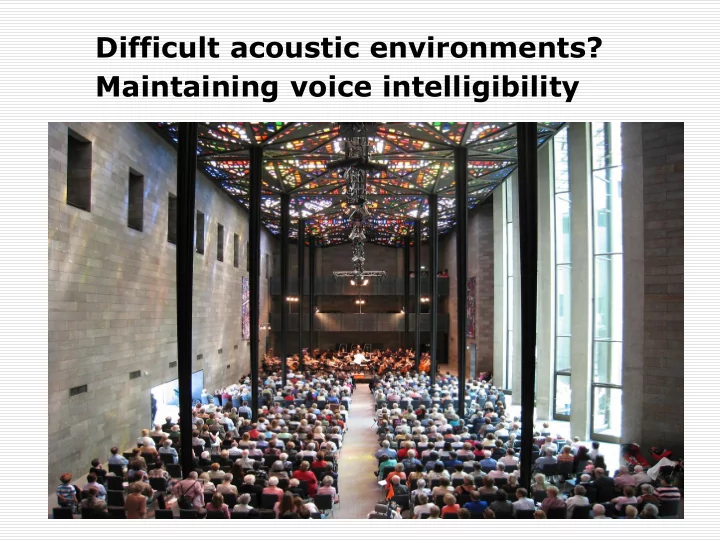
Maintaining voice intelligibility Difficult acoustic environments?
SLIDE 2
Mechanics of the hearing circuit
SLIDE 3
Mechanics of the hearing circuit
Why don’t Hi-Fi Audiophiles all own the same sound system
SLIDE 4
Don and Carol Davis
Another take on why we hear differently
(In-The-Ear Microphony)
SLIDE 5
Mechanics of the hearing circuit
Friends, Romans and countrymen, lend me your ears! (From the pinna onwards)
SLIDE 6 Mechanics of the hearing circuit
The video referenced here can be viewed on YouTube at https://www.youtube.com/watch?v=PeTriGTENoc (or search YouTube for “Auditory Transduction”)
SLIDE 7
Mechanics of the hearing circuit
30 dB gain thanks to levers and hydraulics
SLIDE 8
Listening through a pipe?
The outer ear canal
SLIDE 9
So we can settle on the idea that any two people will not be hearing with the same polar pattern
SLIDE 10
This suggests that measurement conventions are a guide and not an infallible reference
SLIDE 11
Moving to the venue
So much for hearing, we will return focus to the room and its reaction to an installed speaker system
SLIDE 12
Out with the old and in with the new
SLIDE 13 The masking influence of reverberation
SLIDE 14
What is critical distance?
Critical distance is that point in the room where the reverberant sound and early reflections are at the same SPL as the direct sound from the FOH speakers
SLIDE 15
Room reflections have a number of detrimental side effects
SLIDE 16
Every venue space is different – with the same intelligibility problem
Venues can be divided into two primary classes
Public spaces - announcements and background program Performance spaces – full range audio with both speech and music
SLIDE 17
Hearing the announcement
Public spaces
Airports, railway stations, retail shopping areas, public plaza
Once the domain of small 100V speakers, people now want more fidelity and performance
SLIDE 18 Distributed systems
Not limited to the cheap and nasty (Quantity can have a quality all its own)
A large number of small format ceiling speakers overlapping in mid-high coverage can provide excellent coverage with minimum echo
Joseph Stalin -1943
SLIDE 19 Distributed systems
This Haas to be a good idea
Large numbers of small format ceiling speakers overlapping in mid-high coverage can provide excellent coverage with minimum echo For complex program, the human ear will blend two or more sound sources seamlessly up to around 35-40 milliseconds
SLIDE 20
Distributed systems
This Haas to be a good idea
The effect doesn’t really come to full force until the time difference reaches 5 milliseconds
SLIDE 21
Distributed systems
So what is the ideal spacing for intelligible voice
SLIDE 22 Full range PA systems in performance venues are much harder to solve
Performance venues
Auditoriums, houses of worship, Multi purpose venues, nightclubs,
A wide range of audio solutions with varying degrees of cost and success Here the Haas Effect and the delay ring can be a great tool
SLIDE 23
Modern venues will most likely be reverberant spaces
Spot the areas of audio shadow – A delay system candidate
SLIDE 24
The Reverberant Field
The reflections collapse into a random field of micro echoes in a ‘big swoosh’ as the energy dissipates through out the room RT60 is the time that it takes the reverberant sound to decay 60 dB.
SLIDE 25
Handling the Reverberant Field
The common denominator when it comes to the intelligibility issue is too much acoustic energy in the wrong place.
SLIDE 26
What is a delayed system?
The inverse law chart we started with a sound wave SPL of 120 dB. Even though a concert array is capable of 145dB peaks, we will have a big drop in level. To compensate we can add extra speakers in front of the main array. But there is a problem.
SLIDE 27 The Answer – Concentric delayed sound
Add more boxes just before the physical point where the volume drops to too low a level. This is the delayed system
Pictured is a front of house supported by a delayed system behind the mixing position.
SLIDE 28 It doesn’t need to be big to need a delay.
A front of house supported by one or two delay lines fixes the coverage and SPL problem.
SLIDE 29
How is it done without the whole area being drowned in echoes and reflections?
Loudspeaker Synchronization with a digital delay
SLIDE 30
How to set the delay times
In the early days, a sound guy would be running around the building with a tape measure but now there is an easier way so back to Haas. The Precedence (Haas) Effect: Aligning the Acoustic Image
SLIDE 31
How to set the delay times
SLIDE 32 Back at the venue
We must delay the sound from the under-balcony speaker to synchronize the signals. Do we set the digital delay to 76 or 84 milliseconds? Obviously, the geometry will not allow us to exactly synchronize every location under the balcony; we have to compromise.
SLIDE 33 Technique to time out-fill, or under-hang components
In the situation where front fill is required, the front fill is closer than the flown cluster and should be delayed. The sound
- perator will estimate the
distance to the flown boxes and add 15 ms. The image will then appear to come from the flown cluster and stage.
SLIDE 34
So to the question of room acoustics and intelligibility
SLIDE 35
Intelligibility as an energy problem
SLIDE 36
The conventional point source array Tangential waves and interference
SLIDE 37
Point source asymmetrical distribution in a horizontal array
SLIDE 38
Asymmetrical distribution in the vocal range
SLIDE 39
Horn drivers also require favourable geometry for the wave to transition to the horn flare without adding further phase and wave reflection problems
Getting a driver to work on an asymmetrical flare is a challenge
SLIDE 40
Horn drivers
How does a compression driver work?
SLIDE 41
Horn drivers
How does a compression driver work?
SLIDE 42
Phase plug
How does a compression driver work?
SLIDE 43
Phase plug design covers many disciplines
SLIDE 44
Want is Impedance Matching (Acoustic)
SLIDE 45
Impedance matching the horn
How does a compression driver work?
SLIDE 46
All compression drivers have issues - the wider the frequency range the more issues This lumpy and resonant waterfall plot is not uncommon
SLIDE 47
Digital audio processing is the new black (box)
A corrective technology is not an ideal solution compared to fixing the problems at the source
SLIDE 48
Asymmetrical projection that is reasonably phase coherent?
SLIDE 49
There are plenty of computerised fluid flow models – some work for audio
SLIDE 50
Back to the question of energy control
SLIDE 51
Uniform coverage is possible under most circumstances
SLIDE 52
Other people have given this a try with variable results
SLIDE 53
The Quest solution can be applied in a number of ways.
SLIDE 54
A three box array covering a 900 seat venue
SLIDE 55
A multi-purpose system that is not a compromise
SLIDE 56
Light weight is important for when designers haven’t made structural provision for a PA
SLIDE 57
The rigging is designed to give coverage choices
SLIDE 58
So despite the potential for comb filtering, lobbing and other undesirable effects, there was not a “dead” seat in the building
Whether a line array, point source system, delay system, distributed system or a combination of some or all the above, each option is a tool in a toolbox Understanding the limits of the tools and how they could fit together is the key
SLIDE 59
The Future is not the past
SLIDE 60
Ultimately is needs to work in the real world