Integrating CC CC in Res esearch, T Tea eaching & & - - PowerPoint PPT Presentation

integrating cc cc in res esearch t tea eaching hea ealth
SMART_READER_LITE
LIVE PREVIEW

Integrating CC CC in Res esearch, T Tea eaching & & - - PowerPoint PPT Presentation

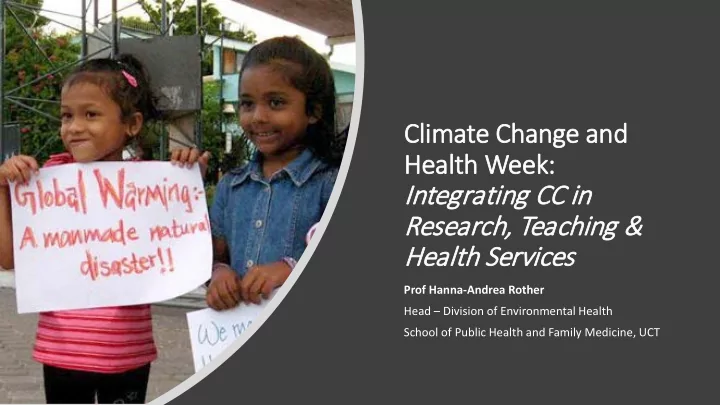
Cl Climate Ch Change a and Health W Week eek: Integrating CC CC in Res esearch, T Tea eaching & & Hea ealth S Ser ervices Prof Hanna-Andrea Rother Head Division of Environmental Health School of Public Health and


slide-1
SLIDE 1

Cl Climate Ch Change a and Health W Week eek: Integrating CC CC in Res esearch, T Tea eaching & & Hea ealth S Ser ervices

Prof Hanna-Andrea Rother Head – Division of Environmental Health School of Public Health and Family Medicine, UCT

slide-2
SLIDE 2

Introduc uction n – Purp rpose of C CC & Health th Week

  • American Public Health Association (APHA)

at 2017 conference encouraged for all health related work to include climate change

  • Inspiration for Division of EH CC and Health

week spearheaded by Mary Miller – Fulbright Visiting Scholar in SPHFM

  • For all staff and students to ponder how to

include CC in their current work/studies or to expand on current focus.

slide-3
SLIDE 3

To Today’s Pro rogra ramme for En r Engaging with C CC in

  • ur W

r Work rk

  • Andrea Rother - Introduction
  • Christie Godsmark - Climate Change and Health Christie - A Call to Action
  • James Irlam - Primary Health Care Implications
  • Leslie London - Human Rights Issues
  • Sheona Shackleton - ACDI’s activities
  • Student Reps James van Duuren & Robyn Kamau (SHAWCO) & Refilwe

Mofokeng (Green Campus Initiative)

  • Andrea Rother: Q&A/discussion (and Mentimeter Word Cloud)
slide-4
SLIDE 4

WHO CC & Health Facts – Research / / Teaching Areas – What’s M Missing?

  • Climate change impacts social and environmental determinants of health –

clean air, safe drinking water, sufficient food and secure shelter.

  • 2030 and 2050 - CC predicated to impact approximately 250 000 additional

deaths per year, from malnutrition, malaria, diarrhoea & heat stress.

  • Direct damage costs to health (i.e. excluding costs in health-determining sectors

such as agriculture and water and sanitation), is estimated to be between USD 2- 4 billion/year by 2030.

  • Areas with weak health infrastructure – mostly in LMIC – least able to cope

without assistance to prepare and respond.

  • Reducing greenhouse gases emissions through better transport, food & energy-

use choices can improve health, particularly through reduced air pollution.

http://www.who.int/news-room/fact-sheets/detail/climate-change-and-health

slide-5
SLIDE 5

What t are th e the r res esearch, t , tea eachin ing & & hea ealt lth s ser ervic ices

  • p
  • pportunit

itie ies f for

  • r U

UCT staff a f and s stu tudents?

Source: CDC - https://www.cdc.gov/ climateandhealth/eff ects/default.htm

 What areas relevant for LMIC are not being researched?  What opportunities are we missing?

slide-6
SLIDE 6

Curr rrent Postgrad S Student Research Topics in Divi vision of En Envi vironmental Health

PhD:

  • Climate change impact on Zimbabwean farmers exposure to

endocrine disrupting pesticides

  • Climate related heat stress and South African outdoor workers

MPH:

  • Climate change, air quality and child asthma cases in WC
  • Climate change impact on food insecurity and disaster management

in WC

  • Climate change impact on violent behavior
  • Impact of temperature increases on urban pests and use of

pesticides in WC

slide-7
SLIDE 7

Divi vision of EH EH CC Work rk

  • CC & Health in the WC
  • CHEC/WCG – Christie presenting
  • Health Policy - WUN collaboration –NCDs & CC; International

Consortium for Urban Environmental Health & Sustainability

  • GCRF Application 1 – Clean Air Low Carbon Cities - Global
  • GCRF Application 2 – Networking Air Pollution & NCDs Africa
  • Building an environmentally sustainable medical curriculum &

CC in Medical Curricula –

  • AMEE & international collaborators
  • CSIR – heat stress WfW, Vulnerability, PhD Pesticides & EDCs
slide-8
SLIDE 8
slide-9
SLIDE 9
slide-10
SLIDE 10

WUN UN collaboration

  • n Chapter

er In Pres ess

Chapter 23 A Collaborative Framework Highlighting Climate Sensitive Non-Communicable Diseases in Urban Sub-Saharan Africa Rother, Hanna-Andrea1#, Sabel, Clive E.2#, and Vardoulakis, Sotiris3*

1Professor and Head, Division of Environmental Health, School of Public Health and Family Medicine, University of Cape Town, South Africa 2Professor, Department of Environmental Science, Aarhus University, Denmark 3Research Director, Institute of Occupational Medicine, Edinburgh, U.K.

*Co-Chair and #Members, Healthy-Polis International Consortium for Urban Environmental Health and Sustainability (www.healthy-polis.org) Abstract Climate change vulnerabilities are key environmental and social determinants of health, particularly in Africa where public health and other infrastructure are not yet geared toward counteracting the potential impacts of changing climates. Health related climate change adaptation research for Africa is limited and what research has been conducted is not effectively translated into practical advice for decision makers. A World University Network (WUN) collaboration started in 2016 and continues to research on climate change impacts on non-communicable diseases (NCDs) in global, including African, urban areas. This interdisciplinary collaboration, established through the Healthy-Polis International Consortium for Urban Environmental Health and Sustainability, focuses on the intersection of health, climate, and sustainability within urban environments through innovative research methods, co-production of knowledge, capacity building (including research translation and training), and intervention development and evaluation. NCDs (e.g., cancers, asthma, diabetes, cardiovascular disease, mental health) are on the increase in African urban areas and can be further aggravated by climate change. If NCDs and the climate nexus are unaddressed,
slide-11
SLIDE 11

CC and Health T Teaching Programmes in DoEH – Sch chool o

  • f Public Health

th & Family Medici cine

  • Master of Public Health (MPH) –

Environmental Health Track

  • Climate Change, Pollution and Health

Course

  • Children’s Environmental Health Course
  • 4th year Medical Student Block
  • Environmental Health (environmental

history taking) and Climate Change (the role of the health professional)

slide-12
SLIDE 12

Opport rtunities f for I r Including CC i in L LMIC W Work rk

  • Climate change impact on HIV/AIDs
  • CC impact on Women’s Health
  • CC impact on Men’s Health
  • Economics of CC
  • Ethical, social & behavioural impacts of

CC

  • Medicine’s role in mitigating CC effects
slide-13
SLIDE 13

ENGAGE DISCUSS ACT

slide-14
SLIDE 14

CLIMATE C TE CHA HANGE A AND D HE HEALTH W WEEK EK SEMINARS 1 13-16 A August 2 t 2018

  • Tuesday 14 August: 16:00-17:30 - Post Graduate Seminar 1, Barnard Fuller

SEMINAR: Dr Sophie Cairncross-Kisting - Climate Change and the Health System in South Africa

  • How our Public Institutions need to anticipate health impacts of Climate Change
  • Wednesday 15 August: 17:00 - 19:00 - Wolfson Auditorium

PRESENTATION AND PANEL: National Policy, Emergency Preparedness & Local Initiatives

  • James Irlam: Introduction
  • Bono Nemukula - Deputy Director: Environmental Health - Climate Change

▪ SA National Dept of Health - National Government Policy (TBC)

  • Professor Edda Weimann - Paediatric Endocrinologist - Green Hospitals
  • Robyn Kamau, 3rd year medical student; SHAWCO representative
  • Tristan Gorgens – Western Cape Government - Disability and Climate Change (TBC)
  • Thursday 16 August: 12:00-13:00 – Falmouth Building, 1st Floor, Seminar Room 2

SEMINAR: Andrea Rother & Team

  • Q-storming: Interactive session learning how to integrate climate change into your current work
  • Facilitated by Prof Hanna-Andrea Rother, HoD, Environmental Health)
  • Discussion of Faculty Survey

Visit Our New Web Page: Climate Change and Health

slide-15
SLIDE 15

What w word descri ribes the action y you c can take to incorp rporate h health a and c climate change into your r curr rrent w work rk and teaching?

  • Log into Mentimeter
  • Go to www.menti.com and use the code 72 65 31
slide-16
SLIDE 16

What w would prevent you from including CC in your r curr rrent w work rk?

  • Log into Mentimeter
  • Go to www.menti.com and use the code 36 95 2