Integrated Service Delivery Integrated Care Programs Center of - - PDF document

integrated service delivery integrated care programs
SMART_READER_LITE
LIVE PREVIEW

Integrated Service Delivery Integrated Care Programs Center of - - PDF document

7/28/2016 Prevalence of Affective Disorders in Patients With and Without Medical Comorbidities Integrated Behavioral Health Care via Telepsychiatry No medical illness 14 1 medical illness 12.9 12 P <.01 10 9.4 Meera Narasimhan, MD 8 8.4


slide-1
SLIDE 1

7/28/2016

Integrated Behavioral Health Care via Telepsychiatry

Meera Narasimhan, MD Associate Provost University

  • f South Carolina

& Professor and Chair Department of Neuropsychiatry and Behavioral Science USC-SOM

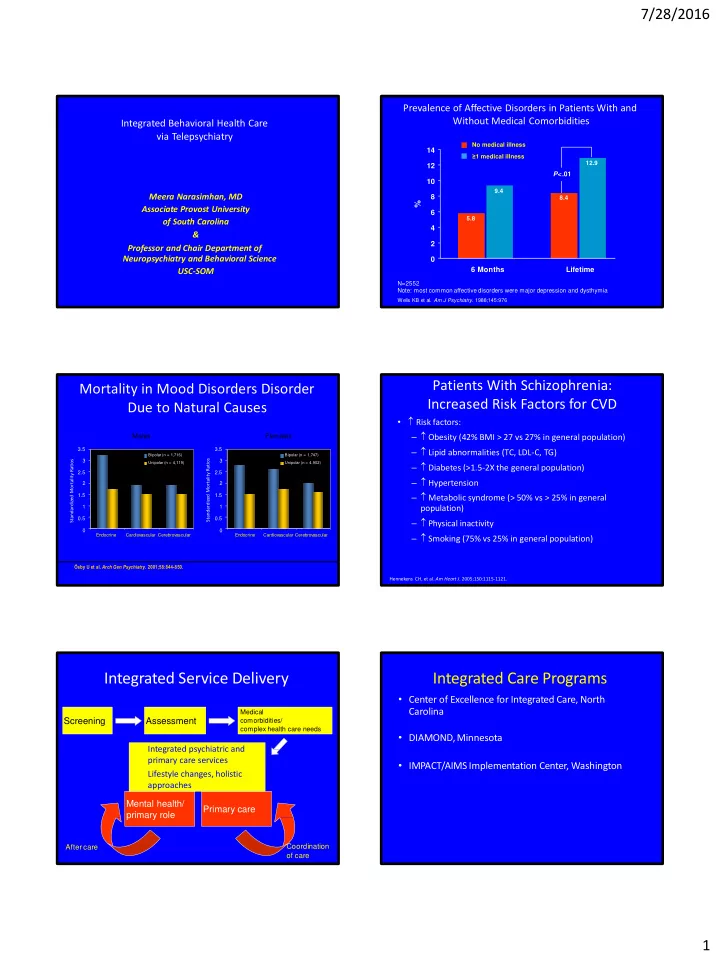
Prevalence of Affective Disorders in Patients With and Without Medical Comorbidities

N=2552 Note: most common affective disorders were major depression and dysthymia

Wells KB et al. Am J Psychiatry. 1988;145:976

2 6 4 10 8 12 14 6 Months Lifetime

No medical illness ≥1 medical illness P<.01

%

5.8 9.4 8.4 12.9

Mortality in Mood Disorders Disorder Due to Natural Causes

Males Females

2 1.5 1 0.5 3 2.5 3.5 3.5

Bipolar (n = 1,747) Unipolar (n = 4,902)

Ősby U et al. Arch Gen Psychiatry. 2001;58:844-850. Hennekens CH, et al. Am Heart J. 2005;150:1115-1121. Standardized Mortality Ratios Standardized Mortality Ratios 2 1.5 1 0.5 3 2.5

Bipolar (n = 1,716) Unipolar (n = 4,119) Endocrine Cardiovascular Cerebrovascular Endocrine Cardiovascular Cerebrovascular

Patients With Schizophrenia: Increased Risk Factors for CVD

  •  Risk factors:

–  Obesity (42% BMI > 27 vs 27% in general population) –  Lipid abnormalities (TC, LDL-C, TG) –  Diabetes (>1.5-2X the general population) –  Hypertension –  Metabolic syndrome (> 50% vs > 25% in general population) –  Physical inactivity –  Smoking (75% vs 25% in general population) Assessment Primary care Mental health/ primary role

Medical comorbidities/ complex health care needs

Screening

Integrated Service Delivery

Integrated psychiatric and primary care services Lifestyle changes, holistic approaches

After care Coordination

  • f care

Integrated Care Programs

  • Center of Excellence for Integrated Care, North

Carolina

  • DIAMOND, Minnesota
  • IMPACT/AIMS Implementation Center, Washington

1

slide-2
SLIDE 2

7/28/2016

T elepsychiatry – Overview

  • Access to optimal mental health care1,2
  • Reduce health disparities 3
  • Social determinants, minority, rural counties
  • Offers a host of benefits
  • Several challenges: licensure, state regulations

Thomas KC, et al. Psychiatr Serv. 2009;60:1323‐1328. Mohr DC, et al. Ann Behav Med. 2006;32:254-258. Grady B, et al. Telemed J E Health. 2011;17:131-148

Barrier to Care

  • Shortage of Mental Health Providers
  • Rural Counties: transportation, costs
  • Time constraints
  • Attitude and stigma

Psychiatry

Psychoanalysis Psychopharma cology Implementation Science Improvement Science Digital Personalized Medicine & Population Health

Tele mental health or Telepsychiatry

  • Telemedicine refers communications

technologies and electronic information to provide and support health care when distance separates the participants

  • It has applications in clinical care, education

and research

  • Reduce health disparities in patient

Benefits of T elepsychiatry

  • Telepsychiatry may be a feasible means to deliver

psychotherapy and pharmacotherapy.

  • Improves access to care in rural, underserved areas, reduce

cost over time, decreased costs for patients and systems. Lower attrition rate and similar levels of patient satisfaction as compared to person

Jenkins-Guarnieri MA, et al. Telemed J E Health. 2015;21:652-660. Mohr DC, et al. JAMA. 2012;307:2278-2285. Leigh H, et al. J Telemed Telecare. 2009;15:286-289.

Various Clinical Settings

  • Inpatient
  • Outpatient
  • Veterans Administration
  • Correctional Facilities
  • Nursing Homes
  • Primary Care Clinics
  • Home Based
  • Rural Settings

2

slide-3
SLIDE 3

7/28/2016

Reimbursement Policy for Telehealth

  • State policies for telemental health vary in specificity and scope

– Map represents state rankings for Medicaid coverage of mental and behavioral health services provided via telemedicine, based on scope and conditions of payment Thomas L, et al. http://www.americantelemed.org/policy/state-policy- resource-center. Accessed February 11, 2016.

Considerations for Telepsychiatry Implementation

  • Technological competence
  • Licensure and other liability issues
  • HIPAA compliance, and disclaimer language
  • Confidentiality and security measures
  • Reimbursement
  • Data storage and technical issues
  • Management of emergent situations and safety protocols
  • Therapeutic alliance
  • Acceptance by providers

T elehealth

  • Tele Stroke Network
  • TeleID
  • Telepsychiatry

PRIMARY STROKE CENTER

The REACH Virtual & Collaborative Healthcare Model – Clinical Workload Balance

Physician

  • Laptop/PC
  • Standard Web cam
  • Internet access

Hub

  • Tertiary Medical or

Referral Hospital * Recommended/provided by REACH

Spoke

  • Cart*
  • CT scanner
  • Internet access

TelePSYCHIATRY

A New Frontier in Improving Access, Affordability, Efficiency, Costs and Clinical Outcomes

3

slide-4
SLIDE 4

7/28/2016

NRI Presentation April 13-16, 2009 20 20

All Maine & South Carolina ER Visits per Thousand Members in Group per Year (ME/SC Study

5000 4000 3910 1730 1680 880 1123 1394 3011 615 1000 2000 3000 MH Dx SA Dx MH & SA Dx No MH/SA Dx Maine SC

A Deeper Look at Medical Co-morbidities – South Carolina

Cardiometabolic Risk

7.8% 8.7% 7.7% 4.7% 13.6% 13.6% 8.6% 18.6% 12.1% 13.5% 5.7% 17.0%

0% 5% 10% 15% 20% Diabetes Lipidosis Other Nutritional (includes obesity) Hypertention

None Non DMH-MH DMH-MH

Narasimhan et al, NASMHPD Research Institute, 2009

The Uniqueness of the Telepsychiatry Project

  • Largest ED telepsychiatry project in the nation!!!
  • 30,000 patients in 22 ED, 3 more coming on board
  • Public, private and academic partnership.
  • Policy Practice and Research
  • Data warehouse all-payer state database in healthcare.
  • Opportunity to rigorously study the impact of this novel

intervention on outcomes

  • Contextual factors that may allow the program to be

disseminated to other states.

Quality, Utilization, tEconomic Impact and Sustainbility of Telepsychiatry, (National Institute of Mental Health funded R01) Aim 1: To examine the impact of telehealth on access and quality of

mental health care at both an individual and Emergency Department levels ( LOS, hospitalization and 30 day follow-up). Aim 2: To examine the individual, ED, and community-level moderators of the telehealth program. Aim 3: To conduct a budget imanalysis

Outcomes

  • Lower rates of inpatient admission from the ED in the 30 days

after telepsychiatry compared to the ED encounters with no telepsychiatry (8% vs 19%; p< 0.01)

  • Shorter lengths of stay than those in the control group (4.1

days vs. 6.2; p < 0.01 days for any hospitalization) and

  • 30 day outpatient follow-up than patients who received no

telepsychiatry (38% vs. 13%; P < 0.01) and

  • 90 day follow-up than those who received no telepsychiatry

(46% vs. 17%; P < 0.01).

4

slide-5
SLIDE 5

7/28/2016

Staff and Physician Perceptions of Telepsychiatry Program

8 9 .5% 4 % 5 % 6 % 7 % 8 % 9 % 1 %

S atisfaction w ith E fficie n t U se

  • f C
  • m

fort w ith Im proved P atie n t Te c h no logy Tim e Tele p s ychiatry C are a n d S ervices

Patient Perceptions of Telepsychiatry Program

80.4% 81.8% 50% 40% 100% 90% 80% 70% 60% Satisfaction with Satisfaction with Services Process

Successful Integrated Models

Telehealth Other Digital technologies iPad Integration Health apps Health Coach

Patient Centerednesss

Primary Provider Specialty Care

27

Summary

  • Telepsychiatry may improve access to mental

health care1 and offer multiple benefits

  • Telepsychiatry may be acceptable for use among

patients within several psychiatric settings.

  • Telepsychiatry is a feasible for use among various

underserved patient populations

  • Telepsychiatry may offer advantages to all

stakeholders in the service and delivery of mental health care, ie, patients, providers, and payors

5

84.3% 84.1% 77.1%