Instructions and Directions Aim Being able to develop instruction - - PDF document

instructions and directions
SMART_READER_LITE
LIVE PREVIEW

Instructions and Directions Aim Being able to develop instruction - - PDF document

INF3280 28 Jan 2015 Instructions and Directions Aim Being able to develop instruction sheets and videos Being able to develop a skill training session Being able to do Assignment 1 Literature Textbook chapter 2


slide-1
SLIDE 1

Jens Kaasbøll INF3280 — 28 Jan 2015

Instructions and Directions

  • Aim

– Being able to develop instruction sheets and videos – Being able to develop a skill training session – Being able to do Assignment 1

  • Literature

– Textbook chapter 2

  • Additional literature
  • Clark (2007) Leveraging multimedia for learning: Use instructional

methods proven to align with natural learning processes

1

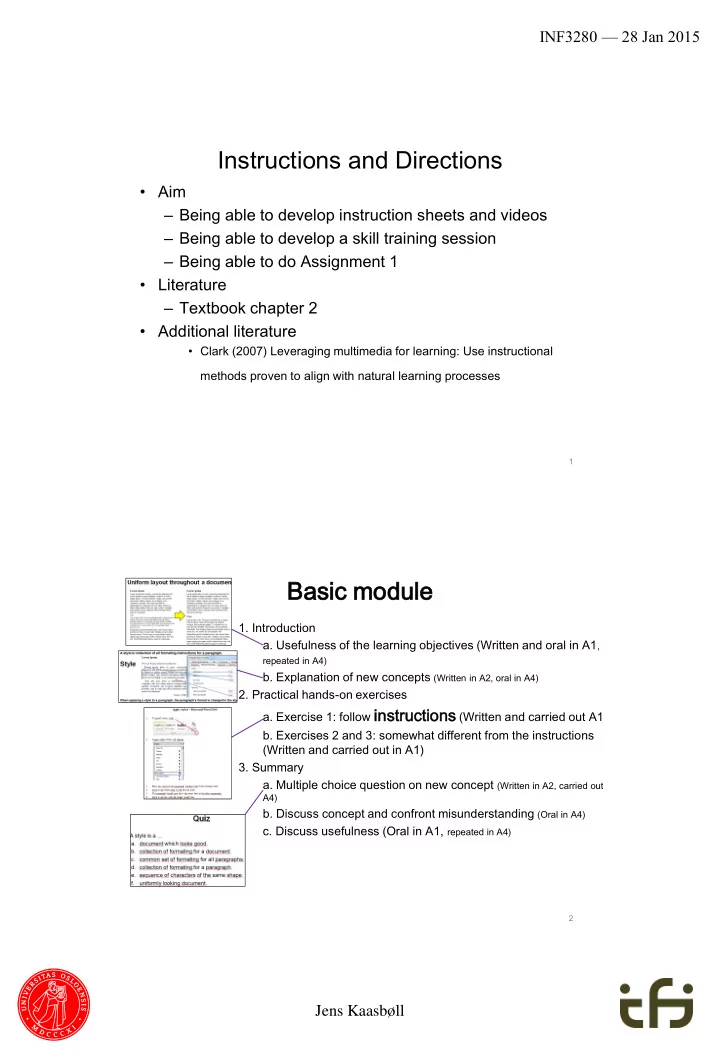
Basic c module e

  • 1. Introduction
  • a. Usefulness of the learning objectives (Written and oral in A1,

repeated in A4)

  • b. Explanation of new concepts (Written in A2, oral in A4)
  • 2. Practical hands-on exercises
  • a. Exercise 1: follow instruc

structio tions (Written and carried out A1)

  • b. Exercises 2 and 3: somewhat different from the instructions

(Written and carried out in A1)

  • 3. Summary
  • a. Multiple choice question on new concept (Written in A2, carried out in

A4)

  • b. Discuss concept and confront misunderstanding (Oral in A4)
  • c. Discuss usefulness (Oral in A1, repeated in A4)

2

slide-2
SLIDE 2

Jens Kaasbøll INF3280 — 28 Jan 2015

Improving skills

  • IT user skill

– Competence of using IT

  • Learning

– Development of competence that provides a relatively stable change of behaviour

  • Two ways of learning skills

– New skill: imitation

  • Observing others’ behaviour
  • Random
  • Teachers’ instructions
  • Instruction videos
  • Instruction sheets

– Improving skill: repeating it

3

Instructions

IT

Repeat Imitate Skills Skills

Navigate

  • Already understand

functionality

  • Learn

– Find where re functionality is located in the user interface Directions Instructions

IT

Repeat Imitate Navigate Skills Understanding Skills

4

slide-3
SLIDE 3

Jens Kaasbøll INF3280 — 28 Jan 2015

Perception — Closeness

  • People group stimuli

– Located closely together – Constituting expected shapes – Similar

  • Shape
  • Font
  • Colour

5

1 2 3

Demonstrating with projector

  • Point to what you are talking about
  • The cursor

– when moving it

6

slide-4
SLIDE 4

Jens Kaasbøll INF3280 — 28 Jan 2015 Guiding the user through a series of operations  Sequential Basis for imitation  Recognisable Users interested in doing, not reading  Short Avoid getting stuck  Complete

7 Photo: LIFE free-best-wallpaper.com

Instructions for Imitation

KISS – Keep It Small and Simple Sequential

Numbered sheet Video Instructor actions

8

1 2 3

slide-5
SLIDE 5

Jens Kaasbøll INF3280 — 28 Jan 2015

Recognisable

Screenshot Example

9

  • Recognisable format
  • Unrecognisable content

 Content does NOT attract attention

Short

One page or slide or minute

  • Example

No example

  • Operations

Options could have been removed

10

slide-6
SLIDE 6

Jens Kaasbøll INF3280 — 28 Jan 2015

Complete

  • All steps
  • Often forgotten

– Last step of saving, etc

  • Last step should allow for feedback

– Visible result – Checking whether the goal is achieved

11

  • 1. Click where you want to create the table.
  • 2. Click Table, and then click Draw Table.

The pointer changes to a pencil.

  • 3. To define the outer table boundaries, draw a rectangle.
  • 4. Draw the column lines and row lines inside the rectangle.

Directions for Navigation

  • Functio

ctionali lity ty

  • Where

re to locate it

12

Functionality

Draw a table You can draw a complex table — for example, one that contains cells of different heights or a varying number of columns per row. 1.Click where you want to create the table.

  • 2. Under Insert, click Table, and then click Draw Table.

The pointer changes to a pencil. 3.To define the outer table boundaries, draw a rectangle. 4.Draw the column lines and row lines inside the rectangle.

Instructions

slide-7
SLIDE 7

Jens Kaasbøll INF3280 — 28 Jan 2015

Locating directions

  • Designers’ terms do not match users’

80% - 90% cases

  • Users do not find the button for the functionality

– The button has an unfamiliar name – There are maaaaaaaany buttons and menu choises  Users look up in software documentation – Users do not find the place for the functionality – The documentation uses an unfamiliar name

13

Directions should be written by users

14

– Blogs – E-mail groups – Frequently Asked Questions

  • Access for general software
  • Internal business information systems

– Links from user interface – Intranet search – Skills

slide-8
SLIDE 8

Jens Kaasbøll INF3280 — 28 Jan 2015

  • Screen capture

Snipping Tool

  • Windows 2007

Applications  Accessories  Take Screenshot  Grab

  • Ubuntu Linux
  • Media generation

Slides

Google Presentation Impress PowerPoint Prezi

Tools for making instruction sheets

15

Professional production of user documentation

  • Screenshots

– Portable Network Graphics format .png

  • Graphics and text

– Scalable Vector Grahics format .svg

Adobe Illustrator CSS Inkscape (freeware)

  • DocBook or another XML storage format .xml

Tagged text format Similar to HTML

Serna Free emacs

 Basis for generation in any media

16

3

slide-9
SLIDE 9

Jens Kaasbøll INF3280 — 28 Jan 2015

Technical production sequence

17

Text DocBook XML DocBook XSL Stylesheets Multiple output formats

DocBook only specifies the content. Stylesheets transform DocBook XML to a presentation format.

Vector graphics Screenshots

Videos

  • Four principles

– Medium is sequential – Screenshot video is recognisable

  • Example should be well known

– One minute length

  • One example of the operation
  • The learner can replay

– Complete

  • Include start and stop
  • Replace written text with oral
  • Only essential mouse movements

18 Photo: LIFE free-best-wallpaper.com

slide-10
SLIDE 10

Jens Kaasbøll INF3280 — 28 Jan 2015

Making videos from the computer screen

19

  • 1. Screenshots

 A series of frames

  • 2. Editing frames
  • 3. Rendering

 Video files

  • Animated vector graphics – Flash .swf
  • Compressed video – MPEG-4 .mp4

20

  • 1. Recording

File  New  Choose Screen or Window Alt/Pause – Switching capture on/off

  • 2. Edit frames with Properties, right column
  • 3. Project  Render

Detailed instructions INF3280 website  Syllabus/achievement requirements  Under the headline Tutorials

slide-11
SLIDE 11

Jens Kaasbøll INF3280 — 28 Jan 2015

Instructions in learning

  • Some users don’t follow instructions

– Those with poor skills – Those who already know a way

21

Written instructions Video instructions Trainer demonstrating with projector

Concrete Abstract

Trainer’s instruction

22

  • A. Learners quickly forget details of computer operation
  • B. Reviewing training material is twice

ce as successful as searching for help when solving problems

 Always include instruction sheets or videos in training

  • C. Imitating a person is easier than imitating anything else
  • D. Low skilled users do not follow instructions

Novices or complex tasks

 Also demonstrate at the projector

slide-12
SLIDE 12

Jens Kaasbøll INF3280 — 28 Jan 2015

Development process

23

Review Developer test Learner test Identify functionality Make the sheets/video Divide into one page/minute chunks

Learner tests

24

  • Give the learners the instructions
  • Observe closely what they do
  • Note down when they

– deviate from the instructions – get stuck

  • Afterwards

– Ask them about what happened when they did not follow the instruction – Where they got stuck

  • Check the instructions