
SLIDE 1
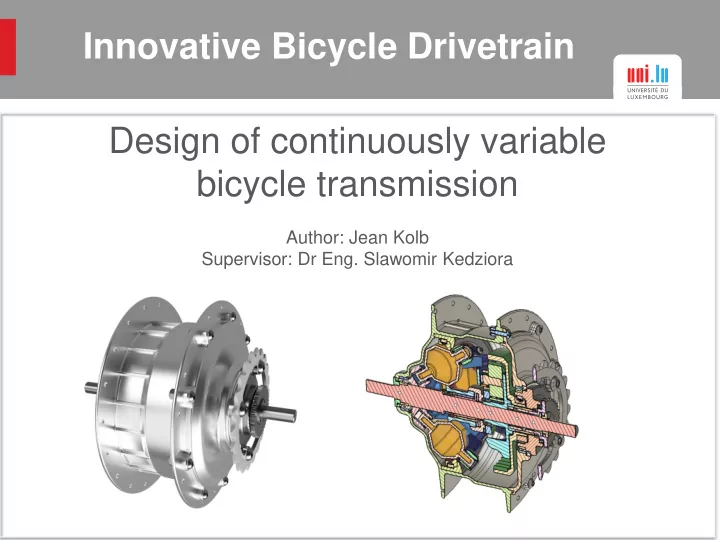
Design of continuously variable bicycle transmission
Author: Jean Kolb Supervisor: Dr Eng. Slawomir Kedziora
Innovative Bicycle Drivetrain Design of continuously variable - - PowerPoint PPT Presentation
Innovative Bicycle Drivetrain Design of continuously variable bicycle transmission Author: Jean Kolb Supervisor: Dr Eng. Slawomir Kedziora Chain drive with derailleur change mechanism 98.5% efficiency Relatively low weight The most
Author: Jean Kolb Supervisor: Dr Eng. Slawomir Kedziora
Source: https://www.fallbrooktech.com/nuvinci-technology
Autodesk Fusion 360 unites every development step Cloud computing
Upstream planetary gear train Input Input Sprocket
Input torque on ring gear Fixed carrier
Output
Planetary roller train Input
Input torque on sun roller Non-rotatable but on axle
Output
Preloaded spring to guarantee enough traction Wave spring
Needle bearings Left handed thread
Radial bearing on slidable sleeve Axial bearing gets pushed Left handed thread Gap between roller and sun
Spline
Control sleeve gets rotated Spiral groove Rod slides in guideway Roller carrier attached on rod
Rod Roller carrier Control sleeve
Low ratio High ratio
Crank set to rear sprocket
0.5
Planetary gear train (Step 1) ->
0.37
Planetary gear train (Step 2) ->
1.82
Planetary roller train -> 1.5 to 6
Lowest ratio = 0.5 Highest ratio = 2 400% ratio range
(Ratio) (Roller carrier displacement in mm) 12.95
75 W at 60 rpm for 30 minutes 12 Nm input torque Maximum peak 200 W
Over-locknut-dimension
Axle threads on both sides: M10 x 1 Flange width
Number of spoke holes
75 W
Source: Bicycling Science, Second Edition 2nd Edition, Frank Rowland Whitt, David Gordon Wilson, ISBN-10: 026273060X
Static linear analysis Reaction forces have been calculated Parabolic mesh – second order tetra element Fusion cloud computing
Roller planet Axle Control sleeve (part 1) Control sleeve (part 2) Gear carrier Roller ring Sprocket-ring gear assembly Roller sun Roller carrier Enclosure
Aluminium 201.0-T6 Casting Alloy Yield strength : 435 MPa Fatigue strength : 135 MPa Maximal principal stress : 83.8 MPa
0.022 mm displacement on planet gear location
Analysed with ANSYS software Wheel assembly with pretension spokes, rim and
Aluminium 201.0-T6 Casting Alloy
400% ratio range
2.7 kg weight
Limited space for the design
Selection of the right lubrication Simplification of certain components Weight reduction Fatigue analysis