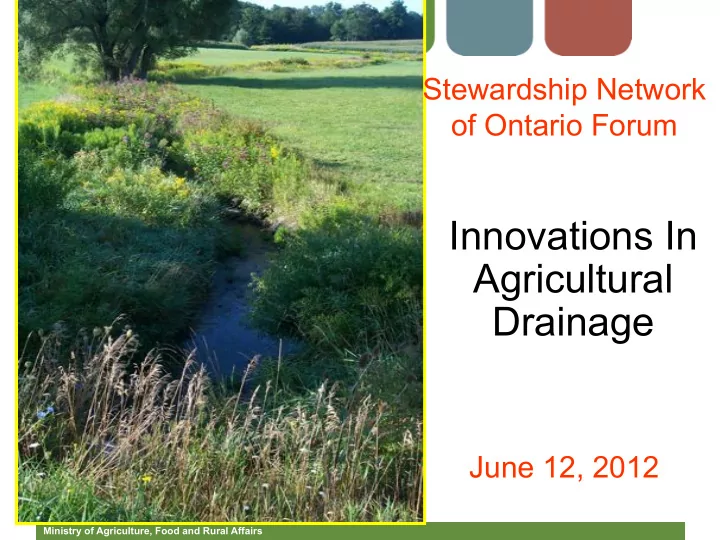
SLIDE 1 Stewardship Network
Innovations In Agricultural Drainage
June 12, 2012
Ministry of Agriculture, Food and Rural Affairs
SLIDE 2 What is Agricultural Drainage?:
- Majority of soils in agricultural parts of the province are
poorly drained or have a confining layer
- Significantly limits crop growth
- This would be similar to a flower pot without holes in
the bottom to drain the gravitational water
– Private cropland drainage systems – Communal drainage system improvements
SLIDE 3 AGRICULTURAL DRAINAGE WHAT IS IT? Subsurface Drainage
installed beneath the land surface
600mm (2 ft)
750mm (2.5 ft)
depending on crop, soil, drainage need and economics
SLIDE 4
CONTROLLED DRAINAGE
SLIDE 5 Controlled Drainage:
- Reduces outflow from the tile drainage system
- Reduces movement of nitrogen and soluble
phosphorus
SLIDE 6
BIOFILTERS
SLIDE 7 Biofilters:
- Craig Merkley, UTVCA
- Removal of nitrates - 50% +
- Doesn’t have to interfere with agricultural
- perations
SLIDE 8
COMMUNAL DRAINAGE SYSTEMS The Drainage Act
SLIDE 9
- Attributes of the Drainage Act:
- Means of solving drainage problems through the
implementation of a “drainage works”
- Design is developed through a public process
administered by local municipality
- Professionally designed
- Costs are shared among property owners
- Legal existence
- Right of use of private land
- Municipality is responsible for management
SLIDE 10 Drainage Act defines “drainage works” as:
a drain constructed by any means,
including the improving of a natural watercourse, and includes works necessary to regulate the water table or water level within or on any lands
- r to regulate the level of the waters of a drain,
reservoir, lake or pond, and includes a dam, embankment, wall, protective works or any combination thereof
SLIDE 11 “!a drain constructed by any means!”
The Historical Use of the Drainage Act
SLIDE 12
Natural Channel Design
“!a drain constructed by any means!”
SLIDE 13
Fish Habitat Considerations
“!a drain constructed by any means!”
SLIDE 14 Drainage Act defines “drainage works” as: a drain constructed by any means,
including the improving of a natural watercourse,
and includes works necessary to regulate the water table or water level within or on any lands
- r to regulate the level of the waters of a drain,
reservoir, lake or pond, and includes a dam, embankment, wall, protective works or any combination thereof
SLIDE 15
SLIDE 16 The Issues: ! Obstructions on natural watercourses - Flooding ! Complaints to CA and/or the municipality ! Who’s responsible? ! Who pays for the work? ! Right of entry onto land? ! Liability
“! including the improving
- f a natural watercourse !”
Solution:
- Drainage system under the Drainage Act
- Authority to manage obstructions/debris
- No need to channelize
SLIDE 17 Drainage Act defines “drainage works” as: a drain constructed by any means, including the improving of a natural watercourse,
and includes works necessary to regulate the water table or water level within or on any lands
- r to regulate the level of the waters of a drain,
reservoir, lake or pond, and includes a dam, embankment, wall, protective works or any combination thereof
SLIDE 18 “! and includes works necessary to regulate the water table or water level within or on any lands !”
Wetland Drain Restoration Projects
Cooperative effort between:
- Municipality
- MNR
- Stewardship Council
- Landowners
- Conservation Authority
- Other Partners
SLIDE 19 Results:
enhanced wetlands
the landscape
improvements “! and includes works necessary to regulate the water table or water level within or on any lands !”
SLIDE 20 Drainage Act defines “drainage works” as: a drain constructed by any means, including the improving of a natural watercourse, and includes works necessary to regulate the water table or water level within or on any lands
- r to regulate the level of the waters of a drain,
reservoir, lake or pond,
and includes a dam, embankment, wall, protective works or any combination thereof
SLIDE 21 THE ISSUE: URBAN DEVELOPMENT
- Development in neighbouring city; runoff increased
- Ongoing serious erosion/bank slumping
- Ongoing sediment movement downstream
- Channel 5X larger than original
WHAT ARE THE LANDOWNER’S OPTIONS?
- Legal recourse? Who is responsible/liable?
- Will the local CA assist in resolving?
- Solution will be expensive – how to share costs?
- If solution is implemented, who’s responsible to ensure
that it continues to function properly?
“! and includes a dam, embankment, wall, protective works or any combination thereof !”
SLIDE 22
“! and includes a dam, embankment, wall, protective works or any combination thereof !”
SLIDE 23
- Property owner petitioned under Drainage Act
- Project still in development
- Project is located in County of Brant, but all the
urban development is in the City of Brantford
- Working with the GRCA
- Working with Parrish Geomorphology for a
natural channel design approach
- Ability to cost-share
- Municipality responsible for future maintenance
“! and includes a dam, embankment, wall, protective works or any combination thereof !”
SLIDE 24
Buffers along drainage systems are useful for a variety of reasons The Issue: ! Private landowners have purchased land; may not want to voluntarily donate land for buffer ! Buffer agreements – ! Enforcement of agreements? ! Agreement termination? ! Who manages the buffer?
“! and includes a dam, embankment, wall, protective works or any combination thereof !”
SLIDE 25
Solution: ! Incorporate buffers as part of a project under the Drainage Act: ! Landowners are compensated ! Buffer has legal existence through a municipal by-law ! Municipality has authority to enter land to manage ! Municipality has authority to enforce ! No end date
“! and includes a dam, embankment, wall, protective works or any combination thereof !”
SLIDE 26 So, H , How Do Do W We De Develo lop Inno Innovative Us Uses O Of T The he Dr Draina nage A Act?
n your mi mind nd t to p possibili lities
Ident ntify p y possible le i issues w whe here i inno nnovation i n is ne needed
Ident ntify p y partne ners t to w work w k with yo h you; d ; develo lop a a p proje ject t team; c m; cond nduct a a scoping ng e exercise
Develo lop t the he c commo mmon g n goal l
ho s sho hould ld p pay f y for i it? – – b be s symp ympathe hetic t to p property o y owne ners – – L Look f k for o
her s sources o
fund nding ng