INJURY NARRATIVE Construction Worker Falls 14 Feet from a Beam onto - - PowerPoint PPT Presentation

injury narrative
SMART_READER_LITE
LIVE PREVIEW

INJURY NARRATIVE Construction Worker Falls 14 Feet from a Beam onto - - PowerPoint PPT Presentation

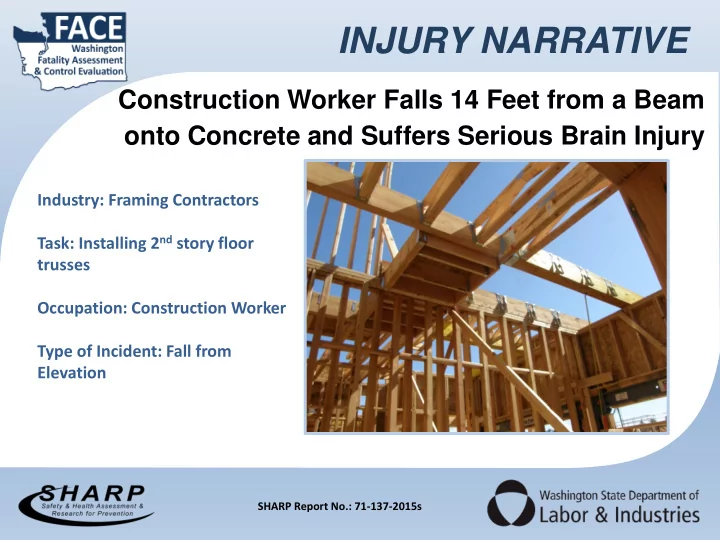
INJURY NARRATIVE Construction Worker Falls 14 Feet from a Beam onto Concrete and Suffers Serious Brain Injury Industry: Framing Contractors Task: Installing 2 nd story floor trusses Occupation: Construction Worker Type of Incident: Fall from


slide-1
SLIDE 1

INJURY NARRATIVE

Construction Worker Falls 14 Feet from a Beam

  • nto Concrete and Suffers Serious Brain Injury

Industry: Framing Contractors Task: Installing 2nd story floor trusses Occupation: Construction Worker Type of Incident: Fall from Elevation

SHARP Report No.: 71-137-2015s

slide-2
SLIDE 2

INJURY NARRATIVE

On May 12, 2014, a 41- year-old construction worker suffered a severe traumatic brain injury when he fell approximately 14 feet and hit his head on the concrete below. The incident occurred at a new multi-family home construction site. The injured worker had only worked for two weeks for the employer, a small construction company that provided framing and carpentry services. He had been installing floor trusses on the second story above the garage of a multi-family home under construction at the time of the incident. The foreman and another employee were standing about 100 feet away in front of the building when they heard a noise and responded. They found the injured worker lying on the concrete, breathing but barely conscious. He was still connected to the rope and harness of his fall arrest system, which was anchored to a beam next to the garage. Although the injured worker was wearing fall protection, there had been too much slack in the rope, and it was not able to stop his fall. The foreman had warned him about having too much slack in the rope one week before the incident. He was taken to the hospital where he was found to have multiple skull fractures, brain hemorrhaging, and a spinal fracture. He underwent emergency surgery to relieve brain swelling. Nearly a year later, the injured worker is still in rehabilitation for his brain injuries and requires 24-hour-a-day living assistance.
slide-3
SLIDE 3

INJURY NARRATIVE

Incident scene showing the area where the injured worker was installing floor trusses (photo 1) before falling 14 feet onto the concrete floor of the garage (photo 2).

Photo 1: Incident scene Photo 2: Garage interior

slide-4
SLIDE 4

INJURY NARRATIVE

Utilizing bracket scaffolds or mobile scaffolds during beam and truss installation can reduce worker exposure to fall hazards.

Photo 3: Bracket scaffold Photo 4: Mobile scaffold

Photo credit: OSHA Photo credit: OSHA

slide-5
SLIDE 5

INJURY NARRATIVE

Requirements

  • Make sure the appropriate fall protection system is provided, installed, and

implemented according to requirements when employees are exposed to fall hazards of ten feet or more to the ground or lower level while working

  • n any surface that does not meet the definition of a walking/working
  • surface. See WAC 296-155-24611(1)(c)
  • Develop and implement a written fall protection work plan that includes

each area of the work place where the employees are assigned and where fall hazards of ten feet or more exist. See WAC 296-155-24611(2).

  • Provide retraining for employees exposed to fall hazards when inadequate

use indicates that they have not retained the knowledge of how to use fall protection systems safely. See WAC 296-155-24621.

slide-6
SLIDE 6

INJURY NARRATIVE

Recommendations

  • Consider using aerial work platforms or scaffolds to reduce the

risk of falls when installing trusses, rather than having workers stand on the beam edge.

  • Reduce exposure to falls by placing and securing plywood over the

already installed trusses to create a walking/working surface to which an anchor can be secured for a personal fall restraint system.

slide-7
SLIDE 7

INJURY NARRATIVE

Developed by Washington State Fatality Assessment and Control Evaluation (FACE) Program and the Division of Occupational Safety and Health (DOSH), Washington State Dept. of Labor & Industries. The FACE Program is supported in part by a grant from the National Institute for Occupational Safety and Health (NIOSH grant# 5 U60 OH008487-09). For more information, contact the Safety and Health Assessment and Research for Prevention (SHARP) Program, 1-888-667-4277.

This bulletin was developed to alert employers and employees of a serious traumatic injury to a worker in Washington State and is based on preliminary data ONLY and does not represent final determinations regarding the nature of the incident or conclusions regarding the cause of the injury.