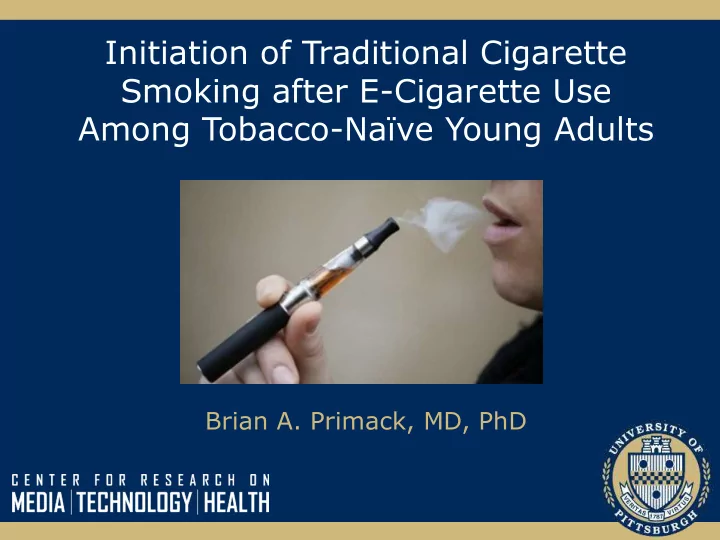
Initiation of Traditional Cigarette Smoking after E-Cigarette Use - - PowerPoint PPT Presentation

initiation of traditional cigarette smoking after e
SMART_READER_LITE
LIVE PREVIEW

Initiation of Traditional Cigarette Smoking after E-Cigarette Use - - PowerPoint PPT Presentation

Initiation of Traditional Cigarette Smoking after E-Cigarette Use Among Tobacco-Nave Young Adults Brian A. Primack, MD, PhD Co-Authors Ariel Shensa, MA Jaime E. Sidani, PhD Beth L. Hoffman, BSc Samir Soneji, PhD James


slide-1
SLIDE 1

Initiation of Traditional Cigarette Smoking after E-Cigarette Use Among Tobacco-Naïve Young Adults

Brian A. Primack, MD, PhD

slide-2
SLIDE 2

Co-Authors

  • Ariel Shensa, MA
  • Jaime E. Sidani, PhD
  • Beth L. Hoffman, BSc
  • Samir Soneji, PhD
  • James Sargent, MD
  • Robert Hoffman, MD
  • Michael Fine, MD, MSc
slide-3
SLIDE 3

Disclosures

  • None
slide-4
SLIDE 4

What is an E-Cigarette?

slide-5
SLIDE 5

E-Liquid

  • Propylene glycol
  • Glycerin
  • Flavorings
  • Nicotine
slide-6
SLIDE 6
slide-7
SLIDE 7
slide-8
SLIDE 8

“Mid-Size” Generation

  • Refill with e-juice
  • eGo
  • $5-15
  • USB charger
slide-9
SLIDE 9
slide-10
SLIDE 10

Other

slide-11
SLIDE 11

Prevalence of ENDS use

  • Among U.S. high

school students

– Increased nearly 800% between 2011 and 2014 – More prevalent than cigarettes

13.4% vs. 9.2%

Arrazola, 2015

slide-12
SLIDE 12

Toxicants in Vapor

Toxicant Conventional vs. E-Cigarette Ratio Formaldehyde 9 Acetaldehyde 130 Acrolein 4 Toluene 23 NNN 145 NNK 30 Cadmium 16 Nickel 15

Goniewicz et al., Tobacco Control, 2013

slide-13
SLIDE 13

Harm Reduction Argument

  • If these devices replace cigarettes, harm

could be a fraction of what it is today

  • Analogous to methadone for heroin addicts

– Still get drug – Don’t get associated toxins

slide-14
SLIDE 14

On the Other Hand …

  • Could be a perfect “starter cigarette”
  • May lead to habituation in nicotine-naïve

individuals

  • Three longitudinal studies have shown a

longitudinal association

– Local (Los Angeles, Hawaii); none nationally representative – Focus on youth, but looking at young adults may be particularly valuable

Moore, 2014; Schraufnagel, 2015

slide-15
SLIDE 15

Purpose

  • Longitudinally follow a nationally-

representative sample of non-smoking young adults

  • Assess association between baseline e-

cigarette use and progression to cigarette smoking 18 months later

slide-16
SLIDE 16

Setting

  • Nationally-representative sample of

participants with help from GfK

  • Recruited via random digit dialing (both

landline and cell phones) and address- based sampling

  • Sampling frame 97% of U.S.
  • Wave 1: March 2013
  • Wave 2: October 2014
slide-17
SLIDE 17

Population & Procedures

  • 18-30 years old at baseline
  • Never taken a puff of a cigarette at

baseline

  • IRB approved
  • $20 equivalent for completion at each

wave

slide-18
SLIDE 18

Independent Variable

  • Whether participants had ever used an e-

cigarette at baseline

slide-19
SLIDE 19

Dependent Variable

  • Initiation of traditional cigarette smoking

by follow-up

slide-20
SLIDE 20

Covariates

  • Age
  • Sex
  • Race/ethnicity
  • Education level
  • Relationship status
  • Living situation
  • Self-esteem
  • Household income
  • Sensation seeking
  • Rebelliousness
slide-21
SLIDE 21

Analyses

  • Logistic regression
  • Survey weights took into consideration
  • ver/under-coverage and loss to follow up
  • Primary analyses controlled for all

covariates

  • Sensitivity analyses

– Raw data without survey weights – Only covariates with association with outcome P<.15 – Covariates as continuous instead of catgorical

slide-22
SLIDE 22

Sample

  • Wave 1: N = 1506
  • Wave 2: N = 915 (60.8%)
  • No significant differences between responders

and non-responders in terms of sociodemographics

– Age (P=.38) – Sex (P=.36) – Race (P=.20)

slide-23
SLIDE 23

Sample

Unweighted Weighted Female 61.6% 50.3% White 64.8% 55.2% Black 10.9% 14.6% Hispanic 14.2% 19.7% Age, median (IQR) 23 (20-26) 23 (20-27)

slide-24
SLIDE 24

Baseline E-cigarette Use

  • Unweighted: 16 / 915 = 1.8%
  • Weighted: 801,010 / 32,040,393 = 2.5%
slide-25
SLIDE 25

Uptake of Traditional Smoking (Non-Weighted)

  • E-cigarette users: 6/16 (37.5%)
  • Non-e-cigarette users: 81/899 (9.0%)

P<.001

slide-26
SLIDE 26

Uptake of Traditional Smoking (Weighted)

  • E-cigarette users: 47.7%
  • Non-e-cigarette users: 10.2%

P=.001

slide-27
SLIDE 27

Initiation of Cigarette Smoking AOR (95% CI) E-cigarette Use at Baseline No 1 [REF] Yes 6.8 (1.7-28.3) Age, y 18-20 1 [REF] 21-23 0.9 (0.4-2.0) 24-26 0.7 (0.2-2.4) 27-30 0.3 (0.1-0.9)

slide-28
SLIDE 28

Initiation of Cigarette Smoking AOR (95% CI) Race/Ethnicity White 1 [REF] Black 1.4 (0.4-4.2) Hispanic 3.1 (1.3-7.6) Rebelliousness Low 1 [REF] Medium 1.3 (0.5-3.0) High 4.4 (1.8-10.9)

slide-29
SLIDE 29

All Non-Significant

  • Sex
  • Relationship Status
  • Living Situation
  • Household Income
  • Education Level
  • Self-Esteem
  • Sensation Seeking
slide-30
SLIDE 30

Additional Analyses

  • All same
slide-31
SLIDE 31

Summary

  • Only a small percentage of never

smokers had experimented with e- cigarettes

  • But that initial e-cigarette use was

significantly associated with transition to cigarettes

slide-32
SLIDE 32

Low Number of Initial E-cigarette Users

  • However, this is

increasing according to CDC data

  • May be valuable to

repeat

  • Wide CIs, but robust

in sensitivity analyses

slide-33
SLIDE 33

Potential Value of E-Cigarettes

  • Anecdotal and focus group evidence

– Physical sensations – Vaping community/identity/“hobby”

  • Specific populations

– Schizophrenics – “Nothing else works”

slide-34
SLIDE 34

Concern 1: Gateway?

  • May bring in new users
  • Provides nicotine in highly acceptable,

youth-oriented form

slide-35
SLIDE 35

Concern 2: Benefit even for intended audience?

  • May not actually help many smokers quit
  • Remain dual users and not actually lower

toxicant load substantially

  • May just keep cycle of addiction to

nicotine going

  • Allows people to cope with anti-smoking

regulations

slide-36
SLIDE 36
  • Renormalizing

nicotine use

  • Re-introducing

powerful images and cues

Concern 3: Dialing back public health?

slide-37
SLIDE 37

Tobacco Industry

  • Lorillard (Blu)
  • Reynolds American (Vuse)
  • Altria (MarkTen)
slide-38
SLIDE 38

Summary

  • ENDS do seem to provide a gateway,

at least for some

  • Continue surveillance
  • Continue tracking trajectories

– Gateway in – Gateway out

slide-39
SLIDE 39

Thank You!

bprimack@pitt.edu ~ Center for Research on Media, Technology, and Health @CRMTH_Pitt

slide-40
SLIDE 40

Concern 4: Toxicity?

  • High variability because of lack of

regulation

  • Some studies show increased toxins

(NEJM 2015)

  • “Popcorn lung” (bronchiolitis obliterans)
  • Nicotine
slide-41
SLIDE 41
slide-42
SLIDE 42

Nicotine Levels

  • Extra strong: 24-36 mg/mL
  • Full flavored: 16-18 mg/mL
  • Light: 10-12 mg/mL
  • Ultra light: 6-8 mg/mL
  • Zero-nicotine: 0 mg/mL (sort of)
slide-43
SLIDE 43
slide-44
SLIDE 44
slide-45
SLIDE 45

Cigalike Brands

  • Njoy
  • E-Lites
  • Ever Smoke
  • SkyCig
  • V2
  • Pure
  • Green Smoke
  • White Cloud
  • Blu
  • E-Tron
  • Fling
  • Krave
  • Logic
  • Misitic
  • OneJoy
  • Pro Smoke
slide-46
SLIDE 46

$15.99 on Amazon

slide-47
SLIDE 47

Mid-Size Brands

  • Apollo
  • Aqua Vapor
  • Desire
  • Joyetech
  • Panda
  • Kik Sticks
  • Sharp Smoker
  • Totally Wicked
  • Vision
slide-48
SLIDE 48

Amounts of Liquid

  • Average liquid per day: 3-4 mL
  • Average nicotine: 18 mg/mL
  • Average daily dose of nicotine: 54-72 mg

– But only about 10-40% absorbed – Resulting in 5-25 mg of nicotine

  • Each cigarette delivers about 1 mg nicotine

(20 mg per pack)

  • Lethal dose for humans generally accepted

as 30-60 mg

slide-49
SLIDE 49