Risk Factors Cigarette Smoking Doubles Risk Causes 26% of - - PDF document

risk factors
SMART_READER_LITE
LIVE PREVIEW

Risk Factors Cigarette Smoking Doubles Risk Causes 26% of - - PDF document

Genetics of Pancreatic Cancer: Identifying & Managing Increased Risk Jennifer E. Axilbund, M.S., C.G.C. Cancer Risk Assessment Program The Johns Hopkins Hospital Risk Factors Cigarette Smoking Doubles Risk Causes 26% of


slide-1
SLIDE 1

1

Genetics of Pancreatic Cancer: Identifying & Managing Increased Risk

Jennifer E. Axilbund, M.S., C.G.C. Cancer Risk Assessment Program The Johns Hopkins Hospital

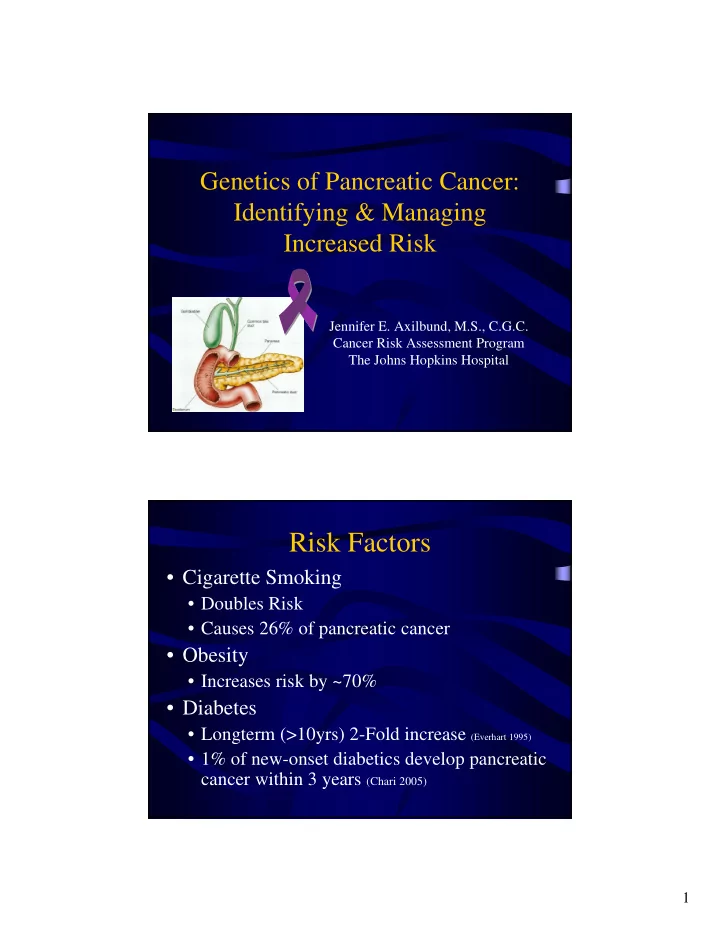
Risk Factors

  • Cigarette Smoking
  • Doubles Risk
  • Causes 26% of pancreatic cancer
  • Obesity
  • Increases risk by ~70%
  • Diabetes
  • Longterm (>10yrs) 2-Fold increase (Everhart 1995)
  • 1% of new-onset diabetics develop pancreatic

cancer within 3 years (Chari 2005)

slide-2
SLIDE 2

2

What Percentage of Cancer is Considered to be Hereditary?

  • 60-85% of cancer is

thought to be sporadic

  • 10-30% of cancer is

thought to be familial

  • 5-10% of cancer is

thought to be hereditary

Hereditary Familial Sporadic

slide-3
SLIDE 3

3

EVERYONE has hereditary cancer genes, but very FEW have a mutation rendering the gene non-functional.

Family History Questionnaires

Name

  • Date of

Birth

  • Age at dx/ Type
  • f Cancer
  • Date of

Death

  • Hospital

!" #

slide-4
SLIDE 4

4

ASCO

1st, 2nd-, and 3rd-Degree Relatives

2 2 2 2 1 1 2 1 2 1 1 3

Child Brother Sister Father Mother Uncle First cousin Maternal grandmother Maternal grandfather Paternal grandmother Paternal grandfather Aunt

When to Suspect a Hereditary Cancer Syndrome

  • Cancer in 2 or more close relatives

(on same side of family)

  • Early age at diagnosis
  • Multiple primary tumors
  • Bilateral or multiple rare cancers
  • Constellation of tumors consistent with specific

cancer syndrome (eg, breast and ovary)

  • Evidence of autosomal dominant transmission
slide-5
SLIDE 5

5

B b b b

b b b b B b B b

Autosomal Dominant Inheritance Factors that Influence the Cancer Pattern within a Family

  • Penetrance
  • Gender
  • Environment
  • Genotype
  • Risk-Reduction
  • Early death
  • Modifier genes
slide-6
SLIDE 6

6

ASCO

Genetic Heterogeneity

  • Mutations in different

genes can cause the same disease

  • BRCA1 and BRCA2

account for half of all hereditary breast cancer

Chr 17 Chr 13

BRCA1 BRCA2 Hereditary breast and ovarian cancer

ASCO

Ideally, Begin Testing With an Affected Person

If a mutation is found in an affected person, testing will be more informative for other family members

Person seeking counseling (proband) Test first, if possible

slide-7
SLIDE 7

7

ASCO

Interpreting a Negative Result

No identified mutation in family Family with known mutation

Inconclusive

Pan Ca, 62 Pan Ca, 57 Breast Ca, 45 37 BRCA2 − − − −

True negative

Pan Ca, 62 Pan Ca, 57 Breast Ca, 45 37 BRCA2 − − − − BRCA2 + + + +

In general, when Should Genetic Testing Be Considered?

  • Patient has a reasonable likelihood of

carrying an altered cancer susceptibility gene

  • Genetic test is available that can be

adequately interpreted

  • Results will influence medical management
  • r aid in the diagnosis of a hereditary cancer

syndrome

slide-8
SLIDE 8

8

Clinical Management of Mutation-Positive Patient

Positive genetic test result Possible testing for

  • ther adult relatives

Increased surveillance Prophylactic surgery Lifestyle changes Chemo- prevention

ASCO

Cost of Genetic Testing

BRCA1/2 Sequencing ~$3400 BRCA1/2 Ashkenazi Jewish Panel ~$575 HNPCC Sequencing ~$3000 FAP (APC) Sequencing ~$2000 Large Deletion Testing $400-750 Known Family Mutation ~$475

Test: Cost:

slide-9
SLIDE 9

9

Insurance Coverage for Genetic Testing

  • The vast majority of insurance companies

cover some percentage of genetic testing

  • Medicare does cover many cases, but

Medical Assistance often does NOT

  • Many laboratories offer pre-authorization

services prior to committing to testing

Benefits of Genetic Testing

  • Identifies high-risk individuals
  • Identifies non-carriers in families with a known

mutation (i.e. general population risk)

  • Allows early detection and prevention strategies
  • May relieve anxiety (positive or negative)
slide-10
SLIDE 10

10

Risks and Limitations

  • f Genetic Testing
  • Does not detect all mutations and variants of

uncertain significance

  • Continued risk of sporadic cancer
  • Efficacy of interventions unproven
  • Psychosocial issues
  • Anxiety/fear
  • Guilt
  • Self-esteem
  • Depression
  • Stigmatization
  • Grief and/or loss
  • Family dynamics

Psychological and Ethical Issues in Adult-Onset Predisposition Testing

  • Right to know/right not

to know

  • Sharing of information
  • Coercion
  • Privacy
  • Reproductive decisions
  • Testing of minors
slide-11
SLIDE 11

11

Variant of Uncertain Significance

  • Prevalence: 5-15% in whites; 15-

30% in other ethnic groups

  • Effect on Risk Unknown
  • Supporting Data:

– Number of Unrelated Families – Seen with Deleterious Mutation – Co-segregation with Cancer

  • Management based on Family

History

  • Do Not Test Unaffected Relatives

What Is Genetic Discrimination?

  • Social or economic discrimination based on
  • ne’s hereditary predisposition to disease

– denial of access to or increased cost of insurance – loss of employment, educational, or other

  • pportunities
  • It is not clear that insurance discrimination

based on cancer predisposition is a major issue

slide-12
SLIDE 12

12

What Protection Exists?

  • GINA

– Went into effect in May 2009 – Health insurance and employment protections

  • HIPAA:

– Protects those with group health plans – Does not cover individual policies

  • State Legislation:

– Many states have laws that protect against all forms

  • f health insurance discrimination

– Limited for life, disability and long-term insurance

Familial Pancreatic Cancer

  • 10% of cases have a positive

family history of disease

  • Represent a high-risk group that

may benefit from early detection and risk assessment

slide-13
SLIDE 13

13

Familial Pancreas Cancer: Differential Diagnosis

– HNPCC – FAP – Peutz-Jeghers – FAMMM – Hereditary Pancreatitis – BRCA1 – BRCA2 – PALB2 – Undiscovered Gene(s)

Hereditary Nonpolyposis Colorectal Cancer

  • 70% are right-sided

cancers

  • 40% lifetime risk of

endometrial cancer

  • Average age at cancer

diagnosis is 44 years

  • Other associated

malignancies (ovary, small bowel, urinary tract, stomach, biliary tract)

slide-14
SLIDE 14

14

Polyposis Associated with Classic FAP

  • >100 Adenomas
  • Evenly distributed

throughout colon

  • Average age of polyp
  • nset is 15 years
  • Cancer risk

approaches 100%

  • Average age of cancer

diagnosis is 39 years

Peutz-Jeghers syndrome

  • Often presents as small bowel intussusception
  • Melanin pigmentation
  • Lifetime risk of any cancer is 93%
  • Autosomal Dominant (STK-11)
slide-15
SLIDE 15

15

Familial Atypical Multiple Mole and Melanoma (FAMMM)

  • Characterized by a dominant pattern of melanoma and

dysplastic nevi

  • Risk for pancreas cancer is increased (22-fold)
  • P16 gene
  • Genetic testing is controversial

www.msn.com

Hereditary Pancreatitis

  • Chronic pancreatitis

following autosomal dominant pattern

  • Risk of pancreas

cancer approaches 40% by age 70 years

  • Average age of onset

is 39 years old

  • Cationic Trypsinogen

gene (PRSS1)

http://imagebank.ipcmedia.com

slide-16
SLIDE 16

16

Hereditary Breast and Ovarian Cancer: BRCA1 and BRCA2

  • Autosomal Dominant Transmission
  • Small increase in risk of other cancers

(e.g. pancreas, melanoma) breast cancer

(50%−85%)

  • varian cancer

(10%−20%)

male breast cancer

(6%)

Adapted from ASCO

second primary breast cancer 40%−60%

prostate cancer

(20-30%)

Risk of PC with BRCA2 mutations

  • J Med Genet. 2005 Sep;42(9):711-9

– Overall RR = 5.9 (3.2-10 95% CI)

  • <65 y.o. RR = 37.1 (16-73.1 CI)
  • >/= 65 y.o. RR = 2.5 (1-5.2 CI)
  • Breast CA Linkage Consortium (1999) JNCI

– Carriers vs. Non-carriers vs. Unknown

  • Overall RR = 3.51 (1.87-6.58 95% CI; p = .0012)
  • 0-64 y.o. RR = 5.54 (2.72-11.32 CI)
  • 65-85 y.o. RR = 1.61 (0.45-5.72 CI)
slide-17
SLIDE 17

17

BRCA2 Prevalence

  • 7% of apparently sporadic pancreas cancer

(Goggins et al. 1996)

  • 10% of Ashkenazi Jewish patients with

pancreas cancer (Ozcelik et al. 1997)

  • 17% of kindreds with three or more

relatives affected with pancreas cancer (Murphy et al. 2002)

BRCA1 and BRCA2 in the Ashkenazi Jewish Population

185delAG Prevalence = ~1% 5382insC Prevalence = ~0.15% 6174delT Prevalence = ~1.5%

BRCA1 BRCA2

Adapted from ASCO

1 in 40 Individuals of Ashkenazi Jewish descent has a BRCA1 or BRCA2 Mutation

slide-18
SLIDE 18

18

PALB2

  • Official name “partner and localizer of

BRCA2”

  • Genome maintenance gene
  • PALB2 binds to BRCA2 stabilizing it and

anchoring it to structures in the nucleus allowing BRCA2 to repair DNA

PALB2

  • Sequence Analysis of 20,661 genes: PALB2 mutated

in one proband

  • 3 of 96 additional FPC patients sequenced also had

truncating PALB2 mutations

  • Co-segregation was observed

– Two brothers with pancreatic cancer both had same PALB2 stop mutations

  • 3 of 4 families also had history of breast cancer

– Not all families had history of breast cancer – Prevalence of PALB2 mutations higher than observed for HBOC families (3% vs 1%)

Jones, SciencExpress March 5, 2009

slide-19
SLIDE 19

19

Most patients with a strong family history of pancreatic cancer do not fit into one of these recognized syndromes

Empiric Risk based on FDRs

  • One FDR = 4.5-fold
  • Two FDRs = 6.4-fold
  • Three FDRs = 32-fold
  • PC 54

67 95 PC 62

slide-20
SLIDE 20

20

Ongoing gene discovery studies

  • PacGene

Multi-center linkage consortium: Johns Hopkins, Mayo

Clinic, Karmanos Cancer Institute, M.D. Anderson Cancer Center, University of Toronto, Dana-Farber Cancer Institute

  • PANSCAN

Genome Wide Association Studies: The Pancreatic

Cancer Cohort Consortium; JHU, MD Anderson, Mayo, Mount Sinai, MSKCC, USCF, Group Health (Seattle WA)

ASCO

Genetic Predisposition Testing Is a Multi-Step Process

Provide post-test counseling and follow-up Identify at-risk patients Provide pretest counseling Provide informed consent Select and

  • ffer test

Disclose results

slide-21
SLIDE 21

21

Cancer Genetics Centers

  • National Society of

Genetic Counselors

– http://www.nsgc.org

  • Gene Clinics

– http://www.geneclinics.org

  • National Cancer Institute

– http://www.cancer.gov