Infrastructure Risks: Megaprojects in Australia Scott Elaurant and - - PowerPoint PPT Presentation
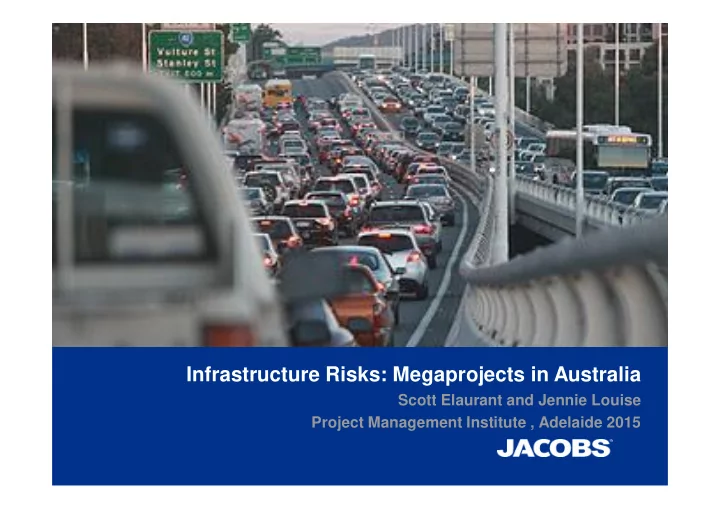
Infrastructure Risks: Megaprojects in Australia Scott Elaurant and Jennie Louise Project Management Institute , Adelaide 2015 Overview 1. Introduction This is modified from a paper for The Royal Society, Qld June 2015 2. The Macro Level:
Overview
- 1. Introduction
– This is modified from a paper for The Royal Society, Qld June 2015
- 2. The Macro Level: Transport funding
- 3. The Micro Level: Project Delivery
– Evidence of Australian Megaprojects – Unit Costs – Cost Risk – Demand Risk
- 4. Improving Delivery and Planning
- 1. Introduction
SMH
- 1. Introduction
- Multiple multi-billion dollar transport project failures since 2000
- Lack of bipartisan political support for transport policy & projects
- Lack of effective long - term planning and programming
- Loss in public confidence in decision making – is this fair?
- 1. Introduction
- Flyvbjerg (Megaprojects and Risk) analysed cost and demand
forecasting risk in European infrastructure projects
- This paper applies that analysis to Australian projects
- Extends analysis to include delivery cost efficiency
- Aim to identify common factors for success (and failure)
- 2. The Macro Level: Transport Funding
APH website
2 Macro Level: Transport funding
- Capital funding inconsistent; maintenance funding low vs OECD
- Population growth (+1.5%pa) among highest in OECD (+0.5%pa)
- Long network, inconsistent funding, low mntce = poor quality
Infrastructure Quality Rankings 2014 (World Economic Forum)
2 Macro Level: Transport funding alternatives
The road less travelled:
- Travel demand management? No road pricing
- Developer contributions? No value capture (yet)
- Reviewing population growth rate? No stated policy
Transport for London
3 The Micro Level: Comparing Megaproject Delivery
3 Micro Level: Project Delivery
- Measure efficiency and risks in project delivery (Flyvbjerg 2003)
- Unit Costs: are projects efficient?
- Cost Risk: are cost estimates reliable?
- Demand Risk: are demand forecasts accurate?
Road building across Blue Mountains, 1860s
3 Micro Level: Data Issues
- Database of 38 projects, 1992 to 2015; $200m to $5300m
- All public data; Qld TMR and WA PTA provided demand data
- Major data weaknesses:
– No post completion checks – No database of forecasts – Business cases not public
Lolcats
Australian Megaproject Database
Project Type Year Real Cost ($M 2015) Cost/Lane-km ($M) PPP Outcome Sydney Harbour Tunnel, Sydney Tunnel 1992 $1106 $99 Profitable M2 Motorway, Sydney Surface 1997 $914 $11 Profitable Eastern Distributor, Sydney Tunnel 1999 $1310 $55 Profitable City Link Melbourne Surface 2000 $3947 $30 Profitable Sydney Airport Rail Tunnel 2000 $1615 $81 Bankrupt South East Busway, Brisbane Surface 2000 $912 $28 Pacific Motorway, SEQ Surface 2000 $1491 $4 Brisbane Airtrain Surface 2001 $362 $21 Bankrupt Yelgun - Chinderah, NSW Surface 2002 $573 $5 Liverpool – Parramatta T-Way, Sydney Surface 2003 $546 $9 Alice Springs - Darwin Rail Surface 2004 $1894 $1.3 Bankrupt Cross City Tunnel, Sydney Tunnel 2005 $967 $115 Bankrupt M7 Motorway, Sydney Surface 2006 $2423 $15 Profitable Regional Fast Rail, Melbourne Surface 2006 $1066 $2 Mandurah Rail Line, Perth Surface 2007 $2133 $15 Lane Cove Tunnel, Sydney Tunnel 2007 $1414 $79 Bankrupt Inner Northern Busway, Brisbane Surface 2008 $614 $68 Tugun Bypass, Gold Coast Surface 2008 $676 $24 East Link, Melbourne Surface 2008 $3114 $13 Profitable
Australian Megaproject Database (continued)
Project Type Year Real Cost ($M 2015) Real Cost/Lane- km ($M 2015) PPP Outcome (7/16 Bankrupt) Deer Park Bypass, Melbourne Surface 2009 $426 $11 Epping Chatswood Rail, Sydney Tunnel 2009 $3020 $108 Forrest Highway, Perth Surface 2009 $829 $3 Clem 7 Tunnel, Brisbane Tunnel 2010 $3493 $182 Bankrupt Gateway Upgrade, Brisbane Surface 2010 $2212 $18 Go Between Bridge, Brisbane Bridge 2010 $369 $132 Profitable Monash-CityLink-Westgate, Melbourne Surface 2010 $1517 $13 Northern Expressway, Adelaide Surface 2011 $621 $7 Airport Link, Brisbane Tunnel 2012 $5288 $132 Bankrupt Western Ring Road Upgrade, Melbourne Surface 2013 $2407 $32 Peninsula Link, Melbourne Surface 2013 $774 $7 Viable (Shadow toll) Butler Rail Extension, Perth Surface 2013 $225 $15 Ipswich Motorway, Brisbane Surface 2014 $2996 $24 Seaford Rail Line, Adelaide Surface 2014 $292 $26 South Road Superway, Adelaide Bridge 2014 $948 $33 Gold Coast Light Rail Surface 2014 $953 $37 Profitable Regional Rail Link, Melbourne Surface 2014 $3719 $39 South West Rail Line, Sydney Surface 2015 $1809 $79 (Legacy Way, Brisbane) Excluded Tunnel 2015 $1507 $82 Unknown
3 Micro Level: Project Delivery
Unit Costs:
- Steady over time
- Road = Rail
- PPP = non-PPP
- Surface = $21m
- Bridge = $61m
- Tunnel = $102m
3 Micro Level: Project Delivery
Cost Risk % planned vs actual
- Steady over time
- Heavily skewed
- Average +15%
- Road = Rail
- PPP = non-PPP
- Better than Europe
(Flyvbjerg)
3 Micro Level: Project Delivery
Demand Risk % planned vs actual
- Steady over time
- Heavily skewed
- Average -15% error
- Public -6% error
- PPP -44% error
- PPP same as Europe
(Flyvbjerg)
3 Micro Level: Summary Performance by Contract Type
- Alliance, D&C lowest cost; Alliance cheapest; D&C fastest
- PPP highest cost, highest demand forecast error
- 60.0%
- 40.0%
- 20.0%
0.0% 20.0% 40.0% 60.0% 80.0% 100.0% 120.0% Unit Cost Cost Control Time Control Demand Forecast Project Outcome vs Industry Average
Delivery Performance by Contract Type
Alliance D&C PPP
3 Micro Level: Were PPPs worse? Yes!
Recent Australian PPPs compared to European Megaprojects
- Cost risks well controlled
- Demand risk for PPPs worse than for non-PPPs
- Margin of demand risk difference (44%) statistically significant
- Poor forecasting accuracy for PPPs persistent over time
- 7 of 16 PPPs bankrupt (44%), including 5 of 8 tunnels (62%)
- PPPs also highest unit cost, suggesting over-estimation of
demand has led to over-scoping
3 Micro Level: Why do our PPPs perform poorly?
Why is performance so bad for PPPs?
- Australian PPPs did not include key governance features:
– Transparency absent – Governance structures not independent (regulator/promoter) – Demand risk was private, now being transferred to public (Melbourne EW Link) – (from Flyvbjerg )
- PPPs perform better where governance better (Chile, USA,
Canada)
Managing project risk (Flyvjberg 2003)
Governance factors are critical for success:
- Decision maker & promoter separate (impartiality)
- Public scrutiny of decision process (transparency)
- Rigorous regulatory regime (accountability)
- Unguaranteed risk capital (risk transfer)
- 4. Improving the Process
Singapore LTA
4 Improving Planning and Delivery
Project Governance Reforms
- Transparency is critical
- Standardisation of contract forms
- PPP guidelines must include governance
- PPP terms too long (UK: up to 20 years; Australia 30+ years?)
- More smaller projects?
- Simpler contract types? (D&C, conventional, not Alliance, PPP)
4 Improving Planning and Delivery
Planning and Project Assessment Reforms
- Need up to date models and data –funding needed
- Future corridors must be preserved in land use planning
- Realistic project assessment:
– Guidelines should match international practice – Realistic discount rates – 4% not 7% – BCR hurdle rate of 1.5+ (cost risk, demand risk) – Guidelines road based; PT parameters deficient – All business cases should be made public when funded
www.jacobs.com | worldwide