
SLIDE 1
Informatics 1
Computation and Logic
Boolean Algebra CNF DNF Michael Fourman
1
Basic Boolean operations
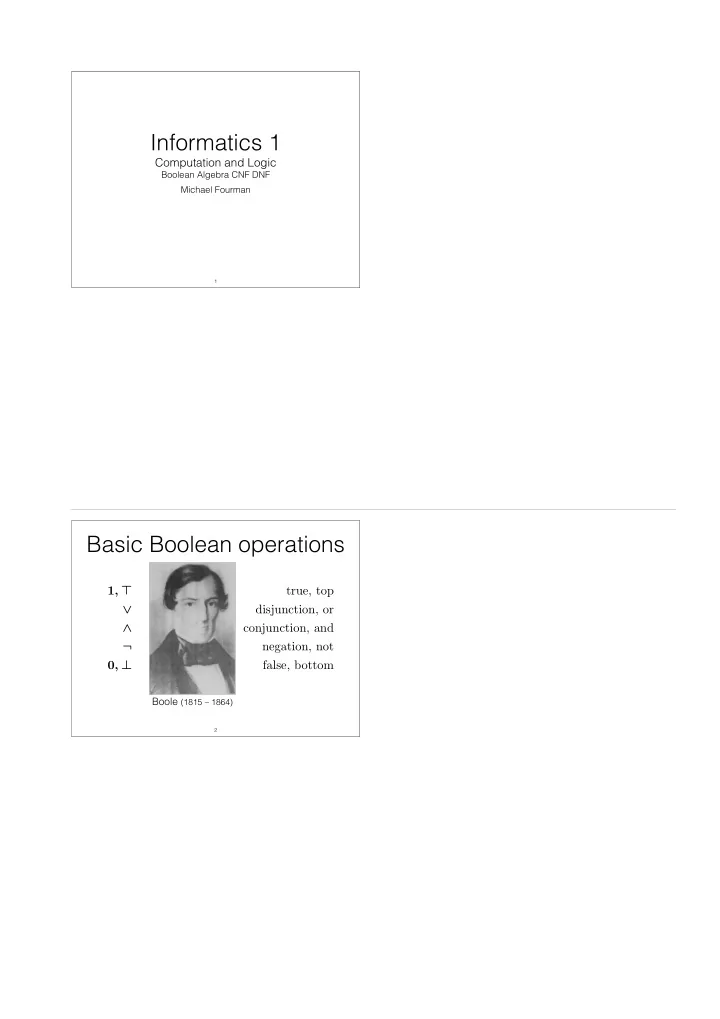
1, > true, top _ disjunction, or ^ conjunction, and ¬ negation, not 0, ? false, bottom
2
Boole (1815 – 1864)
Informatics 1 Computation and Logic Boolean Algebra CNF DNF - - PDF document
Informatics 1 Computation and Logic Boolean Algebra CNF DNF Michael Fourman 1 Basic Boolean operations 1 , > true, top _ disjunction, or ^ conjunction, and negation, not 0 , ? false, bottom Boole (1815 1864) 2 If we use one
Computation and Logic
Boolean Algebra CNF DNF Michael Fourman
1
1, > true, top _ disjunction, or ^ conjunction, and ¬ negation, not 0, ? false, bottom
2
Boole (1815 – 1864)
x ∧ y ≡ xy x ∨ y ≡ x + y − xy ¬x ≡ 1 − x
3
+ 1 1 1 1 ⨉ 1 1 1 − 1 1 ⋀ 1 1 1 ⋁ 1 1 1 1 1 ¬ 1 1
Here, we use arithmetic mod 2 The same equations work if we use ordinary arithmetic!
If we use one bit (binary unit, 0 or 1) to code each truth value, with 0 ~ ⊥ and 1 ~ ⊤ then we can express the logical operations algebraically. It doesn’t matter whether we interpret these expressions in Z or in Z2
X ∨ Y = X ∪ Y union X ∧ Y = X ∩ Y intersection ¬X = S \ Y complement 0 = ∅ empty set 1 = S entire set
4
Definitions: x → y ≡ ¬x ∨ y implication x ← y ≡ x ∨ ¬y x ↔ y ≡ (¬x ∧ ¬y) ∨ (x ∧ y) equality (iff) x ⊕ y ≡ (¬x ∧ y) ∨ (x ∧ ¬y) inequality (xor) Some equations: x ↔ y = (x → y) ∧ (x ← y) x ⊕ y = ¬(x ↔ y) x ⊕ y = ¬x ⊕ ¬y x ↔ y = ¬(x ⊕ y) x ↔ y = ¬x ↔ ¬y
5
(x ↔ y) ↔ z = ¬(x ↔ y) ↔ ¬z (a ↔ b = ¬a ↔ ¬b) = (x ⊕ y) ↔ ¬z (¬(a ↔ b) = a ⊕ b) = (x ⊕ y) ⊕ z (a ↔ ¬b = a ⊕ b)
6
Once we know the rules for iff and xor shown on the right, we can give an algebraic proof that the xor combination of three variables is the same as their iff combination
Some equalities: x ∨ y = ¬(¬x ∧ ¬y) x ∧ y = ¬(¬x ∨ ¬y) ¬x = x → 0 x ∨ y = ¬x → y We will see that ∧, ∨, ¬ and ⊥ are sufficient to define any boolean function. These equations show that {∧, ¬, ⊥}, {∨, ¬, ⊥}, and {→, ⊥} are all sufficient sets.
7
x ∨ (y ∨ z) = (x ∨ y) ∨ z x ∧ (y ∧ z) = (x ∧ y) ∧ z associative x ∨ (y ∧ z) = (x ∨ y) ∧ (x ∨ z) x ∧ (y ∨ z) = (x ∧ y) ∨ (x ∧ z) distributive x ∨ y = y ∨ x x ∧ y = y ∧ x commutative x ∨ 0 = x x ∧ 1 = x identity x ∨ 1 = 1 x ∧ 0 = 0 annihilation x ∨ x = x x ∧ x = x idempotent x ∨ ¬x = 1 ¬x ∧ x = 0 complements x ∨ (x ∧ y) = x x ∧ (x ∨ y) = x absorbtion ¬(x ∨ y) = ¬x ∧ ¬y ¬(x ∧ y) = ¬x ∨ ¬y de Morgan ¬¬x = x x → y = ¬x ← ¬y
8
The equations above the gap define a Boolean algebra. Those below the line follow from these.
x + (y + z) = (x + y) + z x × (y × z) = (x × y) × z associative x + (y × z) = (x + y) × (x + z) x × (y + z) = (x × y) + (x × z) distributive x + y = y + x x × y = y × x commutative x + 0 = x x × 1 = x identity x + 1 = 1 x × 0 = x annihilation x + x = x x × x = x idempotent x + (x × y) = x x + (x × y) = x absorbtion x + −x = 1 x × −x = 0 complements
Exercise 2.1 Which of the following rules are not valid for arithmetic? Which of the rules are not valid for arithmetic in Z2?
9
Exercise 2.4 (for mathematicians)
In any Boolean algebra, define, x y ⌘ x ^ y = x
0 x and x x and x 1 x ! y = > iff x y if x y and y z then x z if x y and y x then x = y if x y then ¬y ¬x
x ^ y = x iff x _ y = y
10
✔ ✔ ✔ ✔
The meaning of an expression is the set of states in which it is true.
11
To determine whether to expressions are equivalent, we can check whether they give the same values for all 2^n states of the system. The meaning of an expression is the set of states in which it is true.
✔ ✔ ✔ ✔
R(x) ∧ A(x) ∧ G(x) ∨ R(x) ∧ ¬A(x) ∧ ¬G(x) ∨ ¬R(x) ∧ ¬A(x) ∧ G(x) ∨ ¬R(x) ∧ A(x) ∧ ¬G(x)
Disjunctive Normal Form (DNF)
12
A boolean function of three variables is given by a truth table with eight entries We can easily write down a disjunction of terms, each one
single state in which the function is true.
¬ ✓ R(x) ∧ ¬A(x) ∧ G(x) ∨ ¬R(x) ∧ A(x) ∧ G(x) ∨ ¬R(x) ∧ ¬A(x) ∧ ¬G(x) ∨ R(x) ∧ A(x) ∧ ¬G(x) ◆
✔ ✔ ✔ ✔
13
Here we say that we are not in a state where the function is false
✔ ✔ ✔ ✔
¬
¬
¬
¬
Using de Morgan, this becomes a conjunction of negated conjunctions.
✔ ✔ ✔ ✔
15
Using de Morgan again, this becomes a conjunction of disjunctions. We will return to CNF later. CNF
Exercise 2.2 Generate CNF for this subset
16
Exercise 2.3 Generate CNF for this subset
17
To produce conjunctive normal form (CNF) eliminate ⟶ ↔ push negations in push ⋁ inside ⋀
18
¬(a → b) = a ∧ ¬b a → b = ¬a ∨ b ¬(a ∨ b) = ¬a ∧ ¬b ¬(a ∨ b) = ¬a ∧ ¬b ¬0 = 1 ¬¬a = a ¬1 = 0 a ∨ 1 = 1 a ∧ 0 = 0 a ∨ 0 = a a ∧ 1 = a a ∨ (b ∧ c) = (a ∨ b) ∧ (a ∨ c) (a ∧ b) ∨ c = (a ∨ c) ∧ (b ∨ c)
19
20