
SLIDE 1
Informatics 1
Computation and Logic
Boolean Algebra Michael Fourman
1
Basic Boolean operations
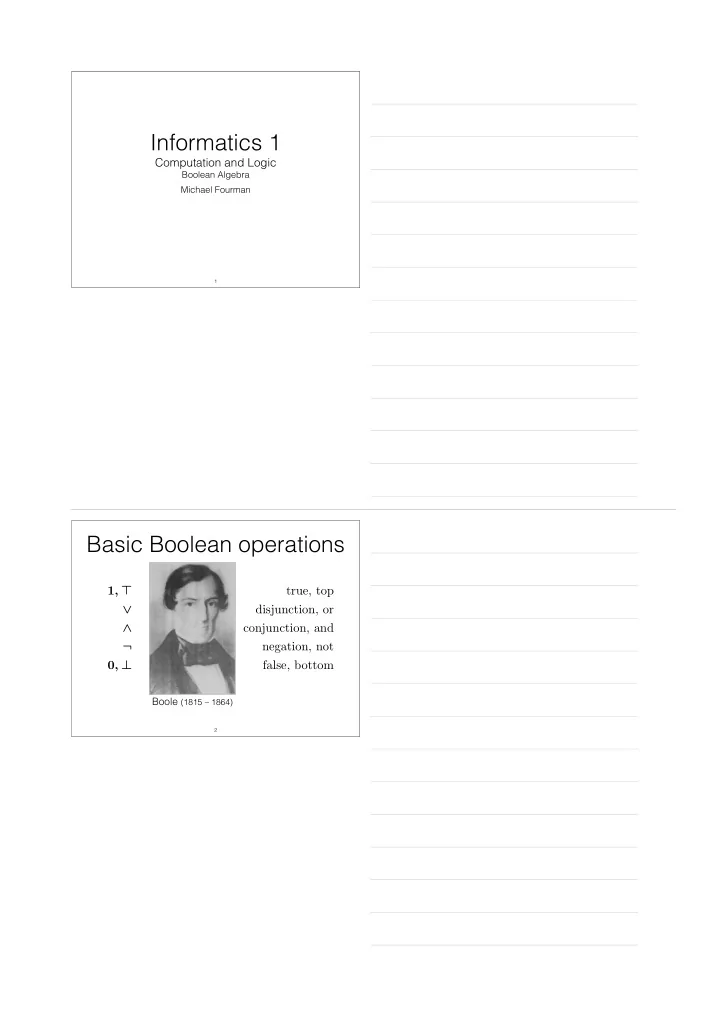
1, > true, top _ disjunction, or ^ conjunction, and ¬ negation, not 0, ? false, bottom
2
Boole (1815 – 1864)
Informatics 1 Computation and Logic Boolean Algebra Michael - - PDF document
Informatics 1 Computation and Logic Boolean Algebra Michael Fourman 1 Basic Boolean operations 1 , > true, top _ disjunction, or ^ conjunction, and negation, not 0 , ? false, bottom Boole (1815 1864) 2 Z 2 = { 0 , 1 } 0
Computation and Logic
Boolean Algebra Michael Fourman
1
1, > true, top _ disjunction, or ^ conjunction, and ¬ negation, not 0, ? false, bottom
2
Boole (1815 – 1864)
x ∧ y ≡ xy x ∨ y ≡ x + y − xy ¬x ≡ 1 − x
3
+ 1 1 1 1 ⨉ 1 1 1 − 1 1 ⋀ 1 1 1 ⋁ 1 1 1 1 1 ¬ 1 1
Here, we use arithmetic mod 2 The same equations work if we use ordinary arithmetic!
X ∨ Y = X ∪ Y union X ∧ Y = X ∩ Y intersection ¬X = S \ Y complement 0 = ∅ empty set 1 = S entire set
4
Definitions: x → y ≡ ¬x ∨ y implication x ← y ≡ x ∨ ¬y x ↔ y ≡ (¬x ∧ ¬y) ∨ (x ∧ y) equality (iff) x ⊕ y ≡ (¬x ∧ y) ∨ (x ∧ ¬y) inequality (xor) Some equations: x ↔ y = (x → y) ∧ (x ← y) x ⊕ y = ¬(x ↔ y) x ⊕ y = ¬x ⊕ ¬y x ↔ y = ¬(x ⊕ y) x ↔ y = ¬x ↔ ¬y
5
(x ↔ y) ↔ z = ¬(x ↔ y) ↔ ¬z (a ↔ b = ¬a ↔ ¬b) = (x ⊕ y) ↔ ¬z (¬(a ↔ b) = a ⊕ b) = (x ⊕ y) ⊕ z (a ↔ ¬b = a ⊕ b)
6
Some equalities: x ∨ y = ¬(¬x ∧ ¬y) x ∧ y = ¬(¬x ∨ ¬y) ¬x = x → 0 x ∨ y = ¬x → y We will see that ∧, ∨, ¬ and ⊥ are sufficient to define any boolean function. These equations show that {∧, ¬, ⊥}, {∨, ¬, ⊥}, and {→, ⊥} are all sufficient sets.
7
x ∨ (y ∨ z) = (x ∨ y) ∨ z x ∧ (y ∧ z) = (x ∧ y) ∧ z associative x ∨ (y ∧ z) = (x ∨ y) ∧ (x ∨ z) x ∧ (y ∨ z) = (x ∧ y) ∨ (x ∧ z) distributive x ∨ y = y ∨ x x ∧ y = y ∧ x commutative x ∨ 0 = x x ∧ 1 = x identity x ∨ 1 = 1 x ∧ 0 = 0 annihilation x ∨ x = x x ∧ x = x idempotent x ∨ ¬x = 1 ¬x ∧ x = 0 complements x ∨ (x ∧ y) = x x ∧ (x ∨ y) = x absorbtion ¬(x ∨ y) = ¬x ∧ ¬y ¬(x ∧ y) = ¬x ∨ ¬y de Morgan ¬¬x = x x → y = ¬x ← ¬y
8
x + (y + z) = (x + y) + z x × (y × z) = (x × y) × z associative x + (y × z) = (x + y) × (x + z) x × (y + z) = (x × y) + (x × z) distributive x + y = y + x x × y = y × x commutative x + 0 = x x × 1 = x identity x + 1 = 1 x × 0 = x annihilation x + x = x x × x = x idempotent x + (x × y) = x x + (x × y) = x absorbtion x + −x = 1 x × −x = 0 complements
Exercise 2.1 Which of the following rules are not valid for arithmetic? Which of the rules are not valid for arithmetic in Z2?
9
Exercise 2.4 (for mathematicians)
In any Boolean algebra, define, x y ⌘ x ^ y = x
0 x and x x and x 1 x ! y = > iff x y if x y and y z then x z if x y and y x then x = y if x y then ¬y ¬x
x ^ y = x iff x _ y = y
10