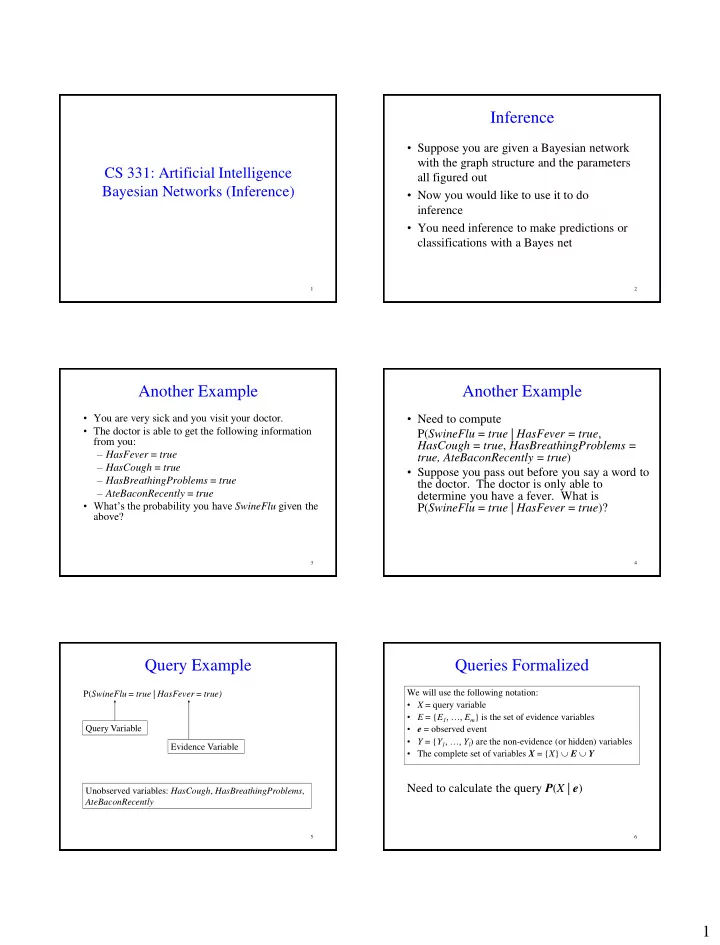
Inference Suppose you are given a Bayesian network with the graph - - PDF document

inference
SMART_READER_LITE
LIVE PREVIEW

Inference Suppose you are given a Bayesian network with the graph - - PDF document

Inference Suppose you are given a Bayesian network with the graph structure and the parameters CS 331: Artificial Intelligence all figured out Bayesian Networks (Inference) Now you would like to use it to do inference You need


slide-1
SLIDE 1

1

1

CS 331: Artificial Intelligence Bayesian Networks (Inference)

2

Inference

  • Suppose you are given a Bayesian network

with the graph structure and the parameters all figured out

  • Now you would like to use it to do

inference

  • You need inference to make predictions or

classifications with a Bayes net

3

Another Example

  • You are very sick and you visit your doctor.
  • The doctor is able to get the following information

from you: – HasFever = true – HasCough = true – HasBreathingProblems = true – AteBaconRecently = true

  • What’s the probability you have SwineFlu given the

above?

4

Another Example

  • Need to compute

P(SwineFlu = true | HasFever = true, HasCough = true, HasBreathingProblems = true, AteBaconRecently = true)

  • Suppose you pass out before you say a word to

the doctor. The doctor is only able to determine you have a fever. What is P(SwineFlu = true | HasFever = true)?

5

Query Example

P(SwineFlu = true | HasFever = true) Query Variable Evidence Variable Unobserved variables: HasCough, HasBreathingProblems, AteBaconRecently

6

Queries Formalized

We will use the following notation:

  • X = query variable
  • E = {E1, …, Em} is the set of evidence variables
  • e = observed event
  • Y = {Y1, …, Yl) are the non-evidence (or hidden) variables
  • The complete set of variables X = {X}  E  Y

Need to calculate the query P(X | e)

slide-2
SLIDE 2

2

7

Inference by Enumeration

  • Recall that:

 

y

y e P e P e P ) , , ( ) , ( ) | ( X X X  

This means you can answer queries by computing sums of products of conditional probabilities from the network

n i i i n

X parents x P x x P

1 1

)) ( | ( ) ,..., (

8

Example #1

Query: P( B=true | C=true ) How do you solve this? 2 steps:

  • 1. Express it in terms of the joint probability distribution P(A, B,

C,D)

  • 2. Express the joint probability distribution in terms of the entries in

the CPTs of the Bayes net B C A D

9

Example #1

Whenever you see a conditional like P( B=true | C=true ), use the Chain Rule: P( B | C ) = P( B, C ) / P(C)

) ( ) , ( ) | ( true C P true C true B P true C true B P      

B C A D

10

Example #1

Whenever you need to get a subset of the variables e.g. P(B,C) from the full joint distribution P(A,B,C,D), use marginalization:

 

              

a b d a d

d D true C b B a A P d D true C true B a A P true C P true C true B P true C true B P ) , , , ( ) , , , ( ) ( ) , ( ) | (

 

y

y Y X P X P ) , ( ) (

B C A D

11

Example #1

To express the joint probability distribution as the entries in the CPTs, use:

N i i i N

X Parents X P X X P

1 1

)) ( | ( ) ,..., ( B C A D

   

                       

a b d a d a b d a d

true C d D P a A true C P a A b B P a A P true C d D P a A true C P a A true B P a A P d D true C b B a A P d D true C true B a A P ) | ( ) | ( ) | ( ) ( ) | ( ) | ( ) | ( ) ( ) , , , ( ) , , , (

      

                             

a b d a d a b d a d

true C d D P a A true C P a A b B P a A P true C d D P a A true C P a A true B P a A P true C d D P a A true C P a A b B P a A P true C d D P a A true C P a A true B P a A P ) | ( ) | ( ) | ( ) ( ) | ( ) | ( ) | ( ) ( ) | ( ) | ( ) | ( ) ( ) | ( ) | ( ) | ( ) (

Example #1

Take the probabilities that don’t depend on the terms in the summation and move them outside the summation B C A D

slide-3
SLIDE 3

3

Example #1

Take the probabilities that don’t depend on the terms in the summation and move them outside the summation B C A D

      

                             

a b d a d a b d a d

true C d D P a A true C P a A b B P a A P true C d D P a A true C P a A true B P a A P true C d D P a A true C P a A b B P a A P true C d D P a A true C P a A true B P a A P ) | ( ) | ( ) | ( ) ( ) | ( ) | ( ) | ( ) ( ) | ( ) | ( ) | ( ) ( ) | ( ) | ( ) | ( ) (

Sums to 1 Sums to 1

Example #1

Take the probabilities that don’t depend on the terms in the summation and move them outside the summation B C A D

       

                              

a a a b a a b a

a A true C P a A P a A true C P a A true B P a A P a A b B P a A true C P a A P a A true C P a A true B P a A P a A true C P a A b B P a A P a A true C P a A true B P a A P ) | ( ) ( ) | ( ) | ( ) ( ) | ( ) | ( ) ( ) | ( ) | ( ) ( ) | ( ) | ( ) ( ) | ( ) | ( ) (

Sums to 1

Doesn’t depend

  • n b. Can move

to the left

        

                                                                                             

b e a e a b e a e a b e a e a

a A true M P a A true J P e E b B a A P e E P b B P a A true M P a A true J P e E true B a A P e E P true B P a A true M P a A true J P e E b B a A P e E P b B P a A true M P a A true J P e E true B a A P e E P true B P true M true J a A e E b B P true M true J a A e E true B P true M true J P true M true J true B P true M true J true B P ) | ( ) | ( ) , | ( ) ( ) ( ) | ( ) | ( ) , | ( ) ( ) ( ) | ( ) | ( ) , | ( ) ( ) ( ) | ( ) | ( ) , | ( ) ( ) ( ) , , , , ( ) , , , , ( ) , ( ) , , ( ) , | (

15

Example #2

B E A J M

16

Practice

A B C D E Write out the equations for the following probabilities using probabilities you can obtain from the Bayesian network. You will have to leave it in symbolic form because the CPTs are not shown, but simplify your answer as much as possible.

  • 1. P(A=true, B=true, C=true, D=true,

E=true)

17

CW: Practice

A B C D E

  • 2. P(B=true | D=true)

18

CW: Practice

A B C D E

  • 3. P(A=true, D=true, E=true | B=true,

C=true)

slide-4
SLIDE 4

4

19

Complexity of Exact Inference

  • The Burglary/Earthquake Bayesian network is an

example of a polytree

  • Singly connected networks (aka polytrees) have at

most one undirected path between any two nodes in the network

Burglary Earthquake Alarm JohnCalls MaryCalls

Complexity of Exact Inference

  • Polytrees have a nice property:

The time and space complexity of exact inference in polytrees is linear in the number of variables

  • What about multiply connected networks?

Sprinkler Rain Wet Grass Cloudy

21

Complexity of Exact Inference

  • What about for multiply connected

networks?

  • Exponential time and space complexity in

the number of variables in the worst case

  • Bad news: Inference in Bayesian networks

is NP-hard

  • Even worse news: inference is #P-hard

(strictly harder than NP-complete problems)

22

The Good News

  • Although exact inference is NP-hard,

approximate inference is tractable

– Lots of promising methods like sampling, MCMC, variational methods, etc.

  • Approximate inference is a current research

topic in Machine Learning

23

CW: Practice

B C A

C B A P(A|B,C) false false false 0.1 false false true 0.9 false true false 0.2 false true true 0.8 true false false 0.3 true false true 0.7 true true false 0.4 true true true 0.6 B P(B) false 0.25 true 0.75 C P(C) false 0.1 true 0.9

  • 4. What is P(B=false,C=false)?

24

CW: Practice

B C A

C B A P(A|B,C) false false false 0.1 false false true 0.9 false true false 0.2 false true true 0.8 true false false 0.3 true false true 0.7 true true false 0.4 true true true 0.6 B P(B) false 0.25 true 0.75 C P(C) false 0.1 true 0.9

  • 5. Can you come up with another Bayes net structure (using only

the 3 nodes above) that represents the same joint probability distribution?

slide-5
SLIDE 5

5

25

What You Should Know

  • How to do exact inference in probabilistic

queries of Bayes nets

  • The complexity of inference for polytrees

and multiply connected networks