
SLIDE 1
LASSONDE INDUSTRIES INC.
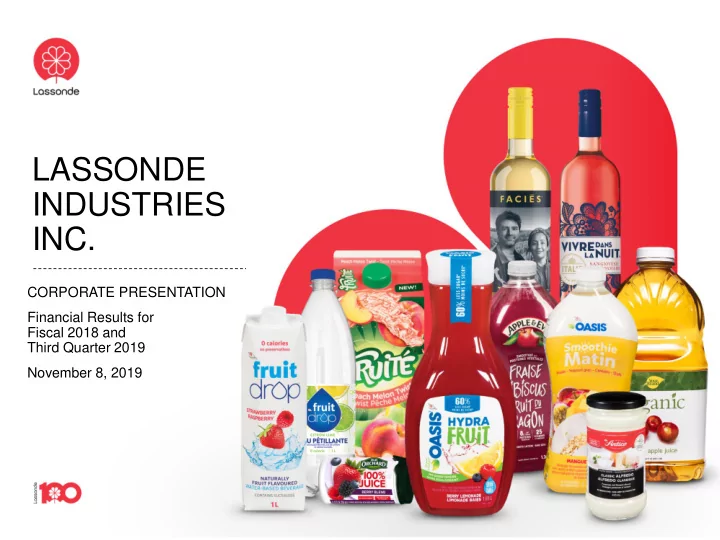
CORPORATE PRESENTATION Financial Results for Fiscal 2018 and Third Quarter 2019 November 8, 2019
INDUSTRIES INC. CORPORATE PRESENTATION Financial Results for - - PowerPoint PPT Presentation
LASSONDE INDUSTRIES INC. CORPORATE PRESENTATION Financial Results for Fiscal 2018 and Third Quarter 2019 November 8, 2019 FORWARD-LOOKING STATEMENTS Caution regarding forward-looking statements Certain statements made in this presentation,
CORPORATE PRESENTATION Financial Results for Fiscal 2018 and Third Quarter 2019 November 8, 2019
Caution regarding forward-looking statements Certain statements made in this presentation, including, but not limited to, statements regarding the prospects of the industry, plans, financial position, and business strategy of the Company may constitute forward-looking statements within the meaning of Canadian securities legislation and regulations. These forward-looking statements do not provide guarantees as to the future performance of Lassonde Industries
provided in the “Uncertainties and Principal Risk Factors” section of the MD&A for the year ended December 31, 2018, available at www.sedar.com and at www.lassonde.com. The forward-looking statements contained in this presentation reflect our expectations as at November 8, 2019 and, accordingly, are subject to change after this date. Except as may be required by Canadian securities laws, we do not undertake any obligation to update or revise any forward-looking statements contained in this presentation, whether as a result of new information, future events, or
The terms “EBITDA,” “free cash flow,” and “Adjusted EPS” are non-GAAP financial measures and do not have any standardized meaning under IFRS. They are therefore unlikely to be comparable to similar measures presented by other issuers. Refer to the section “Financial Measures Not in Accordance with IFRS” in the MD&A of Lassonde Industries Inc. for the Third Quarter ended September 28, 2019.
2
% Δ % Δ 2018 2017 2016 18 vs 17 17 vs 16 Sales 1,594.0 1,526.1 1,509.5 4.4% 1.1% Operating profit 105.2 133.3 126.2
5.6%
Operating profit/Sales 6.6% 8.7% 8.4%
Profit 68.0 95.5 72.2
32.4% Profit attributable to shareholders 66.4 89.9 68.2
32.0% EBITDA 154.0 177.9 171.2
3.9% Earnings per share (EPS) 9.50 12.87 9.75
32.0% Years ended December 31
In millions of $ (except EPS)
3
Sales of $1,594.0M, $67.9M (or 4.4%) vs $1,526.1M in 2017:
$1.0M, sales for 2018 were up $2.0M, mainly due to:
Operating profit of $105.2M, $28.1M (or -21.1%) vs $133.3M in 2017:
benefited from a $0.6M gain on disposal of capital assets;
Company’s U.S. operations, while the Canadian operating profit was up slightly;
from both regulatory changes in the U.S. and labor scarcity;
and PET resin, partly offset by a reduction in the cost of orange concentrates;
from a difficult competitive environment;
and 2017 operating profit.
4
Financial expenses of $15.1M in 2018 vs $12.2M in 2017, $2.9M:
“Other (gains) losses”: $1.1M loss in 2018 vs $0.3M gain in 2017:
The 2018 effective income tax rate was 23.5% versus 21.3% in 2017:
tax liabilities following the U.S. tax reform adopted in December 2017. Without this adjustment, the 2017 effective rate would have been 30.6%.
Profit attributable to shareholders of $66.4M in 2018 vs $89.9M in 2017 and EPS of $9.50 vs $12.87 in 2017:
the gain on disposal of capital assets, the 2018 profit attributable to shareholders would have been down $7.2M year over year.
5
In millions of $
% Δ % Δ 2018 2017 2016 18 vs 17 17 vs 16 Non-cash working capital 196.2 145.0 169.5 35.3%
Property, plant and equipment 305.6 273.3 268.8 11.8% 1.7% Total assets 1,318.6 1,055.7 1,103.6 24.9%
$ Δ Net Debt 18 vs 17
Long-term debt
297.2 158.9 242.5 138.3
Current portion of long-term debt
24.6 9.8 10.0 14.8
Bank overdraft
6.4 (5.0)
Minus: Cash and cash equivalents
(4.6) (16.2) (0.5) 11.6 317.2 157.5 258.4 159.7 Net debt/Total assets 24.1% 14.9% 23.4% As at December 31
* The indebtedness of our U.S. subsidiaries was US$191.1 M as at December 31, 2018, whereas the Company had borrowed US$481.7 M to carry out its three U.S. acquisitions.
6
In millions of $
Variance 2018 2017 2018-2017 Free cash flow Profit 68.0 95.5 (27.5) Adjustments Amortization and Depreciation 48.8 45.2 3.6 Pension plans, income tax and other 5.7 (0.9) 6.6 Change in non-cash working capital (7.8) 5.1 (12.9) Cash flows from operating activities 114.7 144.9 (30.2) Dividends paid (21.2) (17.4) (3.8) Acquisition of PP&E and intangibles (35.4) (38.0) 2.6 Net proceeds from the disposal of PP&E 0.1 2.2 (2.1) 58.1 91.7 (33.6) Business acquisitions (196.9)
Free cash flow (138.8) 91.7 (230.5) Used (Financed) as follows: Decrease (increase) in net debt* (139.0) 91.7 (230.7) Non-controlling interest (2.6)
Repurchase of shares 2.8
(138.8) 91.7 (230.5) Years ended December 31
* Before currency translation effect
7
8
% Δ $ Δ
% Δ $ Δ 2019 2018 19 vs 18 19 vs 18 2019 2018 19 vs 18 19 vs 18 Sales 422.9 418.6 1.0% 4.3 1,246.2 1,167.2 6.8% 79.0 Operating profit 25.0 29.1
(4.1) 75.9 79.4
(3.5)
Operating profit/Sales 5.9% 6.9% 6.1% 6.8%
Profit attributable to shareholders 15.3 18.0
(2.7) 43.5 50.6
(7.1) EBITDA 39.3 41.8
(2.5) 118.4 115.0 2.9% 3.4 Earnings per share (EPS) 2.21 2.57
(0.36) 6.27 7.24
(0.97)
$ Δ 2019 2018 19 vs 18 Net Debt
Long-term debt (including current)
312.4 321.8 (9.4)
Lease Liabilities (IFRS 16)
26.1
Bank overdraft
1.8
Minus: Cash and cash equivalents
(1.1) (4.6) 3.5 339.2 317.2 22.0
In millions of $
As at Third Quarters ended First Nine Months ended
(except EPS)
Sales of $422.9M, $4.3M from $418.6M in 2018:
administrative tribunal on product classification and that reduced the customs duties paid in previous years by $2.6M. Excluding this item and a $2.7M favourable foreign exchange impact, the Company’s third-quarter sales were up $4.2M year over year, due to:
brands, mainly in the United States; and
Operating profit of $25.0M, $4.1M from $29.1M in 2018:
was down $1.5M year over year. This decrease reflects the following items:
the cost of certain inputs; and
and a decrease in the cost of certain inputs. These items were partly offset by an unfavourable foreign exchange impact and the impact of a slower rate of production resulting from investment-related work at one of the Company’s plants; and
quarter operating profit.
9
Financial expenses of $4.6M vs $5.1M in 2018, $0.5M:
“Other (gains) losses”: Gain of $0.9M in 2019 vs $0.3M loss in 2018:
consideration payable, whereas the 2018 loss was mainly due to foreign exchange losses and to a loss resulting from a change in the fair value of financial instruments.
Effective income tax rate of 26.5% in Q3-2019 vs an effective income tax rate of 22.6% in Q3-2018:
deductibility of certain expenses incurred in 2019.
Profit attributable to shareholders of $15.3M in 2019, $2.7M vs $18.0M in 2018 and EPS of $2.21 vs $2.57 in 2018:
years, the 2019 third-quarter profit attributable to the Company’s shareholders was down $0.8M year over year.
10
Dividend:
Outlook:
Barring any significant external shocks (and excluding foreign exchange impacts and the impact of the OOB acquisition to maintain a comparable basis), the Company expects that, for 2019, it will be able to achieve a consolidated annual sales growth rate slightly above that of 2018; and
five years, as two major investment projects will be undertaken to provide the Company with additional capacity for fruit juice and drinks and specialty food products. The Company believes that its use of investing cash flows could reach between $40M and $45M in 2019;
affect its cash flows.
11
LASSONDE INDUSTRIES INC.
2018 Sales:
Lassonde Specialties Develops, manufactures, and markets specialty food products. Arista Wines Imports and markets selected wines and manufactures apple ciders and cider-based beverages. Lassonde Pappas and Company An American leader in the development, manufacture, and marketing of private label and national brand fruit juices and drinks.
The Canadian leader in the development, manufacture, and marketing of fruit juices and drinks.
13
Cash flows from operating activities:
$0 $200 $400 $600 $800 $1,000 $1,200 $1,400 $1,600 $1,800 2010 2011 2012 2013 2014 2015 2016 2017 2018
Canada United States Other 14 In millions
6% 92%
60% 40%
15
1. Calgary (AB) 2. Thornbury (ON) 3. Toronto (ON) 4. Rougemont, Saint-Damase, Boisbriand (QC)
head office and multiple facilities
5. Port Williams (NS) 6. Carver (MA)
cranberry receiving station
7. Seabrook (NJ) 8. Carneys Point (NJ) LPC head office 9. Baltimore (MD)
Apple & Eve
Old Orchard Brands
1 2 3 5 4 12 11 10 9 7 13 6 8
Canada Head office United States Head office
14
Lassonde faced a difficult competitive environment in a context of significant cost increases in 2018:
Company's main US competitor, thereby changing the structure of the private label fruit juice and drinks offering in the United States;
concentrate and the higher cost of PET resin;
and a shortage of drivers;
inflationary pressures because of the extremely low unemployment rate in New Jersey and North Carolina;
retailers to this increased competition, has the effect of limiting the Company's ability to increase its prices in this context of high inflation.
16
17
The new Canada Food Guide was published in January 2019.
to be consumed in moderation.
A Leger Marketing survey of 1,518 Canadians in April 2019 revealed that:
positive view of 100% juice and this figure is consistent with the results of surveys conducted over the years
100% juice contains only the natural sugar of the fruit
have actually read the new version of Canada's Food Guide
We know that:
fresh fruit market;
13% between 2004 and 2015 in Canada1. In the United States, only 12% of adults consume the recommended daily portion of fruits;2
100% pure juice complements fruit consumption, rather than competing with it.
18
1 Differences in the Quantity and Types of Foods and Beverages Consumed by Canadians between 2004 and 2015. Nutrients 2019. 2 State Indicator Report on Fruits and Vegetables, CDC 2018. 3 C.E. O'Neil et coll. Diet quality is positively associated with 100% fruit juice consumption in children and adults in the United States, 2011.
Water Protein Lipids Carbohydrates Fiber Vitamin C Vitamin B1 Vitamin B2 Vitamin B3 Vitamin B6 DFE Folate Vitamin A Vitamin E
100% juice contains:
Sugars (from fruit) Minerals Iron Magnesium Potassium Zinc
19 Nutrient Unit Orange 100 g Orange juice 100 g
Proximate analysis
Water g 86.75 87.22 Energy kcal 47 49 Protein g 0.94 0.68 Lipids g 0.12 0.12 Carbohydrates g 11.75 11.54 Fibre g 2.4 0.3 Sugars (from fruit) g 9.35 8.31
Minerals
Iron mg 0.10 0.13 Magnesium mg 10 11 Potassium mg 181 178 Zinc mg 0.07 0.07
Vitamins
Vitamin C mg 53.2 33.6 Vitamin B1 mg 0.087 0.046 Vitamin B2 mg 0.04 0.039 Vitamin B3 mg 0.282 0.028 Vitamin B6 mg 0.060 0.076 Folate µg 30 19 Vitamin A IU 225 42 Vitamin E mg 0.18 0.20
The molecular biodiversity of the juice is comparable to that of the fruit. In terms of vitamins and minerals, there is nothing closer to a fruit than 100% juice.
20 Nutrient Unit Apple 100 g Apple juice 100 g
Proximate analysis
Water g 85.56 88.24 Energy kcal 52 46 Protein g 0.26 0.10 Lipids g 0.17 0.13 Carbohydrates g 13.81 11.3 Fibre g 2.4 0.2 Sugars (from fruit) g 10.39 9.62
Minerals
Iron mg 0.12 0.12 Magnesium mg 5 5 Potassium mg 107 101 Zinc mg 0.04 0.02
Vitamins
Vitamin C mg 4.6 38.5 Vitamin B1 mg 0.017 0.021 Vitamin B2 mg 0.026 0.017 Vitamin B3 mg 0.091 0.073 Vitamin B6 mg 0.041 0.018 Folate µg 3 Vitamin A IU 54 1 Vitamin E mg 0.18 0.01
The molecular biodiversity of the juice is comparable to that of the fruit. In terms of vitamins and minerals, there is nothing closer to a fruit than 100% juice.
Our initiatives:
participate in the work of the U.S. Juice Product Association.
21
22 TO CONSOLIDATE TO OFFER THE RIGHT PRODUCT IN THE RIGHT SIZE AT THE RIGHT PRICE TO PROMOTE SUSTAINABLE DEVELOPMENT INNOVATE
23
Acquisition of Old Orchard Brands
against a backdrop of rising transportation costs;
smaller environmental footprint.
Increased production capacity at Lassonde Specialties:
24
Additions to the Stefano Faita sauces Investments at the Boisbriand plant
Packaging – goals by 2025
plastic straws;
in our packaging;
for our products;
and associations to promote the collection
25
Water
the amount of water used to produce each liter of juice;
will enable us to reduce its water consumption by 67%.
26
AVERAGE WATER CONSUMED TO PRODUCE ONE LITRE OF FINISHED PRODUCT - 2018
LASSONDE, JUICE DIVISIONS MAJOR GLOBAL PRODUCERS BREWING INDUSTRY, WORLD
HEALTH
Promote healthy lifestyle habits by reducing the amount of sugar and calories in our products 1.7 2.0 3.0 - 3.5
Innovate in our current market segments: fruit juices and drinks, iced tea, ready-to-drink infusions and smoothies
Enter adjacent segments to ensure long-term growth: flavoured water (regular and sparkling), sparkling juices, protein drinks
27
28
We prioritize two segments in product development:
Health and wellness: sugar reduction efforts between 2014 and 2018
Drop) and with added benefits (Probiotics, Protein Smoothies).
2014 2015 2016 2017 2018
New products in 2019: even more hydration solutions
29
OASIS MORNING SMOOTHIE 1.36 L ARIZONA 200 ML DEL MONTE PRUNE NECTAR 945 ML FRUIT DROP SPARKLING 1 L OASIS INFUSION 1 L DEL MONTE COCONUT WATER 1 L
30
MISSION:
enjoy healthier and happier lives. True to our legacy as innovators, we can do that + more.
VISION:
31
Sharpen LPC’s competitive edge:
capacity: gradual elimination of low margin customers;
actions of the Company’s main private label competitor;
Investments in talent and capital:
brands and private label;
formats.
32
Production and supply chain:
drivers and identifying activities that do not create added value for the Company;
scarcity has the effect of accelerating the payback and return on investment
has become more complex and requires much more than just an online bidding system.
Better brand positioning:
focusing efforts on markets where Lassonde Pappas brands have a strong presence;
categories adjacent to fruit juices and drinks.
Focus on the Northeastern United States Focus on the Midwestern United States
33
Finalize the Old Orchard Brands acquisition and start the integration process. Raise the production capacity of Lassonde Specialties to meet the needs of the strong growth of this subsidiary. This $23M investment program will begin in 2018 and be spent over a three-year period. Reap the benefits of the added capacity from the new production line for family-sized plastic bottles in Canada. It has been operational since April 2018. Support organic growth through innovation (national brands) and by developing new solutions for customers (private brands). Maintain the profitability of our U.S. operations in a context of inflationary pressures and heightened competition. Add a new production line for single-serve products in the United States to expand Lassonde’s offering in this fast-growing segment. This investment program of approximately US$30M is expected to be completed at the end of 2019. Maintain the pace of debt repayment despite significant equipment investments aimed at raising capacity and producing new types of packaging in both Canada and the United States.
Acquisition completed on May 31, 2018 SLI investment program is progressing according to plans and budget The new production line is fully
already at 55% Strong organic growth in Canada while U.S. sales were slightly down in a declining market Lassonde did not maintain the profitability of its US operations due to significant cost increases Lassonde is exploring different types of packaging solution given the current competitive environment Free cash flow of $58.1M in spite of a decline in the Company’s earnings
contribution margin for the use of the Company’s production capacity.
strong growth of that subsidiary. The investment program of roughly $30M extends over three years.
single-serve and family formats and by developing new solutions for our private label customers (single-serve isotonic products).
development of the grocery store wine market in Ontario.
advantage of the logistical benefits of adding the Sparta plant to our manufacturing footprint.
with particular needs.
increase capacity in both Canada and the U.S.
34
LASSONDE INDUSTRIES INC.
36
1,181.0 1,449.3 1,509.5 1,526.1 1,594.0 0.0 200.0 400.0 600.0 800.0 1,000.0 1,200.0 1,400.0 1,600.0 1,800.0 2014 2015 2016 2017 2018 123.2 154.0 171.2 177.9 154.0 0.0 20.0 40.0 60.0 80.0 100.0 120.0 140.0 160.0 180.0 200.0 2014 2015 2016 2017 2018
*CAGR 5 years: 8.9% *CAGR 5 years: 5.9% Fruit Juices and Drinks CAGR 5 years: Canadian market = -1.0% U.S. market = -1.3%
* Compounded average growth rate
6.47 8.15 9.75 12.87 9.50 0.00 2.00 4.00 6.00 8.00 10.00 12.00 14.00 2014 2015 2016 2017 2018
37
*CAGR 5 years: 4.8% *CAGR 5 years: 8.1%
88.4 111.3 126.2 133.3 105.2 0.0 20.0 40.0 60.0 80.0 100.0 120.0 140.0 160.0 2014 2015 2016 2017 2018
* Compounded average growth rate
LASSONDE INDUSTRIES INC.
CORPORATE PRESENTATION Financial Results for Fiscal 2018 and Third Quarter 2019 November 8, 2019