Induction Meeting still face experiment Welcome Aims Provide key - - PowerPoint PPT Presentation

induction meeting still face experiment welcome
SMART_READER_LITE
LIVE PREVIEW

Induction Meeting still face experiment Welcome Aims Provide key - - PowerPoint PPT Presentation

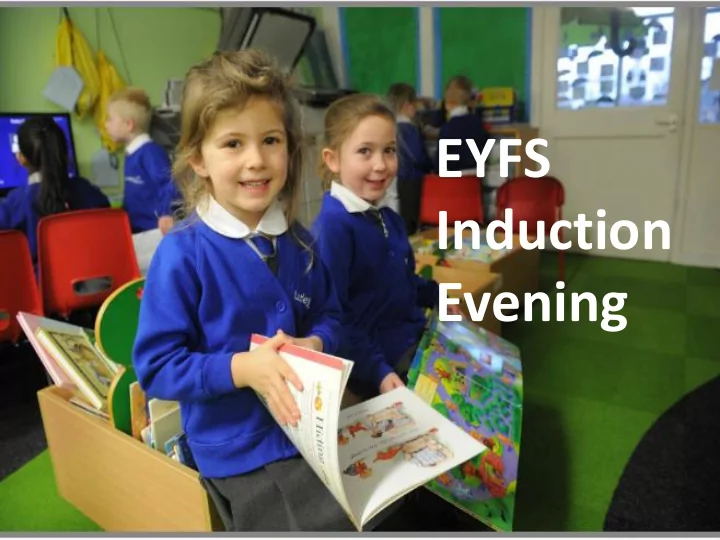
EYFS Induction Evening Induction Meeting still face experiment Welcome Aims Provide key information for being school ready Meet the EYFS team Opportunity to visit the EYFS area To find out which class your child is in


slide-1
SLIDE 1

Induction Meeting

EYFS Induction Evening

slide-2
SLIDE 2

still face experiment

slide-3
SLIDE 3
slide-4
SLIDE 4
slide-5
SLIDE 5

Welcome

Aims

  • Provide key information for being ‘school ready’
  • Meet the EYFS team
  • Opportunity to visit the EYFS area
  • To find out which class your child is in
  • Have any questions that you may have answered
slide-6
SLIDE 6

Headteacher Mrs Rebecca Cox Deputy Headteacher Mrs Kate Hall Assistant Headteacher EYFS and KS1 Mr Alex Hall EYFS Specialist Leader of Education (SLE) Miss Stephanie Wheatcroft Class Teachers TAs Miss Helena Davies Mrs Anne Nock Mrs Heidi Perry Mrs Karen Field Mr Tom Budgen Mrs Tracey Dodgson Healthcare and wellbeing team Mrs Vicky Wright - HLTA, Parent Liaison and Triple P facilitator

Lutley Staff

slide-7
SLIDE 7

School Readiness

slide-8
SLIDE 8

Research shows almost all - 99.5 per cent - primary school leaders say that pupils are joining school below the level of school- readiness they expect.

slide-9
SLIDE 9

What do we mean by ‘school readiness’?

We would expect children to be ready to be separated from their parent or carer, to be able to demonstrate listening skills in being able to show interest and pay attention to a subject or stimulus. To use language to be able to express themselves and talk about themselves and their family. To be able to interact with an adult and peers. For example, during play to be able to take turns and take some responsibility for their actions. We think that children should be able to focus on, and show interest in, their work and the world around them. To make observations, notice things and ask questions. To be able to hold a book, understand some aspects

  • f narrative and respond to some boundary setting.
slide-10
SLIDE 10

Percentage of all children ‘school ready’ pupils in 2017

Worst performers Best Performers Local authority % not school ready Local authority % not school ready Halton 39 Lewisham 21 Liverpool 38 Greenwich 22 Middlesbrough 37 Richmond-upon-Thames 22 Peterborough 37 Surrey 23 Leicester 36 Bromley 23 Rochdale 36 South Gloucestershire 23 Oldham 36 Windsor & Maidenhead 23 Sandwell 36 Bexley 23 Dudley 35 Leeds 35 Hull 35

slide-11
SLIDE 11

The most common reasons for children not being at expected level

slide-12
SLIDE 12

The reasons why children are not at the expected level

  • Mobile phones
  • Mobile technology
  • Screen time
  • Pressure on parents and family life (66 per

cent)

slide-13
SLIDE 13

Working in Partnership with You

We recognise that you are your child’s first and most enduring

  • educators. When we

work together the results have a positive impact on children’s development and learning.

slide-14
SLIDE 14
  • We know the importance of home learning.
  • What you do on a daily basis with your children is important.
  • ‘All parents who regularly involve their children in home learning activities that

stretch a child’s mind can enhance their children’s learning and development.’ ‘What parents and carers do makes a real difference to young children’s development.’ (EPPE) There are a range of activities that parents undertake with their children before starting school (all associated with higher intellectual and social/behavioural scores):

  • reading with your child
  • teaching songs and nursery rhymes
  • painting and drawing
  • playing with letters and numbers and teaching them
  • visiting the library
  • taking children on visits
  • creating regular opportunities for them to play with their friends at home
slide-15
SLIDE 15
slide-16
SLIDE 16
slide-17
SLIDE 17
slide-18
SLIDE 18

What we expect children to be able to do when they start Reception in....

  • Communication and Language, including

speech

  • PSED
  • Health and self-care
slide-19
SLIDE 19

Learning, Caring, Aiming High - Together

How are Lutley getting ready for your children?

  • Parent meetings
  • Home visits
  • Nursery visits and information (22 settings)
  • Teaching team
  • Planning for September based on your child’s interests
  • In school reading sessions
  • Transition days – Teddy Bear’s picnic
  • ‘Enabling’ (learning) Environments
  • Resource and induction information packs

Working together with you to get it right!

slide-20
SLIDE 20

Communication and Language

slide-21
SLIDE 21

What do we mean by language development?

  • Process by which children come to use words,

gestures and vocalisations to communicate with others and gain knowledge

  • Mastery of the sounds, meaning, order and

use of words

  • The child’s increasing understanding of the

social dynamics of language

slide-22
SLIDE 22

Helping children develop their communication skills is one of the most important jobs you can do as a parent. That’s because spoken communication is the key to so much in life that’s important, from making friends and getting a good education to enjoying a successful career. Communication is the foundation for getting a great start in life.

slide-23
SLIDE 23

The impact of language

  • Importantly, one of the first steps towards

learning to read and write.

  • Heart of a child’s social and emotional
  • development. Relationships are made and

maintained through communication. And it’s through communication that children learn to ‘read’ other people’s emotional states and express their own.

slide-24
SLIDE 24

“Children who find communication hard find life hard” Jean Gross, 2016 In later life more likely to be unemployed, have health issues, criminality Emotional and behavioural difficulties Fewer friendships Poorer mental health Speech or language impairment Weaker literacy skills Fewer GCSEs and A-levels

slide-25
SLIDE 25

The Communication Tree

slide-26
SLIDE 26

By the time children enter school we expect them to be able to...

  • Listen to what people say
  • Understand what they say
  • Follow instructions (two parts) without stopping to look at the teacher
  • Speak clearly – use sentences of 4-6 words; use future and past tenses
  • Express themselves using language (good vocabulary of 5000 words)
  • Share their thoughts and ideas with the class
  • Communicate in an age-appropriate way
  • Listen to stories
  • Able to remember and enjoy telling long stories and sing songs
slide-27
SLIDE 27

Speech wheel

slide-28
SLIDE 28

Word gap is increasing

‘The size of a child’s vocabulary is the best predictor of success on future tests and children with a poor vocabulary are four times more likely to struggle with reading in adulthood and three times more likely to have mental health issues.’ The rate at which children develop language is sensitive to the amount of your input and quality of your

  • interactions. High quality interactions include

talking about the child’s focus of interest, varying vocabulary, and using words in different contexts.

slide-29
SLIDE 29
slide-30
SLIDE 30
slide-31
SLIDE 31
slide-32
SLIDE 32
slide-33
SLIDE 33
slide-34
SLIDE 34
slide-35
SLIDE 35

Further Information

  • Listen Up – resources to encourage listening, understanding,

interaction and play for children https://www.thecommunicationtrust.org.uk/media/3163/postcards_p re_school_final.pdf

  • Small talk - information about what helps children learn to talk and

listen https://www.thecommunicationtrust.org.uk/media/3508/small_talk_fi nal.pdf

  • Talk together - the importance of language, the key milestones in

children’s speech and language and development, how to support your child’s language development, what to do if you have a concern. http://www.talkingpoint.org.uk/sites/talkingpoint.org.uk/files/Talk%20 together%202010.pdf

slide-36
SLIDE 36

PSED

slide-37
SLIDE 37

What do we mean by PSED?

  • A positive sense of themselves
  • A positive sense of others
  • Form positive relationships and respect for
  • thers
  • Social skills
  • Manage feelings
  • Confidence in their own abilities
slide-38
SLIDE 38

By the time children enter school we expect them to be able to...

  • Understand turn-taking as well as sharing
  • Initiate conversations
  • Enjoy playing with peers
  • To negotiate problems, using words, not

actions

  • To follow the behaviour rules
  • To ask for help when needed
slide-39
SLIDE 39

What can you do?

  • Set a good example and give children
  • pportunities for interaction with others so that

they can develop positive ideas about themselves and others

  • Demonstrate active listening and model

awareness of the feelings of others and empathy Encourage your child to listen and notice each

  • ther’s feelings
  • Provide sharing and turn-taking activities e.g.

playing board games

slide-40
SLIDE 40

Self-help skills and resilience

slide-41
SLIDE 41

By the time children enter school we expect them to be able to...

  • Tell us when they are hungry, tired...
  • Be toilet-trained and able to wipe self and flush
  • Wash and dry their hands (and know when to do this)
  • Dress themselves mostly independently e.g. put coat on

and fasten a zip, put shoes and socks on, button and unbutton clothes

  • Use a knife and fork
  • Open a packed lunch on own – open wrappers and

packaging

  • Drink from a water bottle
  • Blow their nose
  • To ask for help when needed
slide-42
SLIDE 42

What can you do?

  • Talk to your child about the importance of

hand-washing

  • Help children with their self-care by giving

them small steps to complete and talking them through the process

  • Give children time in the morning to manage

dressing

  • Teach and encourage your child how to use a

knife and fork

slide-43
SLIDE 43
slide-44
SLIDE 44
slide-45
SLIDE 45

Parent Workshop

  • Monday 2nd July 6.00pm **
  • Thursday 5th July 2.00pm**

**Only need to attend one of these Session is focussed on:

  • Being ‘school ready’ in

Reading Writing Mathematics Physical Development

  • Starting your child’s online Learning Journal (Tapestry)
slide-46
SLIDE 46

Attendance

slide-47
SLIDE 47

Pupil Premium

Mrs Hall Deputy Head

slide-48
SLIDE 48

Lutley PTFA https://drive.google.com/file/d/0B2rS9IFC

  • 3n5UTY4SzFwWGZ5Q1U/view?usp=shari

ng

slide-49
SLIDE 49

Meet the teacher…

slide-50
SLIDE 50

Starting Dates

Settling-in sessions from:

Tuesday 4th and Wednesday 5th September

(9.15 – 12.00noon; 1.00 – 3.15pm)

Full-time school from:

Thursday 6th September (8.45am-3.30pm)

slide-51
SLIDE 51

Induction Newsletter

  • Uniform
  • P.E. Kit
  • Outdoor kit
  • What to bring every day,
  • inc. water bottles
  • Where to drop off and

collect your child