Induction bending provides a cost effective and more sustainable - - PowerPoint PPT Presentation
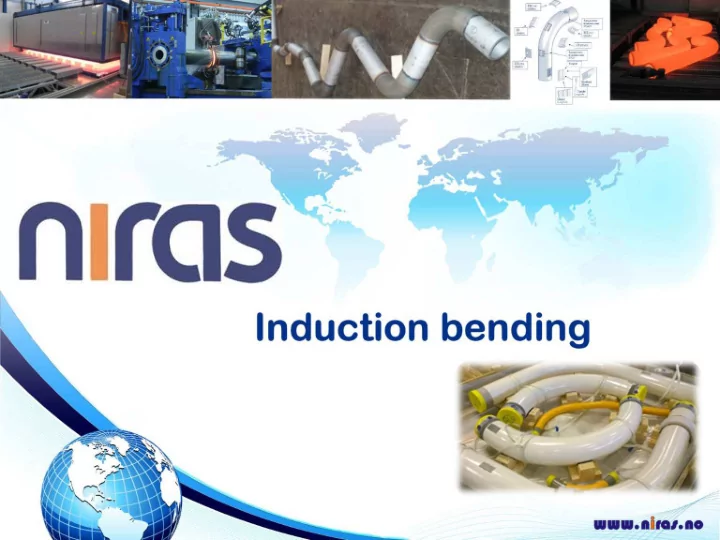
Induction bending provides a cost effective and more sustainable alternative to traditional pipe spool fabrication. NIRAS handles bending of pipes in the outer diameter range: to 20 Laboratory: Microstructural analysis Hardness
Induction bending provides a cost effective and more sustainable alternative to traditional pipe spool fabrication. NIRAS handles bending of pipes in the outer diameter range: ½” to 20”
Laboratory:
- Microstructural analysis
- Hardness testing
- Corrosion testing
Duplex 70 mm wall
Some examples
Reduce number of welds
*Cost saving designs* Traditional
6 welded joints
Induction spool
0 welded joints
Induction bends
1 welded joint
Induction bends
2 welded joints
Benefits when using induction bending
Reducing the number of welds
From 13 to 3 welds Reducing the number of welds
Benefits when using induction bending
Geometry Induction bending allow designers more freedom
Benefits when using induction bending
Flow Designing piping systems with smooth arcs, no welds and larger radii, reduces turbulence and pressure drop and increase the effectivity of the system.
Benefits when using induction bending
Effect of radius on pressure drop in bend
Calculated reduction in pressure drop: 1D 3D 48 % 1,5D 3D 22 %
1 D 1,5 D 3 D
L = equivalent length, V = velocity, D = inner diameter, f = frictions factor (Moody’s diagram), ro = density Example: V = 5m/s, D = 0.100m, f = 0.018, r = 1000kg/m3
Benefits when using induction bending
Reduced erosion rates
Effect of radius on erosion rates
Reduction of erosion rates*: 1,5D 3D 25 % 1,5D 5D 45 % Derived from CFD analysis
- particles in water
1 D 1,5 D 3 D
*Ref.: W. Peng, X. Cao / Powder Technology 294 (2016) 266–279
Niras Spool vs. Standard Spool
Radius: 3D Radius: 1,5D Bend angle: 180°- 45°- 90° Bend angle: 90°- 90°- 45°- 90° Specification: NORSOK Quantity: 10 Spools Material Grade: Super Duplex All costs included:
- Pipes
- Bends
- Welds
- NDT
- Dimensional control
- Documentation
Real Cost Comparison
Niras Spool Standard Spool Route comparison
Niras Spools vs. Standard Spools 6 Inch Sch XXS: 2 Inch Sch 160: 66 % cost saving 61 % cost saving
Induction bending
Basic principle
The principle behind induction bending is to heat up a small cross section of a pipe or profile to such an extent that plastic deformation can be performed by applying relatively small forces. The work piece is forced forward through the induction coil while guided by a rotating arm. Only applying heat to a small section allow high level of control and prevents the pipe or profile from collapsing.
Intrados/extrados
As the pipe moves forward it experiences compression in the intrados of the bend causing material build up and thickening of the pipe. At the same time the extrados of the pipe experience tension. The tension causes the material to stretch and results in wall thinning. Full scale pressure testing has shown that in spite of the thinner wall in extrados the pipe will fail in the unaffected portion of the pipe and not in the bent area.
Intrados- compression Extrados- tension Material build up Wall thinning
- Large radii- small effect
- Small radii- bigger effect
Calculator:
http://www.niras.no/downloads.html
Geometry effects
Intrados/extrados:
Material distribution in bended area
2D 3D 5D
Example of thinning/thickening on 6” sch120 pipe
Pressure distribution
Intrados/extrados:
Centre line approach The pressure is distributed on a larger area in extrados. Local forces acting on the wall becomes less. The pressure is distributed on a smaller area in intrados. Local forces acting on the wall becomes greater. FE-Analysis and destructive pressure testing confirms this approach.
Result: The bend can withstand higher
pressure than the straight pipe!
R&D
Burst testing:
In collaboration with Telemark University Collage, Niras investigated the effect of induction bending
- n fracture location in burst testing.
Material grades investigated were Duplex (UNS S31803) and Grade 316 (UNS S31600). All tests performed showed fracture in the tangent.
R&D
Burst testing:
Burst pressure was 1297 bar, 1.5% above the burst pressure for equivalent standard bends according to ASME B16.9. Selected geometry: 90° 3D bend
Induction bend after burst testing
Plot from calculation model showing plastic deformation over 5%
Duplex Steels
Bending without PBHT Duplex up to 26 mm wall thickness Super Duplex up to 22 mm wall thickness
(dependent of mother pipe and other dimensions)
Limitation: Sufficient heating Sufficient cooling
Critical temperature range: 550 °C – 1050 °C Sigma formation Above 1120 °C Nitride precipitation
Post Bend Heat Treatment (PBHT)
When necessary to maintain the material properties NIRAS will perform PBHT on the induction bended pipes. Applicable PBHT’s:
- Solution annealing
- Normalizing
- Quenching
- Tempering
Capacity: 3.75 MT
- Temp. range: 580 – 1150 °C
Working zone: 5800 X 2300 X 1000 Qualification: NORSOK M-650/API 5L
Materials
Alloys for bending
All electrically conductive materials can be induction bent. Suitable for induction bending:
- All types of steel
- Aluminium
- Copper
- Nickle alloys
- Etc.
If properties can be maintained or enhanced after bending depends on the original condition of the material.
Pipe and Profiles
Pipe Dimensions: 16 mm and up (Niras max. OD is 18inches) Profile dimensions: Maximum 300 x 600 mm Radii up to 22 000 mm Angle: 0° - 300°
Design
Niras design criteria
http://www.niras.no/downloads.html If in doubt please contact us Commonly used
Doing it smart
Produce spools were possible
Save cost of welding and procurement of standard bends. Reduces lead time due to fewer welding operations.
Send drafts and get valuable feedback
We have long experience with routing to optimise for induction bending. Less bending – lower cost and lead time. We do workshops with engineering companies on EPC projects from FEED and through-out to give input on how to best exploit the possibilities of the process.