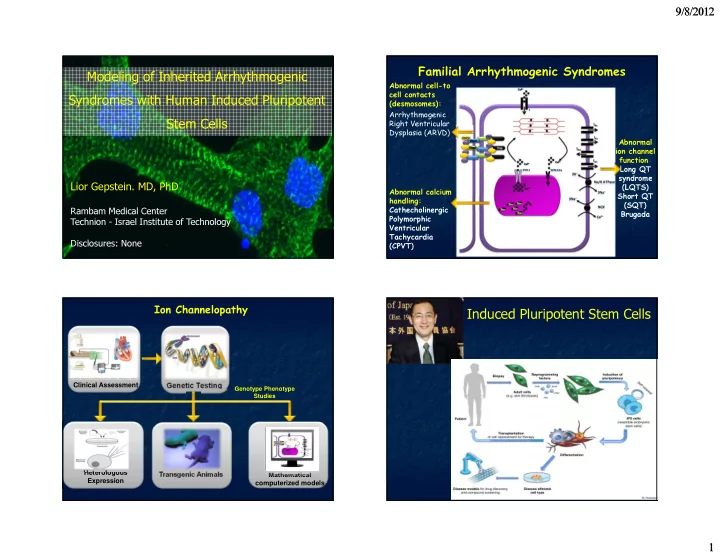
Induced Pluripotent Stem Cells Clinical Assessment Genetic Testing - - PowerPoint PPT Presentation

induced pluripotent stem cells
SMART_READER_LITE
LIVE PREVIEW

Induced Pluripotent Stem Cells Clinical Assessment Genetic Testing - - PowerPoint PPT Presentation

9/8/2012 Familial Arrhythmogenic Syndromes Modeling of Inherited Arrhythmogenic Abnormal cell-to cell contacts Syndromes with Human Induced Pluripotent (desmosomes): Arrhythmogenic Stem Cells Right Ventricular Dysplasia (ARVD) Abnormal


slide-1
SLIDE 1

9/8/2012 1

Modeling of Inherited Arrhythmogenic Syndromes with Human Induced Pluripotent Stem Cells

Lior Gepstein. MD, PhD

Rambam Medical Center Technion - Israel Institute of Technology Disclosures: None

Abnormal cell-to cell contacts (desmosomes): Arrhythmogenic Right Ventricular Dysplasia (ARVD) Abnormal ion channel function: Long QT syndrome (LQTS) Short QT (SQT) Brugada Abnormal calcium handling: Cathecholinergic Polymorphic Ventricular Tachycardia (CPVT)

Familial Arrhythmogenic Syndromes

Ion Channelopathy

Clinical Assessment

Genetic Testing

Genotype Phenotype Studies

Mathematical computerized models Heterologous Expression Transgenic Animals

Induced Pluripotent Stem Cells

slide-2
SLIDE 2

9/8/2012 2 Cardiomyocyte Differentiation of hiPSCs

Tra-I-60

Zwi et al., Circulation 2009 Fibroblasts hiPSCs-colonies hiPSCs-derived cardiomyocytes

*

α-actinin cTnI

1 sec 30 mV

hIPSCs-Derived Cardiomyocytes

Zwi et al., Circulation 2009

Calcium Handling in hiPSCs-CMs

Caffeine puff

Sarcomeric α-actinin RyR2

1 F/F0 5 sec Itzhaki, et al. PLoS One 2011

iPS Cells Somatic Cells Structural analysis Gene expression analysis Multielectrode array recordings Patch-clamp

250 ms

Confocal Calcium Imaging Patient/Disease Specific Cardiomyocytes Reprogramming

slide-3
SLIDE 3

9/8/2012 3

Long QT Syndrome

LQTS-Fibroblasts

PVC QTc-520ms

Itzhaki I, et al. Nature 2011

C T (Ala614 Val)

* *

KCNH2 gene

Ventricular Atrial Nodal

0 mV 400 ms 30 mV 0 mV

LQTS Control

200 400 600 800 1000 APD 50 APD 70 APD 90 APD (mseC)

Atrial

Control LQTS

500 1000 1500 APD 50 APD 70 APD 90 APD (msec)

Ventricular

Control LQTS

200 400 600 800 APD 50 APD 70 APD 90 APD (msec)

Nodal

Control LQTS

* * * * * *

LQTS Control

Ventricular- Paced at 0.5Hz

1 sec

30 mV 500 1000 1500 APD 50 APD 70 APD 90 APD (msec)

Ventricular - Paced at 0.5 Hz

Control LQTS

* * * Spontaneous APs

Action Potential Recordings from Control and LQTS hiPSCs-CMs

Ventricular Atrial Nodal 0 mV 400 ms 30 mV

LQTS Control Control LQTS FPD- 0.31 sec FPD- 1.01 sec

Multielectrode Array (MEA) Recordings

The observed prolongation (in APD and cFPD) is the characteristic electrophysiological signature of the LQTS.

slide-4
SLIDE 4

9/8/2012 4

Itzhaki I, Meizels L, Huber I, et al. Nature 2011

Α614ς

Ventricular EAD Atrial EAD

0 mV 400 ms 30 mV

LQTS

Ventricular Atrial Nodal 0 mV 400 ms 30 mV

LQTS Control

Early After Depolarizations (EADs) in the LQTS Itzhaki I, Meizels L, Huber I, et al. Nature 2011

2 sec 20 mV 5 sec EAD Triggered beat EAD Triggered beat

Development of Triggered-Activity in the LQTS hiPSCs-CMs Itzhaki I, et al. Nature 2011

2 sec

Pinacidil (KATP Channel Opener) Ameliorating Effects on the LQTS-hiPSCs-CMs

5 sec 20 mV

LQTS – Pinacidil LQTS – Baseline

1 sec 30 mV

LQTS – Pinacidil LQTS – Baseline

Itzhaki I, Meizels L, Huber I, et al. Nature 2011

slide-5
SLIDE 5

9/8/2012 5

CPVT- Type I CPVT- Type II

Catecholaminergic Polymorphic Ventricular Tachycardia (CPVT)

Liu, et al. J Mol Cell Cardiol, 2009

* T

G (Met4109 Arg)

*

(M4109R) heterozygous missense mutation

OCT4 NANOG TRA1 –60 AP SSEA 4

Itzhaki I, Meizels L, et al. J Am Coll Cardiol (accepted)

OCT4 NANOG NKX2-5 MLC2V MYH6 MYH7 CTNI β-ACTIN Undiff CMs cTnI α- actinin α - actinin merged CPVT RyR RyR α - actinin merged Control

0 mV

Ventricular Atrial Nodal

30 mV 500 ms

Control

30 mV 500 ms 0 mV

CPVT

Itzhaki I, Meizels L, et al. J Am Coll Cardiol (accepted)

Control hiPSC-CM DADs (phase 4)

30 mV 1 sec 30 mV 1 sec

Control - Paced CPVT- Paced

30 mV 1 sec

Control hiPSC-CM

1 sec 30 mV

*

0% 10% 20% 30% 40% 50% 60% 70% 80% CPVT Control

% of cells presenting DADs

CPVT hiPSC-CM DADs (phase 4)

30 mV 1 sec 30 mV 1 sec

CPVT hiPSC-CM Late phase 3 ADs

CPVT hiPSCs-CMs are Arrhythmogenic

Itzhaki I, et al. J Am Coll Cardiol (accepted)

slide-6
SLIDE 6

9/8/2012 6

1 sec 30 mV

Baseline

30mV 2 sec

Isoproterenol TA

1 sec 30 mV

Isoproterenol

1 sec 30 mV

Baseline Forskolin TA

TA

30mV 2 sec

Adrenergic Stimulation Enhances Arrhythmogenic potential of the CPVT hiPSCs-CMs

Itzhaki I, Meizels L, et al. J Am Coll Cardiol (accepted)

1 sec 5 mV

CPVT hiPSC-CM Baseline CPVT hiPSC-CM Thapsigargin

30mV 1 sec

CPVT hiPSC-CM Baseline CPVT hiPSC-CM Flecainide

Role of intracellular calcium stores

Drug testing using CPVT-hiPSCs-CMs: Flecainide

Laser Confocal Calcium Imaging

2 sec 1 F/F0 1 F/F0 4 sec 1 F/Fo 8 sec 2 sec 5 F/F0 1 F/F0 8 sec

CPVT-hiPSCs-CMs Control-hiPSCs-CMs

Itzhaki I, Meizels L, et al. J Am Coll Cardiol (accepted)

Calcium Imaging of the CPVT- hiPSCs-CMs –

CPVT-hiPSCs-CMs Baseline

2 sec 2 F/F0 2 sec 2 F/F0 2 F/F0 2 sec

CPVT-hiPSCs-CMs Isoproterenol CPVT-hiPSCs-CMs Propanolol

Adrenergic Stimulation

Itzhaki I, Meizels L, et al. J Am Coll Cardiol (accepted)

slide-7
SLIDE 7

9/8/2012 7

Priori SG, Chen SR, Circ Res. 2011

Store Overload Induced Calcium Release (SOICR) Store Overload Induced Calcium Release (SOICR)

Control hiPSC-CM CPVT hiPSC-CM

0.1mM 0.3mM 0.5mM 1 mM 2 mM 3 mM 4 mM 0.2mM+

2 F/F0 2 F/F0 2 F/F0 2 F/F0 2 F/F0 2 F/F0 2 F/F0 2 sec 2 F/F0 2 F/F0 2 sec 2 F/F0 2 F/F0 2 F/F0 2 F/F0 2 F/F0 2 F/F0 2 F/F0

Itzhaki I, Meizels L, et al. J Am Coll Cardiol (accepted)

Store Overload Induced Calcium Release (SOICR)

0% 20% 40% 60% 80% 100% 120% 0.1 0.2 0.3 0.5 1 2 3 4

Bath Ca2+ concentration (mM)

Control CPVT

% of cells presenting Ca2+ transients

* * * * * * Itzhaki I, Meizels L, et al. J Am Coll Cardiol (accepted)

slide-8
SLIDE 8

9/8/2012 8

CPVT2 hiPSC-CM Baseline CPVT2 hiPSC-CM Isoproterenol CPVT2 hiPSC-CM Isoproterenol + propanolol CPVT2 hiPSC-CM Post-pacing

CPVT-2 hiPSCs-CMs are Arrhythmogenic

4 σεχ 5 Φ/Φ0 8 σεχ 5 Φ/Φ0

CPVT2 hiPSC-CM 0.1mM Ca2+ 0.5mM Ca2+ 1mM Ca2+ 2mM Ca2+ 3mM Ca2+ 4mM Ca2+ 0.2mM Ca2+

2 sec 2 Φ/Φ0 2 Φ/Φ0 2 Φ/Φ0 2 Φ/Φ0 2 Φ/Φ0 2 Φ/Φ0 2 Φ/Φ0

0% 20% 40% 60% 80% 100% 120% 0.1 0.2 0.5 1 2 3 4 % cells presenting Ca2+ transients Bath Ca2+ concentration (mM) Control CPVT2

Laser Confocal Calcium Imaging of CPVT-2 hiPSCs-CMs

Insertion mutation

c.972InsT A324fs335X/N

Stop codon

Modeling of ARVC with hiPSCs

Modeling of ARVC with hiPSCs

v

ARVC Cardiomyocytes

ARVC

ARVC hiPSCs

Control

PKP-2 PKP-2

Plakoglobin Plakoglobin

0% 2% 4% 6% 8% 10% 12% 14% Control ARVC PKP2/cTNI Signal Intensity

PKP-2

0% 1% 2% 3% 4% 5% 6% 7% Control ARVC PKG/cTNI Signal Intensity

Plakoglobin

slide-9
SLIDE 9

9/8/2012 9

10 20 30 40 Control ARVC nm

Desmosomal gap width *

50 100 150 200 Control ARVC nm

Total desmosome width **

Modeling of ARVC with hiPSCs

200nm 200nm

Control

S S D D D D M ARVC Cardiomyocytes

ARVC

ARVC hiPSCs

Modeling of ARVC with hiPSCs

ARVC Cardiomyocytes ARVC hiPSCs

Modeling of ARVC with hiPSCs

ARVC Cardiomyocytes ARVC hiPSCs

Exposure to Lipogenic stimuli

50 100 150 200 250 300 350 400 450 500 Control ARVC RQ

PPARG

Summary

The disease phenotypes presented by the

LQTS, CPVT, ARVC, and Pompe Disease patients at bedside could be recapitulated in-vitro using the hiPSC approach

LQTS: APD prolongation, EADs, and triggered activity CPVT: Abnormal Ca leak, DADs, triggered activity ARVC: Abnormal desmosomes

slide-10
SLIDE 10

9/8/2012 10

Summary

The hiPSC-CM model can be used to confirm or

provide new insights into disease mechanisms

LQTS: Confirm the role of EADs and TA CPVT: Role of DADs and TA, role of the RyR2

mutation in altering the threshold for SOICR

ARVC: Correlation between the degree of

desmosomal abnormalities and lipid accumulation. Potential role for adipogenesis in the disease process

Summary

The hiPSC approach may bring a unique value to the

field of drug development and personalized medicine; screening the effects of potential disease aggravators and existing and novel therapies in a patient-specific manner Limitations and challenges of iPSC technology

  • Incomplete reprogramming

& Epigenetic memory

  • Cardiomyocyte

Heterogeneity

  • Early-stage cardiac

phenotype

  • Need for a more clinically-

realistic three-dimensional multicellular highly- structured engineered cardiac tissue

Tissue Engineering: Zimmermann et al. (Circ. Res, 2002)

slide-11
SLIDE 11

9/8/2012 11

Humane Engineered Myocardium

Tiburcy et al. (unpublished)

Izhak Kehat Oren Caspi Leonid Kheimovitz Ilanit Izhaki Manhal Habib Irit Huber Amira Gepstein Gil Arbel Aya Lange Izhak Mizrahi Limor Zvi Leonid Meisels Oren Feldman Joseph Itskovitz-Eldor Michal Amit Jackie Schiller Rafael Beyar Haim Hammerman Monther Bolous Hana Mandel UCSF – Jeffery Olgin Emily Wilson Chunua Ding Wolfram Zimmermann Thomas Hescenhagen Jonathan Satin

slide-12
SLIDE 12

9/8/2012 12

Thank You