
SLIDE 1
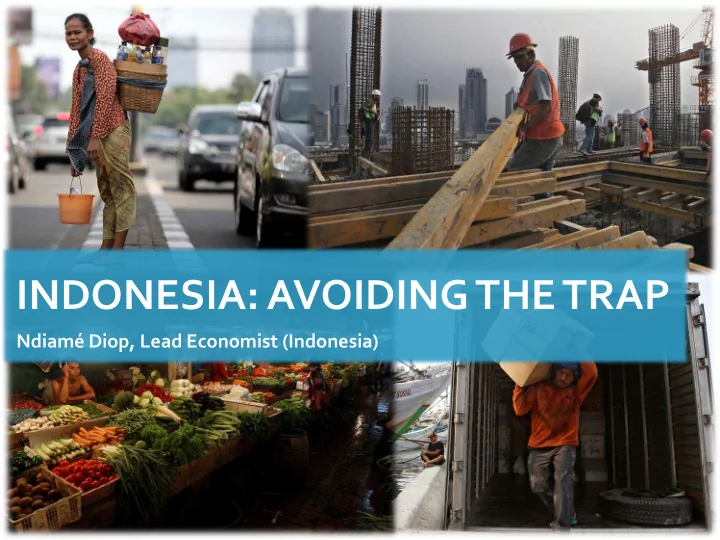
INDONESIA: AVOIDING THE TRAP
Ndiamé Diop, Lead Economist (Indonesia)
INDONESIA: AVOIDING THE TRAP Ndiam Diop, Lead Economist (Indonesia) - - PowerPoint PPT Presentation
INDONESIA: AVOIDING THE TRAP Ndiam Diop, Lead Economist (Indonesia) INDONESIAS FUTURE: RISING OR FLOATING? 2014 2030 DOMESTIC MEGATRENDS CAN HELP GROWTH DEMOGRAPHICS RAPID URBANIZATION RISING MIDDLE CLASS BUT LABOR PRODUCTIVITY
Ndiamé Diop, Lead Economist (Indonesia)
2014 2030
92% of differences in income per capita around the world can be explained by differences in labor productivity.
4,000 6,000 8,000 10,000 12,000 14,000 Cambodia Mongolia Indonesia Phillippines China Thailand Malaysia Lao PDR Vietnam
Value Added per Worker (2005 PPP$)
1995 2005 2010
– Half of ASEAN population but only 15% of manufacturing exports – Thailand: 15% ASEAN population and 34% of exports
requires a lot of expertise and capital
peers
– FDI inflows to Indonesia: 1.9% of GDP – FDI inflows to Vietnam5% of GDP; Average Middle Income in ASEAN: 3.3% of GDP
2 4 6 8 10 Mar-10 Sep-10 Mar-11 Sep-11 Mar-12 Sep-12 Mar-13 Sep-13 Mar-14
Total Agriculture Mining Industry (non-oil & gas) Non gov services
BRAZIL IN 1980-2004; FLOATED AFTER STRONG GROWTH
Source: World Bank, World Development Indicators
1,000 2,000 3,000 4,000 5,000 6,000 7,000 1960 1962 1964 1966 1968 1970 1972 1974 1976 1978 1980 1982 1984 1986 1988 1990 1992 1994 1996 1998 2000 2002 2004 2006 2008 2010 2012
Brazil
Per capita GDP constant 2005 USD
$1700 $5200 Only $200 increase in 23 years $4400 $4200
Source: World Bank, World Development Indicators
1,000 2,000 3,000 4,000 5,000 6,000 7,000 1960 1962 1964 1966 1968 1970 1972 1974 1976 1978 1980 1982 1984 1986 1988 1990 1992 1994 1996 1998 2000 2002 2004 2006 2008 2010 2012
South Africa
$3300 Only $400 increase in 32 years
Per capita GDP constant 2005 USD
SOUTH AFRICA IN 1980-2004; FLOATED AFTER STRONG GROWTH
$5400 $5800
Source: 2012 CENTRAL GOVERNMENT BUDGET and WB staff calculation
50 100 150 200 250 300 350 Energy Education Infrastructure Health Fuel subsidy
Electricity subsidy Non-
energy subsidy
IDR Trillion
2011 National Budget (Central + Provinces + Districts)
Source: Susenas, World Bank staff calculations
6.4 50.9 10 20 30 40 50 60 Bottom 20 Top 20 Share of benefits Percent Share of the benefits of electricity and fuel subsidies by consumption decile, 2012
CLOSE INFRASTRUCTURE GAP
REFORM OPTIONS
million TEUs/year
Indonesia has lost about 1 percentage point of growth due to infrastructure gap Given dynamism of domestic demand, supply bottlenecks = lost growth opportunities Closing the gap is crucial for attaining higher productivity, competitiveness and growth
REFORM OPTIONS
accredited institutions
value-added, strategic sectors
graduates work in unskilled positions
50 percent of senior secondary and 15 percent of tertiary education graduates find work in unskilled positions
The of many sectors rests in large part on improving availability of skills rapidly With ASEAN integration, risk of losing the best and not being competitive in the middle
REFORM OPTIONS
rent-seeking activities, create uncertainty and send mixed signals.
yield lose-lose outcomes.
lowest in ASEAN (firms retain cash for future use or borrow at high costs)
industrial expansion.
The difference between growing by 6.5% and 4% = millions of jobs!
(health, waste management, water, sanitation)
IMPROVED MANAGEMENT OF NATURAL RISKS
REFORM OPTIONS
More money does not improve access/quality…
without good local governance
REFORM OPTIONS
REFORM OPTIONS
resilience into site design and construction standards
incentivizes investment with built-in resilience
and resolve policy conflicts
public administration
results with public spending
premium and diesel over 5 years
Phasing out fuel subsidies would free up 2 percent
subnational personnel spending
1.4 percent of GDP can be secured if central and subnational personnel spending could be tempered to grow in line with inflation rather than at 5 to 8 percent above inflation in recent years.
improving tax administration and increasing tobacco excise tax
Tax administration measures could increase revenues by nearly 1.5 percent of GDP per year by 2019, while increasing excise tax on tobacco to 70 percent would increase revenues by 0.5 percent
INDONESIA WANTS TO REDUCE INEQUALITY AND POVERTY
The poor and vulnerable did not benefit from past growth as well as the rich
1 2 3 4 5 6 Poorest 2 3 4 5 6 7 8 9 Richest Household per capita consumption deciles
Average real consumption growth, 2003 - 2013
Annualized growth of mean national consumption
Indonesia can get rich before growing old, with serious reforms!
dependence on natural resource
the world (market opportunity and investment dynamism)
formidable economic, cultural and geographical diversity, a rising middle class and a stable democracy.