
SLIDE 1
Raphaël Néouze – LPO Grands Causses
Individual farm feeding stations
in Grands Causses
Sassari – 30th of June 2016
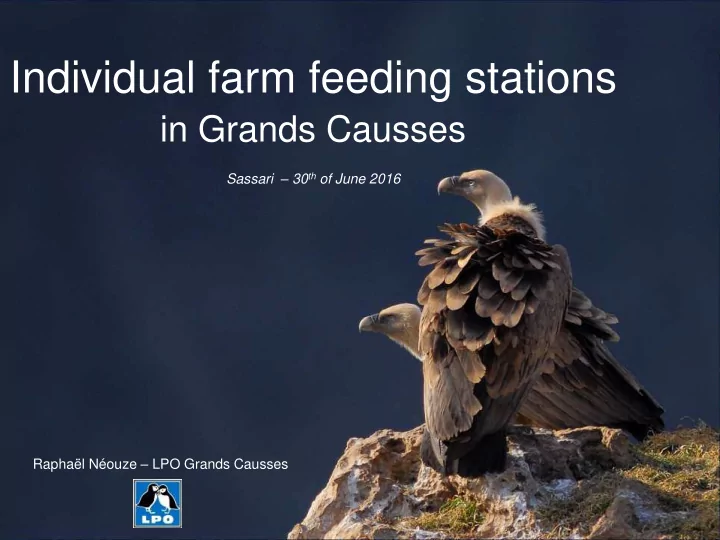
Individual farm feeding stations in Grands Causses Sassari 30 th of - - PowerPoint PPT Presentation
Individual farm feeding stations in Grands Causses Sassari 30 th of June 2016 Raphal Nouze LPO Grands Causses Acknowledgements Several tables from Olivier DURIEZ are used in this talk. Most photos from Bruno BERTHEMY
Raphaël Néouze – LPO Grands Causses
Individual farm feeding stations
in Grands Causses
Sassari – 30th of June 2016
Griffon Vulture
Sardinia
30th June 2016
Acknowledgements
used in this talk.
common work
Griffon Vulture
Sardinia
30th June 2016
Intention of this presentation
experimented in Grands Causses
conservationists and their partners
relation to that subject
PRESENTATIONS
Griffon Vulture
Sardinia
30th June 2016
The vulture programs in France
Southern Alps
Western Pyrenees
(native population)
Jonte - 1981-1986 Navacelle
1993-1998
Grands Causses
Verdon 1999 - 2004 Diois 1999 Baronnies
1991 - 1996
Griffon Vulture
Sardinia
30th June 2016
Situation of Grands Causses
Griffon Vulture
Sardinia
30th June 2016
Grands Causses = Many cheep
Griffon Vulture
Sardinia
30th June 2016
Grands Causses = Many birds
Griffon Vulture
Sardinia
30th June 2016
Description of the Grands Causses
divided by deep canyons
Griffon Vulture
Sardinia
30th June 2016
Griffon vulture
Egyptian vulture
Black vulture
bearded vulture
History of the Grands Causses conservation programs
Griffon Vulture
Sardinia
30th June 2016
Partnership with scientists
– Museum National d’Histoire Naturelle (MNHN) – Centre National de Recherche Scientifique (CNRS)
base, GPS project, dynamics of populations....
1985 1990 1995 2000 2005 2010 Survival rate +/- 95% CI 0.3 0.4 0.5 0.6 0.7 0.8 0.9 1.0 Number of feeding sites 50 100 150 200 Model constant Model nb fledglings Model nb fledglings / feeding sites nb feeding sites Griffon Vulture
Sardinia
30th June 2016
Reproduction of Griffon Vultures in Grands Causses
Griffon Vulture
Sardinia
30th June 2016
Evolutions…
1 2
Temps Nb de couples
Griffon Vulture
Sardinia
30th June 2016
At the beginning : Heavy feeding stations
1981 – 2001: 4 official « heavy » feeding sites ( very close to colonies) carrions collected at 62 local farms Food highly predictable in time and space Intense intra specific competition
THE BEGINNING OF
FARM FEEDING STATIONS
Griffon Vulture
Sardinia
30th June 2016
In the 90’s farmers are demanding for individual feeding stations
Acknowledgement of the vulture’s role as natural collaborators in the management of carcasses
use Vultures has carrion’s disposal system to get rid of farm carrions
Causses in 2001
Griffon Vulture
Sardinia
30th June 2016
Decreases sanitary threats
Griffon Vulture
Sardinia
30th June 2016
Improve food availability
First, you type « Grands Causses », then « satellite overview », then choose « sheep » and at last, you click on « latest deceased »
Griffon Vulture
Sardinia
30th June 2016
Technical description
30 m)
give a physical existence to the device
Griffon Vulture
Sardinia
30th June 2016
Draft of a farm feeding station
Griffon Vulture
Sardinia
30th June 2016
Reduce threats close to the farm feeding stations
Griffon Vulture
Sardinia
30th June 2016
An exemple of a farm feeding station
Griffon Vulture
Sardinia
30th June 2016
Another exemple with concrete plate and chain
Griffon Vulture
Sardinia
30th June 2016
Some other examples
Griffon Vulture
Sardinia
30th June 2016
Another exemple…
Griffon Vulture
Sardinia
30th June 2016
Another exemple…
Griffon Vulture
Sardinia
30th June 2016 Photo : Olivier Duriez
A working Farm feeding station or « placette »
Griffon Vulture
Sardinia
30th June 2016
Another exemple… seen from the farm
Griffon Vulture
Sardinia
30th June 2016
Farmer building the fence
Griffon Vulture
Sardinia
30th June 2016
How do farm feeding stations work ?
– Farmer has an official authorization – Farmer manages the disposal his own way – No more than 300 kg at the same time – Taxes reduction of 60 % – Farmer record on a file, sent every year to administration – Farmer clean the “placette” by burning bones and remaining – Reduce sanitary risks – Reduce CO2 emissions and transport costs
Griffon Vulture
Sardinia
30th June 2016
Record of carcass deposits
Griffon Vulture
Sardinia
30th June 2016
Situation of the farm feeding stations in Grands Causses
Griffon Vulture
Sardinia
30th June 2016
Situation of the farm feeding stations and GV home range
Griffon Vulture
Sardinia
30th June 2016
Situation of food supply for griffon vultures in Grands Causses
– 152 placettes in Grands Causses
– 2 HFP, 21 farmers collected – ~ 20 tons collected of carrions – Allows us to capture, read ring codes, communicate and monitor…
represents less tha1% of the total tonnage of quartering service in France
Griffon Vulture
Sardinia
30th June 2016
How a farmer can apply for a farm feeding station ?
– The farmer makes a demand as volunteer – LPO GC works with the farmer on a technical level to prepare the application file – The vet administration check the application details – The Vulture & Livestock comity validate the beginning of construction – The farmer build the station himself – The administration and LPO visit the station and validate or ask for more work – Local “Préfet” sign the “décret” of authorisation for the use of the station – The farmer sign a management convention
Griffon Vulture
Sardinia
30th June 2016
Feeding stations in France
CREATION OF A REGIONAL COMITY
FOR VULTURES AND LIVESTOCK
Griffon Vulture
Sardinia
30th June 2016
Creation of a regional comity for Vultures & Livestock
– Farmers’ organisations and unions – Organisations that run vultures conservation programs – State administrations and parks (national and regional) – Scientists – Environmental police and forestry administration – Hunters organisations – Veterinarian’s organisations – Tourism public services
plan supervised by a “Préfet”
Griffon Vulture
Sardinia
30th June 2016
procedures on Vultures & Livestock interactions
availability for vultures
Action plan of the regional comity for Vultures & Livestock
EXAMPLES OF SCIENTIFIC
RESEARCH PROGRAMS BASED ON
FARM FEEDING STATIONS
Griffon Vulture
Sardinia
30th June 2016
Competition for food: dominance
No difference between Heavy FS / Farm FS
n=23 n=27 n=20 n=28 0,005 0,01 0,015 0,02 0,025 0,03 0,035
young adults immature juveniles
mean +/- standard deviationinteraction rate agressiveness dominance
(Bosè & Sarrazin 2007 Ibis)
Adults dominant over younger birds Videos of focal individual
Griffon Vulture
Sardinia
30th June 2016
Competition for food: Age-ratio at feeding events
% young increases with time and is higher in Farm feeding stations
Summer
20 40 60 80 100 120
% young birds
20 40 60 80 100 Heavy feeding station Light feeding station
Time since beginning (min)
(Duriez, unpublished)
Meat Skeletton Adults predominant when meat, immatures when skeletton young birds prospect more at light FS?
Griffon Vulture
Sardinia
30th June 2016
Competition for food: prospection behaviours
Pilot study in 2009
GPS tracking of individual griffon vultures
TechnoSmart With predictable ressources Traplining strategy? With unpredictable ressources Random strategy?
Feeding stations Vultures’ foraging behaviour
Competition for food: prospection behaviours
Results : Repetitivity of prospection routes
Key Day 1 Day 2 Day 3 Feedi ng stations
Nest
Results : Repetitivity of prospection routes
Random foraging… Random
Key Day 1 Day 2 Day 3 Feedi ng stations
Nest
Traplining
Results : Repetitivity of prospection routes
Random foraging… …But also Traplining strategy Random Nest
Key Day 1 Day 2 Day 3 Feedi ng stations
Traplining
Results : Repetitivity of prospection routes
Random foraging… …But also Traplining strategy Confirmed by repetitivity analysis Random Nest
Key Day 1 Day 2 Day 3 Feedi ng stations
SPECIFIC COMMUNICATION ON
FARM FEEDING STATION
Griffon Vulture
Sardinia
30th June 2016
A technical leaflet on natural and official disposal of carions
edited by LPO GC and distributed widely to farmers, farming
communities, elected people, administrations…
Griffon Vulture
Sardinia
30th June 2016
An annual spécific news letter
interviews of farmers and specific articles…
farmers that have a farm feeding station and farming organisations…
Griffon Vulture
Sardinia
30th June 2016
Posters…
Griffon Vulture
Sardinia
30th June 2016
A semestrial news letter on global vulture issues
partners
farmers, farming
communities, elected people, administrations, partners, other conservation programs…
Griffon Vulture
Sardinia
30th June 2016
Last news…
Causses received on the 15th of October 2015:
The Grand Prix Natura 2000
Category : Socio-Economical benefits
Griffon Vulture
Sardinia
30th June 2016
Conclusions : arguments in favour of farm feeding stations
Griffon Vulture
Sardinia
30th June 2016
Conclusions : arguments in favour of farm feeding stations
Griffon Vulture
Sardinia
30th June 2016
Propositions
food management
Griffon Vulture
Sardinia
30th June 2016
Thank you for your attention…
Griffon Vulture
Sardinia
30th June 2016
Griffon Vulture
Sardinia
30th June 2016
Les textes de références:
avec effet au 4 mars 2011;
règlement (CE) n°1069/2009;
d’application en France: par voie réglementaire: l’arrêté du 6 août 2005 et l’arrêté du 28 février 2008; et la note de service DGAL/SDSPA/N2006-8300 du 19 décembre 2006. La reconnaissance de l’équarrissage naturel en France:
Griffon Vulture
Sardinia
30th June 2016
par voie réglementaire: l’arrêté du 6 août 2005 et l’arrêté du 28 février 2008; et la note de service DGAL/SDSPA/N2006-8300 du 19 décembre 2006.
Griffon Vulture
Sardinia
30th June 2016
What are the needs for Griffon vultures ?
170 kg of food per year
(with ~50 kg of consumable flesh ~75 %)
griffon vulture eat the flesh of 3 to 4 carrions of sheep per year (75 % of carrions)
Griffon Vulture
Sardinia
30th June 2016
What needs for the colony?
– So 1058 reproducing adult griffon vultures
1400 and 1700 birds
290 tons per year
This represents 4700 to 5800 carrions per year (used at 75 % )
Griffon Vulture
Sardinia
30th June 2016
Quelle quantité cela représente ?
– Les charniers :
– Les 152 placettes individuelles :
– Les cadavres de la faune sauvage :
Soit un total de 230 à 240 tonnes / an
Griffon Vulture
Sardinia
30th June 2016
Quelle quantité cela représente ?
– Les 100 à 120 éleveurs « hors placette » :
Soit un total 60 à 90 tonnes/an La ressource totale est donc estimée entre 290 et 330 tonnes/an (utilisable) Cette ressource disponible connait des variations saisonnières mais est suffisante Cependant une grande partie est non maîtrisée