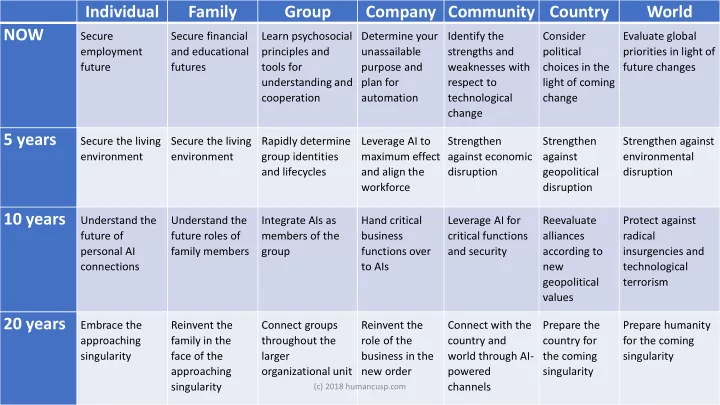
Individual Family Group Company Community Country World NOW - - PowerPoint PPT Presentation

individual family group company community country world
SMART_READER_LITE
LIVE PREVIEW

Individual Family Group Company Community Country World NOW - - PowerPoint PPT Presentation

Individual Family Group Company Community Country World NOW Secure Secure financial Learn psychosocial Determine your Identify the Consider Evaluate global employment and educational principles and unassailable strengths and


slide-1
SLIDE 1

Individual Family Group Company Community Country World NOW

Secure employment future Secure financial and educational futures Learn psychosocial principles and tools for understanding and cooperation Determine your unassailable purpose and plan for automation Identify the strengths and weaknesses with respect to technological change Consider political choices in the light of coming change Evaluate global priorities in light of future changes

5 years

Secure the living environment Secure the living environment Rapidly determine group identities and lifecycles Leverage AI to maximum effect and align the workforce Strengthen against economic disruption Strengthen against geopolitical disruption Strengthen against environmental disruption

10 years

Understand the future of personal AI connections Understand the future roles of family members Integrate AIs as members of the group Hand critical business functions over to AIs Leverage AI for critical functions and security Reevaluate alliances according to new geopolitical values Protect against radical insurgencies and technological terrorism

20 years

Embrace the approaching singularity Reinvent the family in the face of the approaching singularity Connect groups throughout the larger

  • rganizational unit

Reinvent the role of the business in the new order Connect with the country and world through AI- powered channels Prepare the country for the coming singularity Prepare humanity for the coming singularity

(c) 2018 humancusp.com

slide-2
SLIDE 2

Asilomar Principles – Research Issues

  • 1. Research Goal: The goal of AI research should be to create not undirected

intelligence, but beneficial intelligence.

  • 2. Research Funding: Investments in AI should be accompanied by funding for

research on ensuring its beneficial use, including thorny questions in computer science, economics, law, ethics, and social studies, such as:

a) How can we make future AI systems highly robust, so that they do what we want without malfunctioning or getting hacked? b) How can we grow our prosperity through automation while maintaining people’s resources and purpose? c) How can we update our legal systems to be more fair and efficient, to keep pace with AI, and to manage the risks associated with AI? d) What set of values should AI be aligned with, and what legal and ethical status should it have?

slide-3
SLIDE 3

Asilomar Principles – Research Issues (cont’d)

  • 3. Science-Policy Link: There should be constructive and healthy exchange

between AI researchers and policy-makers.

  • 4. Research Culture: A culture of cooperation, trust, and transparency should be

fostered among researchers and developers of AI.

  • 5. Race Avoidance: Teams developing AI systems should actively cooperate to

avoid corner-cutting on safety standards.

slide-4
SLIDE 4

Asilomar Principles – Ethics and Values

  • 6. Safety: AI systems should be safe and secure throughout their operational lifetime, and

verifiably so where applicable and feasible.

  • 7. Failure Transparency: If an AI system causes harm, it should be possible to ascertain why.
  • 8. Judicial Transparency: Any involvement by an autonomous system in judicial decision-making

should provide a satisfactory explanation auditable by a competent human authority.

  • 9. Responsibility: Designers and builders of advanced AI systems are stakeholders in the moral

implications of their use, misuse, and actions, with a responsibility and opportunity to shape those implications.

  • 10. Value Alignment: Highly autonomous AI systems should be designed so that their goals and

behaviors can be assured to align with human values throughout their operation.

  • 11. Human Values: AI systems should be designed and operated so as to be compatible with

ideals of human dignity, rights, freedoms, and cultural diversity.

slide-5
SLIDE 5

Asilomar Principles – Ethics and Values (cont’d)

  • 12. Personal Privacy: People should have the right to access, manage and control the data they

generate, given AI systems’ power to analyze and utilize that data.

  • 13. Liberty and Privacy: The application of AI to personal data must not unreasonably curtail

people’s real or perceived liberty.

  • 14. Shared Benefit: AI technologies should benefit and empower as many people as possible.
  • 15. Shared Prosperity: The economic prosperity created by AI should be shared broadly, to

benefit all of humanity.

  • 16. Human Control: Humans should choose how and whether to delegate decisions to AI

systems, to accomplish human-chosen objectives.

  • 17. Non-subversion: The power conferred by control of highly advanced AI systems should

respect and improve, rather than subvert, the social and civic processes on which the health

  • f society depends.
  • 18. AI Arms Race: An arms race in lethal autonomous weapons should be avoided.
slide-6
SLIDE 6

Asilomar Principles – Longer-Term Issues

  • 19. Capability Caution: There being no consensus, we should avoid strong assumptions regarding

upper limits on future AI capabilities.

  • 20. Importance: Advanced AI could represent a profound change in the history of life on Earth,

and should be planned for and managed with commensurate care and resources.

  • 21. Risks: Risks posed by AI systems, especially catastrophic or existential risks, must be subject

to planning and mitigation efforts commensurate with their expected impact.

  • 22. Recursive Self-Improvement: AI systems designed to recursively self-improve or self-replicate

in a manner that could lead to rapidly increasing quality or quantity must be subject to strict safety and control measures.

  • 23. Common Good: Superintelligence should only be developed in the service of widely shared

ethical ideals, and for the benefit of all humanity rather than one state or organization.