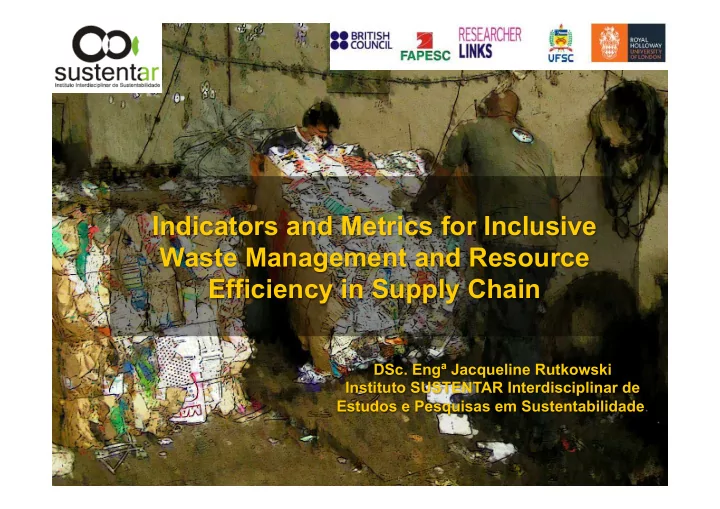
Indicators and Metrics for Inclusive Waste Management and Resource - - PowerPoint PPT Presentation

indicators and metrics for inclusive waste management and
SMART_READER_LITE
LIVE PREVIEW

Indicators and Metrics for Inclusive Waste Management and Resource - - PowerPoint PPT Presentation

Indicators and Metrics for Inclusive Waste Management and Resource Efficiency in Supply Chain DSc. Eng Jacqueline Rutkowski Instituto SUSTENTAR Interdisciplinar de Estudos e Pesquisas em Sustentabilidade . . Who am I? Professor at


slide-1
SLIDE 1

Indicators and Metrics for Inclusive Waste Management and Resource Efficiency in Supply Chain

.

  • DSc. Engª Jacqueline Rutkowski

Instituto SUSTENTAR Interdisciplinar de Estudos e Pesquisas em Sustentabilidade.

slide-2
SLIDE 2

Who am I?

– Professor at Federal University of Ouro Preto Industrial Engineering Dept/ UFOP (un?l 2005) – Ac?on-researcher associated to SUSTENTAR Ins?tute - Interdisciplinary Studies and Research in Sustainability, a technical-scien?fic NGO which objec?ve is to systema?ze, develop and disseminate Social Technologies to support Sustainability – Informal Recycling Sector; – Waste recycling, Sustainability, Solidary Economy, Par?cipatory methodologies ; – Directress of CMRR – Centre of Reference in Recycling, Environmental Founda?on (FEAM), Minas Gerais Government

slide-3
SLIDE 3

Núcleo AlterNativas de Produção/ UFMG

DRS/ -MG

Inc Inclu lusive a and nd S Soli lidary R y Recycli ling ng Obser Observat ator

  • ry

NET

ETWORK ORK TO TO BUIL UILD SOLUT UTIO IONS TO TO WA WASTE RECYCLIN ING AS AS A SOCIA IAL AN AND ENVIR IRONMENTAL ALTERNATIV IVE FO FOR UR URBAN WA WASTE TR TREATME TMENT NT FROM THEORETICAL AND PRACTICAL KNOWLEDGE

slide-4
SLIDE 4

Service C Cha hain Va Value C Cha hain

WP fundamental actor, but the most fragile of the Value and the Service Recycling Chains

PR PRODUCTI DUCTIVE CHAI AIN OF OF REC RECYCLED LED PAP APER

slide-5
SLIDE 5

Solidary Selective Waste Collection:

  • ne Social Technology

Waste pickers ask people to separate recyclables from waste and collect the material on a specific day of week, taking them to their sheds. In this contact, they teach citizens about what is or is not recyclable, and mobilise them to separate, once this will become an income to a waste pickers family.

slide-6
SLIDE 6

Solidary Selective Waste Collection:

  • ne Social Technology

Waste pickers organize themselves as collective enterprises - cooperatives and associations - and so they can be contracted by municipalities as part of the solid waste management systems. In their sheds, the waste pickers sort manually the recyclables (plastics, metals, glass and papers) and prepare pressed bales, selling them to middlemen, that finally sell the material to the industry.

slide-7
SLIDE 7

Solidarity Selec?ve Collec?on

ü RUTKOWSKI,JE.&RUTKOWSKI,EW. Expanding worldwide urban solid waste recycling: The Brazilian social technology in waste pickers

  • inclusion. Waste Management&Research, Vol.

33(12) 1084.-1093 2015 ü Rutkowski, J.E., Lima, F. P.A., Oliveira ,F.G. Improvement of urban solid waste management through recycling incen?ves: a methodology for more sustainable ci?es. ISWA Congress, Viena, 2013.

Descrip?on of the model /processes and main metrics: understanding and organizing the processes and results of the waste pickers' work as private service providers in municipal waste management at Brazilian ci?es.

slide-8
SLIDE 8

8

Solidary Seletive Collection: better environmental results, more material recycled, less waste into landfill

Londrina: CSS; Belo Horizonte: private cleaning enterprise.

slide-9
SLIDE 9

Solidary Selec,ve Collec,on (SoCo) Assessment Tool

slide-10
SLIDE 10

Recycling of solid waste

Ø RUTKOWSKI, J. E.; VARELLA, C. V. S.; CAMPOS, L. S.Recycling of municipal solid waste in Brazil: challenges and opportuni?es for expansion, ISWA Congress, SP/SP, 2014. Ø "Analysis of the Produc?ve Chain of Recyclable Materials in Brazil“, Research Report, 2013.

slide-11
SLIDE 11

REC T2

INTERMEDIARIES, WRECKER, BROKERS, WASTEPAPER WHOLESALERS

  • Screening
  • Sor?ng
  • Packing
  • Marke?ng
  • Transport

REC T1

WASTE PICKERS, COOPERATIVES, PUBLIC SORTING PLANTS

  • Collec?on
  • Screening
  • Packing
  • Trading
  • Transport

REV SEMI- MANUFACTURED INDUSTRY

  • Screening
  • Washing
  • Milling/flakes
  • Extrusion/ pellets
  • Dissolu?on
  • Depura?on
  • Pulp modelling/

drying

  • Marke?ng

TRANSF MANUFACTU- RED INDUSTRY

  • Differents

manufacturing processes

(extrusion, injec?on, blowing, drying compression, etc)

PLASTICS (flakes and pellets) PLASTICS PAPER PAPER(paper board)

slide-12
SLIDE 12
  • The geographical concentra?on of recycling industry diminishes

recyclable material prices, does not allow trading some materials and jus?fies the ac?on of midlemen;

  • A segmented and oligopsonic market with several actors that plays

different roles and have specific needs;

  • Many informal actors and great varia?on on recyclable material

prices with raw recycled materials prices linked to global commodi?es prices;

  • The Waste pickers Coopera?ves organized on solidarity economy,

the produc?ve chain organized on capitalist principles : it is necessary to build strategies and tools to promote this dialogue and rela?onship;

  • Lack of public programs to promote waste recycling;
  • Most important bokleneck is Selec?ve Collec?on of solid waste;

Conclusions

slide-13
SLIDE 13

Ci Circu cular Econom Economy

slide-14
SLIDE 14

CE and recycling of solid waste

Ø RUTKOWSKI J., PURSHOUSE H. , VELIS C., RUTKOWSKI E.,LERPINIERE, D., Waste Sor?ng Social Technology in Brazilian Informal Materials Recovery Facili?es – in progress (comparing results Brazil (“informal”) and UK MRF)

slide-15
SLIDE 15

From now...

  • Understanding the links and results of

waste pickers’ work in the recovery of resources

  • To describe and to assess the contribu?on
  • f the inclusive waste management on

implemen?ng Circular Economy

  • To perceive the influence of the waste

pickers' work on the climate change indicators and how inclusive waste management collaborate to resilient ci?es

  • Informal recycling sector and Zero Waste

ini?a?ves and Funcionality Economy (ORIS)

slide-16
SLIDE 16

Thank you for listening !!!

Jacqueline.rutkowski@gmail.com