Indian Health Care Delivery System American Indian Health Commission - - PowerPoint PPT Presentation

indian health care delivery system
SMART_READER_LITE
LIVE PREVIEW

Indian Health Care Delivery System American Indian Health Commission - - PowerPoint PPT Presentation

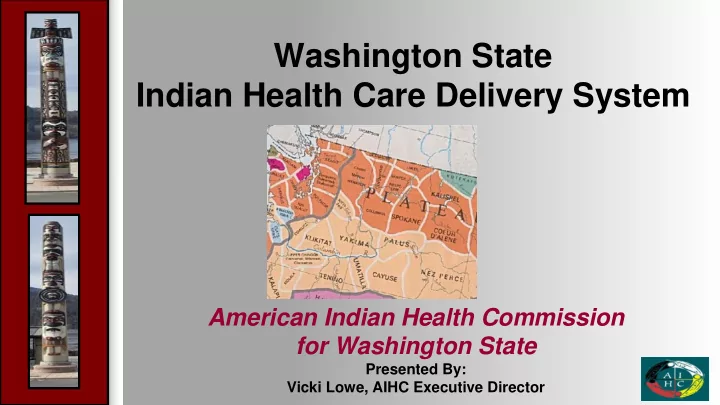
Washington State Indian Health Care Delivery System American Indian Health Commission for Washington State Presented By: Vicki Lowe, AIHC Executive Director A MERICAN I NDIAN H EALTH C OMMISSION FOR W ASHINGTON S TATE Mission: Improve the

slide-1
SLIDE 1

Washington State Indian Health Care Delivery System

American Indian Health Commission for Washington State

Presented By: Vicki Lowe, AIHC Executive Director

slide-2
SLIDE 2

AMERICAN INDIAN HEALTH COMMISSION

FOR WASHINGTON STATE

Mission: Improve the health of American Indians and Alaska Natives (AI/AN) through tribal-state collaboration on health policies and programs that will help decrease disparities

Work on behalf of the 29 federally-recognized Tribes and 2 Urban Indian Health Organizations in the state

Key: Tribal Councils and UIHP appoint delegates to represent the I/T/U through resolution

slide-3
SLIDE 3

GOVERNMENT TO GOVERNMENT RELATIONSHIPS: STATE AND FEDERAL

The government-to-government relationship “respects the sovereign status of the parties, enhances and improves communications between them, and facilitates the resolution of issues.”

WA Centennial Accord 1989 RCW 43.376.020 codified the Accord Federal Trust responsibility to protect Tribal sovereignty/lands–legal obligation Federal Executive Order 13175

slide-4
SLIDE 4

URBAN INDIAN HEALTH PROGRAM INCLUSION

Indian Health Care Provider (IHCP) means a health care program

  • perated by the Indian

Health Services (IHS), Tribal Organization or Urban Indian Health Program (otherwise know as the ITU)…

Section 1902(a)(73) of the Social Security ACT State Plan Amendment #TN11-25 CMS Dear Tribal Leaders Letter January 22, 2010 Section 4 of the Indian Health Care Improvement Act – 25U.S.C. § 1603

slide-5
SLIDE 5

INDIAN HEALTH SERVICE (IHS)

RESULT: AI/ANs have the worst

  • verall health outcomes
  • f any other population

in Washington State

Congressional Budget Office (CBO) estimates that IHS2018 budget is funded at less than 32% of the need The chronic underfunding of I.H.S. programs has made the use of alternate resources vital to these programs The U.S. spends more dollars per capita on federal prisoners than on AI/AN people

slide-6
SLIDE 6

INDIAN HEALTH CARE DELIVERY SYSTEM (IHDS)

Medical Dental Behavioral

Referral & Coordination Specialty Care Inpatient Care I/T/U Facility

slide-7
SLIDE 7

IN WASHINGTON STATE

  • 29 federally recognized Tribes
  • 2 Urban Indian Health Programs (UIHPs)
  • Total of 37 clinics:

– 4 are operated by the Indian Health Service – 31 are operated by Tribes – 2 UIHP serving major metropolitan areas of Seattle and Spokane – 3 Tribes do not have primary care clinics and provide care through PRC funds.

slide-8
SLIDE 8

PORTLAND AREA INDIAN HEALTH SERVICES (PAIHS)

PRC funds have to be used for this expensive care Hospital Services not available in our area Reducing funds available for specialty care

Medicaid coverage helps save limited PRC funds

slide-9
SLIDE 9

MEDICAID AND THE INDIAN HEALTH DELIVERY SYSTEM

CMS established 100% FMAP payments to Indian Health Care providers for AI/AN claims to maintain the Federal Trust responsibility. I.H.S is payor of last resort, even with Medicare and Medicaid. Alternate Resources rules require AI/AN to sign up for and use Medicaid (and other coverages) before PRC funds can be expended on care.

slide-10
SLIDE 10

THIRD PARTY REVENUE

– As much a part of budget as federally appropriated funds – State federal Medicaid program is one of the largest sources of third-party reimbursement – Stability of this revenue-generating source vital to clinic

  • perations

– Reduction in funding = cuts to basic Tribal health services – Tribes, UIHPs and AIHC work with the HCA to identify and implement improvements to the Medicaid system:

  • for AI/AN access and
  • Tribal provider reimbursement.
slide-11
SLIDE 11

OTHER CHALLENGES IN THE DELIVERY SYSTEM

Provider Recruitment and Retention Remote Areas with few health care options Cultural Barriers

slide-12
SLIDE 12

TRIBAL RESILIENCY

  • Holistic Health Care
  • Wrap Around Services
  • Integrated Care
  • Addressing Population Health

through Public Health

Best Practices

  • Economic Growth: Health is a

priority of Tribal Leaders

  • Community Connectedness
  • Culture
  • Creative Solutions with

Limited Funding

Strengths

slide-13
SLIDE 13

1115 Global Waiver- Medicaid Transformation

Integration

  • f

Medical & Behavioral Health Services Creation

  • f

Accountable Communities of Health Medicaid Transition from Fee-For-Service to Value-Based Purchasing State Law SB 6312 1915(b) Waiver Healthier Washington

CHANGES AT THE STATE LEVEL:

Creation of Behavioral Health Organizations

slide-14
SLIDE 14

IMPACTS OF STATE LEVEL DECISIONS: HEALTHIER WASHINGTON INITIATIVE

I.H.S. All Inclusive rate not paid through MCOs No determination of how value based payments will impact

  • ur delivery system

There is no government to government relationship between Tribes and MCOs and AHCs. Additional layers of MCO authorizations and rules make specialty care difficult to access

The use of MCOs for Medicaid has degraded the fee for services (FFS) network

Too many changes, meetings, entities to follow

slide-15
SLIDE 15

Difference between encounter rate and PRC rate

Becomes Tribal reinvestment funds

I.H. S. Encounter Rate paid to IHCP

Contracted Provider paid PRC rate

Contracted Specialty Providers

Care Coordination Agreements Purchased and Referred Care Contracts

CMS-I.H.S.

Tribal Operated Clinic Tribal Federally Qualified Health Center

UTILIZING 100% FMAP IN FFS MEDICAID

TO FUND TRIBAL REINVESTMENT POOLS

slide-16
SLIDE 16
  • Medicaid Eligible AI/AN

receives Medicaid covered service from IHCP

  • IHCP bills Managed Care Plan

and receives payment MCO contracted rate.

  • IHCP bills Provider One for

balance of AIR

  • Patient Referred To specialty

care

Provider Paid IHS All- Inclusive Rate

  • AI/AN patients sees

specialty provider from the MCO network

  • Specialist bills Managed

Care Organizations (MCO)

Specialty Provider receives contracted rate from MCO

  • No additional FMAP savings

for Specialty care payments, funded by MCO through premium they receive from the state.

Savings on FMAP underutilized

100%FMAP Utilization Under Current Managed Care System

slide-17
SLIDE 17
  • Medicaid Eligible

AI/AN See IHCP

  • IHCP then bills through

Enhanced FFS Network* and receives encounter rate

  • Patient Referred to

specialty care

  • TPA ensures care

coordination agreement is in place with specialty provider

Provider Paid IHS All- Inclusive Rate

  • AI/AN patients sees specialty provider

with care coordination agreement in place

  • TPA bills and receives encounter rate

for IHCP

  • Specialist paid contracted rate, either

based on Medicare payment methodology or value based payments.

  • The difference between encounter rate

and payment to provider goes to reinvestment account.

Specialty provider receives contracted rate from TPA

  • IHCP payments

made at 100% FMAP, no state share

  • Specialty providers

payments paid at 100% FMAP, no state share

State savings on FMAP maximized

100%FMAP UTILIZATION ENHANCED FFS SPECIALTY NETWORK

*requires utilization of third party administrator (TPA)

slide-18
SLIDE 18

Questions?

E-mail- vicki.lowe.aihc@outlook.com

  • r

AIHC.General.Delivery@outlook.com Website: www.aihc-wa.com Phone: 360-460-3580