
SLIDE 1
FRTR November 8, 2017
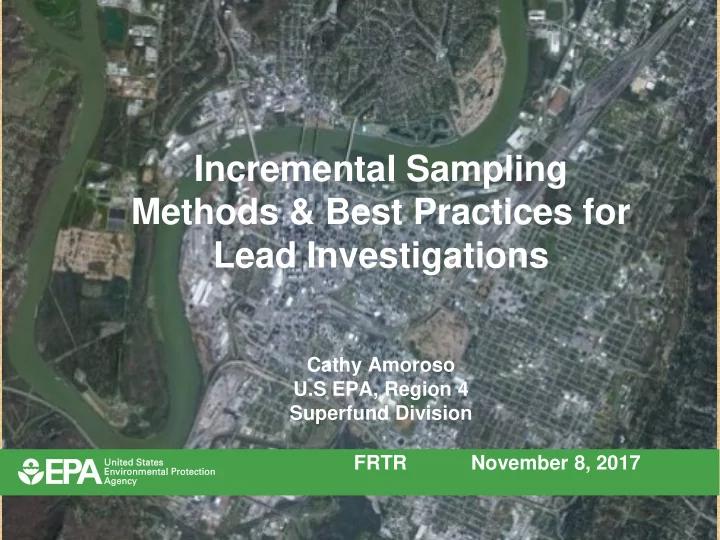
Incremental Sampling Methods & Best Practices for Lead Investigations
Cathy Amoroso U.S EPA, Region 4 Superfund Division
Incremental Sampling Methods & Best Practices for Lead - - PowerPoint PPT Presentation
Incremental Sampling Methods & Best Practices for Lead Investigations Cathy Amoroso U.S EPA, Region 4 Superfund Division FRTR November 8, 2017 Former Chattanooga Foundries 60+ foundries historically located in Chattanooga.
FRTR November 8, 2017
Incremental Sampling Methods & Best Practices for Lead Investigations
Cathy Amoroso U.S EPA, Region 4 Superfund Division
Federal Remediation Technology Roundtable November 8, 2017 2
Former Chattanooga Foundries
60+ foundries historically located in Chattanooga. Generated spent sand and baghouse dust
decades.
Federal Remediation Technology Roundtable November 8, 2017 3
Former Chattanooga Foundries
Federal Remediation Technology Roundtable November 8, 2017 4
Spent Foundry Sand
Foundry waste material can contain lead Foundry material was used as fill
Federal Remediation Technology Roundtable November 8, 2017 5
Initial EPA Involvement
at ER with Pb poisoning
contaminated soil at 84 residences
undefined
may be similarly impacted
Federal Remediation Technology Roundtable November 8, 2017 6
Potential Large Urban Lead Site: Where to Begin?
Is all of downtown Chattanooga contaminated? NO
Federal Remediation Technology Roundtable November 8, 2017 7
Objectives of the Investigation
Establish urban background levels Collect high quality data to support risk management decisions Produce data that can be used for multiple purposes:
Federal Remediation Technology Roundtable November 8, 2017 8
Best Practices for Sampling for Lead in Soil
Federal Remediation Technology Roundtable November 8, 2017 9
Best Practice: Establish Background Level for Lead
Chattanooga Urban Bkg Study 5x5 mile grid; 50 randomly selected cells Used SAP/QAPP template from larger R4 urban background study 7 metals associated with foundries: Pb, As, Cd, Cr, Cu, Ni, Zn
Federal Remediation Technology Roundtable November 8, 2017 10
Urban Background Results
RSL Mean Bkg (SI) Urban background 95% UTL
Lead 400 60 175 Arsenic 0.68 3.4 7 Chromium 25 33
Federal Remediation Technology Roundtable November 8, 2017 11
Chattanooga Lead Background vs. 5 Cities
Federal Remediation Technology Roundtable November 8, 2017 12
Identify Study Areas
Federal Remediation Technology Roundtable November 8, 2017 13
Field Operation
Federal Remediation Technology Roundtable November 8, 2017 14
Best Practice: Incremental Sampling Methodology (ISM)
Why ISM?
Superior method to derive an unbiased estimate of the mean concentration of a given area (i.e. decision unit) One ISM sample is collected for each decision unit Each sample is comprised of 30 aliquots, and produces
represents the entire decision unit (yard) Statistically defensible data
Federal Remediation Technology Roundtable November 8, 2017 15
Federal Remediation Technology Roundtable November 8, 2017 16
Federal Remediation Technology Roundtable November 8, 2017 17
Federal Remediation Technology Roundtable November 8, 2017 18
Incremental Sampling in Chattanooga
Federal Remediation Technology Roundtable November 8, 2017 19
Federal Remediation Technology Roundtable November 8, 2017 20
Collecting ISM: Time & Effort
One 30-point composite from a residential yard takes 8 minutes to collect
Federal Remediation Technology Roundtable November 8, 2017 21
ISM Includes Representative Subsampling
Guidance for Obtaining Representative Laboratory Analytical Subsamples from Particulate Laboratory Samples EPA/600/R-03/027, November 2003
Federal Remediation Technology Roundtable November 8, 2017 22
Disaggregation and Drying
Federal Remediation Technology Roundtable November 8, 2017 23
OLEM Lead Sieving Directive
Recommendations for Sieving Soil and Dust Samples at Lead Sites for Assessment of Incidental Ingestion, OLEM Directive 9200.1-128
Federal Remediation Technology Roundtable November 8, 2017 24
OLEM Lead Sieving Directive
bioavailability in fine particles.
Federal Remediation Technology Roundtable November 8, 2017 25
Dermal Adherence
Federal Remediation Technology Roundtable November 8, 2017 26
Federal Remediation Technology Roundtable November 8, 2017 27
Sieve of Stacked Mesh (#10 and #100)
Federal Remediation Technology Roundtable November 8, 2017 28
Federal Remediation Technology Roundtable November 8, 2017 29
Fine Fraction <150 microns
Federal Remediation Technology Roundtable November 8, 2017 30
Lead Concentrates in the Fine Fraction
Pb in mg/kg
Unsieved Sieved 603 1016 837 1832 1434 4021 1245 2300 591 936
At this site, sieved soil has approximately 100 ppm higher concentration than in unsieved.
Federal Remediation Technology Roundtable November 8, 2017 31
ISM Includes Representative Subsampling
Federal Remediation Technology Roundtable November 8, 2017 32
Representative subsamples for analysis
Federal Remediation Technology Roundtable November 8, 2017 33
Federal Remediation Technology Roundtable November 8, 2017 34
Best Practice: X-Ray Fluorescence Field Operations Guide
Superfund X-Ray Fluorescence Field Operations Guide, EPA Region 4, July 19, 2017 (SFDGUID-001-R0) Tool for OSCs and RPMs Methodology to collect high quality XRF data for lead and arsenic Provides real-time data Multiple readings and QA/QC measures Produces “definitive” data = data of sufficient quality to use in remedial and removal decisions and in the BLRA
Federal Remediation Technology Roundtable November 8, 2017 35
XRF vs Lab Data: Lead
R Squared = 0.98 Excellent agreement between XRF data and lab data.
Federal Remediation Technology Roundtable November 8, 2017 36
XRF vs. Lab: Pb
100 200 300 400 500 600 700 1 3 5 7 9 11 13 15 17 19 21 23 25 27 29 31 33 35 37 39 41 43 45 47 49 Lab Pb XRF PbXRF provides reliable, reproducible & defensible data for Pb for this project (n = 300+)
Federal Remediation Technology Roundtable November 8, 2017 37
Best Practice: Site-specific Clean-up Levels for Lead
Federal Remediation Technology Roundtable November 8, 2017 38
Best Practice: Lead Bioavailability
Bioavailability
Federal Remediation Technology Roundtable November 8, 2017 39
Integrated Exposure Uptake Biokinetic
(IEUBK) Model
Predicts blood lead levels in children resulting from environmental exposures. Utilized by EPA to set cleanup goals for lead in soil.
Federal Remediation Technology Roundtable November 8, 2017 40
Use site-specific lead bioavailability in the IEUBK model ‘ BA will “ health-based clean-up level IEUBK default BA = 30% In this case, 33 soil samples were analyzed for lead bioavailability Chattanooga site soils BA = 29-50%; mean = 36% Other inputs to IEUBK being updated, esp. target blood lead level
Best Practice: Site-specific Clean-up Levels for Lead
Federal Remediation Technology Roundtable November 8, 2017 41
SOP for In Vitro Lead and Arsenic Testing
Standard Operating Procedure… OLEM, May 5, 2017
Federal Remediation Technology Roundtable November 8, 2017 42
Elevated lead is not “everywhere; can distinguish between suspect material and urban background Data supports risk management decisions Unacceptable risk at some properties Removal warranted at some properties Remedial action planned Site-specific cleanup level can be developed
Conclusion of Chattanooga Soil Study
Federal Remediation Technology Roundtable November 8, 2017 43
Best Practices for Sampling for Lead in Soil
Federal Remediation Technology Roundtable November 8, 2017 44