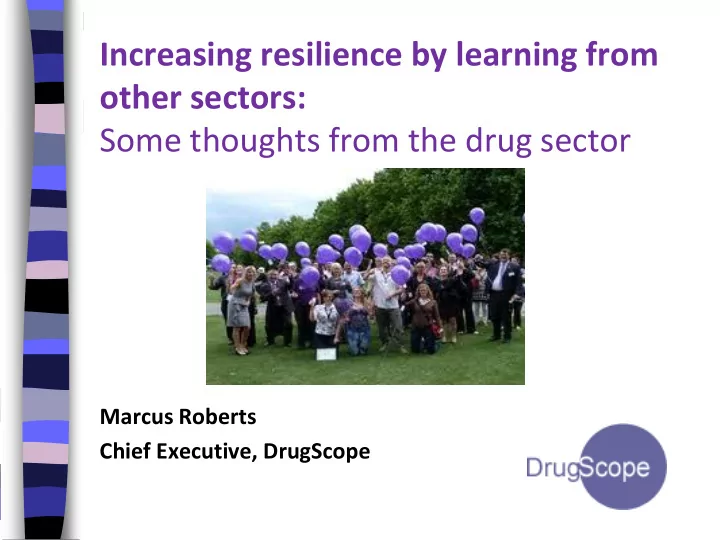
SLIDE 1 Increasing resilience by learning from
Some thoughts from the drug sector
Marcus Roberts Chief Executive, DrugScope
SLIDE 2
Happiness … ?
SLIDE 3 J S Mill on Happiness ‘By happiness is intended pleasure, and the absence
‘It is better to be a human being dissatisfied than a pig satisfied; better to be Socrates dissatisfied than a fool satisfied.’ Aristotle on Happiness ‘He is happy who lives in accordance with complete virtue and is sufficiently equipped with external goods, not for some chance period but throughout a complete life’.
SLIDE 4
Joining some dots …
‘Happiness’ ‘Recovery’ ‘Resilience’
Adaption to new times …
SLIDE 5
A brief history … 1966
Amount of heroin seized – nil Number of known heroin users – 1,349 Number of drug convictions – 2,613 Number of national drug strategies – nil No drug treatment system or sector
SLIDE 6
And now …
Approaching 300,000 problem drug users 193,575 in drug treatment 109,983 in alcohol treatment 2.7 million took an illegal drug in last year
SLIDE 7
Acronyms spell SECTOR
NTA, PTB, DAT, DAAT; SMAS; DRG; CJIP; IDTS, DIP; CARAT; QUADS; NOMS; DANOS; DPAS; NTA; CDCU; UKADCU; MOCAM; DTTO; DRR; EATA; LDPF; ACMD; NTORS; NDTMS; SOCA; NCIS; FDAP; LDAN; NICE; PCT; DAO; NDTMS; NATMS, YOT; LSP; LAA…..
SLIDE 8 Why? – drivers and paradigms
Heroin plus dislocation and deprivation From mid-1980s:
- HIV/AIDs (‘Britain threatened by gay virus plague’, Mail)
- Public health/harm reduction
- Needle exchange
From mid-1990s:
- Crime and community safety
- Tough on crime, tough on the causes of crime
- Cost-benefit case: treatment prevents nearly 5 million crimes
a year. £1 invested saves £2.50
- Expansion of provision, clinical and therapeutic practice, OST
SLIDE 9
Politics of fear Deficit and risk Drivers determine approach Data and statistics ‘Service users’
SLIDE 10 ‘A radical new focus
drug users to re- establish their lives …’
- Assessing needs
- Employment
- Benefits
- Housing
- Pooled budgets
SLIDE 11 ‘Building recovery in communities’
- ‘drug free life’
- ‘individual person-
centred journey’
- ‘recovery capital’
- ‘recovery champions’
- ‘enable reintegration
back into communities’ housing/employment
SLIDE 12
SLIDE 13
SLIDE 14 ‘The idea that either a government programme or private contract can solve complex social problems
- n its own is a false promise. Overreliance on such
methods tends to neglect the agency and insight of people themselves, leaving huge amounts of talent and resources – in all walks of life and in all parts of society – wastefully untapped’. IPPR ‘The Condition of Britain’
SLIDE 15
‘The voluntary sector … [is] very good at delivering and developing innovative models that don’t cost that much, that have a significant impact. We need to go back to those roots and think much more like that … that’s not a bad thing. It’s the responsibility of all of us … it’s a good challenge for us and helps us to think more creatively.’
Karen Biggs, Chief Executive, Phoenix Futures
SLIDE 16 ‘… commissioners a lot of the time talk about quality, but what they’re really interested in is
- money. It’s all about getting more for less, but
sometimes you can’t do that.’
Director, PHE London region
SLIDE 17
Concerns and cautions …
Politics Policy Structures Systems Commissioning Budgets
Public health. Other policy. Localism. Austerity.
SLIDE 18 Recovery is very ambitious as it is asking some people to achieve more than they had before they became dependent on drugs or
develop severe dependence have pre-existing problems or issues. People whose lives are dominated by drug and alcohol dependence
- ften incur significant collateral
damage in addition, e.g. health
- harms. Overcoming drug or
alcohol problems is a difficult …
- ur ambition for recovery should
be tempered with realism.
SLIDE 19
Building on progress Politics of hope Asset and contribution Narratives and stories Recovery activism
SLIDE 20
SLIDE 21
Some links
DrugScope at www.drugscope.org.uk UK Drug Policy Commission archive at
www.ukdpc.org.uk
MEAM at www.meam.org.uk RSA at http://www.thersa.org/action-
research-centre/community-and-public- services/connected-communities Contact: marcusr@drugscope.org.uk