SLIDE 1 1 ITA 235/Mum/2015
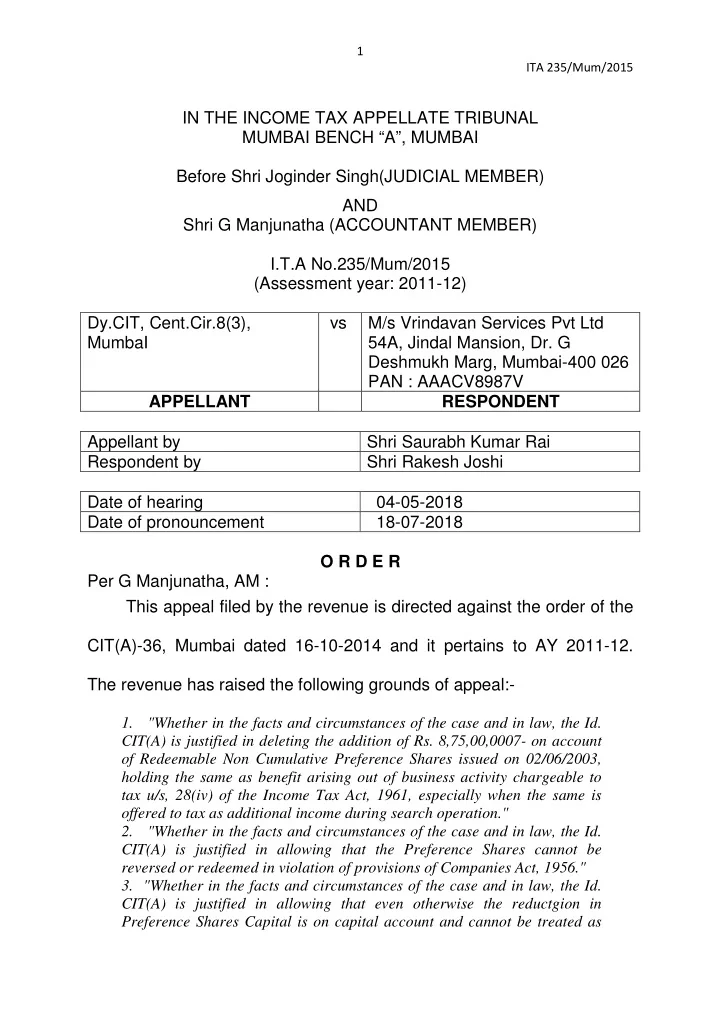
IN THE INCOME TAX APPELLATE TRIBUNAL MUMBAI BENCH “A”, MUMBAI Before Shri Joginder Singh(JUDICIAL MEMBER) AND Shri G Manjunatha (ACCOUNTANT MEMBER) I.T.A No.235/Mum/2015 (Assessment year: 2011-12) Dy.CIT, Cent.Cir.8(3), MumbaI vs M/s Vrindavan Services Pvt Ltd 54A, Jindal Mansion, Dr. G Deshmukh Marg, Mumbai-400 026 PAN : AAACV8987V APPELLANT RESPONDENT Appellant by Shri Saurabh Kumar Rai Respondent by Shri Rakesh Joshi Date of hearing 04-05-2018 Date of pronouncement 18-07-2018 O R D E R Per G Manjunatha, AM : This appeal filed by the revenue is directed against the order of the CIT(A)-36, Mumbai dated 16-10-2014 and it pertains to AY 2011-12. The revenue has raised the following grounds of appeal:-
- 1. "Whether in the facts and circumstances of the case and in law, the Id.
CIT(A) is justified in deleting the addition of Rs. 8,75,00,0007- on account
- f Redeemable Non Cumulative Preference Shares issued on 02/06/2003,
holding the same as benefit arising out of business activity chargeable to tax u/s, 28(iv) of the Income Tax Act, 1961, especially when the same is
- ffered to tax as additional income during search operation."
- 2. "Whether in the facts and circumstances of the case and in law, the Id.
CIT(A) is justified in allowing that the Preference Shares cannot be reversed or redeemed in violation of provisions of Companies Act, 1956."
- 3. "Whether in the facts and circumstances of the case and in law, the Id.
CIT(A) is justified in allowing that even otherwise the reductgion in Preference Shares Capital is on capital account and cannot be treated as
SLIDE 2 2 ITA 235/Mum/2015
Business Income of the previous year."
2. The brief facts of the case are that the assessee is a private limited company, engaged in the business of trading in shares and securities, leasing out property held as investment, etc., filed its return of income for AY 2011-2 u/s 139(1) on 20-09-2011 declaring Nil income. A search and seizure action was carried out u/s 132 of the Income-tax Act, 1961 in JSW group of cases on 16-03-2011. During the course of search, books of account and documents belonging to the assessee company were found and seized. During the course of search, the assessee gave declaration of income in a group of cases as per which, an amount of Rs.8.75 crores towards write back of preference shares has been
- ffered as undisclosed income in assessee’s case. However, the
assessee has not admitted any income in respect of undisclosed income admitted during the course of search, while filing return of income. Therefore, the AO called upon the assessee to explain as to why additional income declared during the course of search shall not be
- added. In response to notice, assessee filed details submissions, as per
which the assessee stated that the company has received loan from M/s South India House Investments Ltd, during the period 19-05-2003 to 30/05/2003 as subscription money towards preference shares. The company has allotted 87,50,000 2.5% redeemable non cumulative
SLIDE 3
3 ITA 235/Mum/2015
preference shares of Rs.10 paid up each to the said applicant. The said shares were alive and outstanding in the books of VSPL on 16-03-2011 and compulsorily redeemable prior to 01-06-2003. Owing to search action, to buy peace and avoid litigation, the assessee has agreed for disclosure of undisclosed income of Rs.8.75 crores by writing off redeemable non cumulative preference shares in its books of account. But facts remain that, such redeemable preference shares cannot be redeemed before the specified period, as per provisions of section 80 of Companies’ Act, 1956. The assessee also stated that the said admission during the course of search is of mistaken understanding of facts, therefore, without any further evidence found during the course of search, only on the basis of admission of the assesse, a receipt in the nature of capital receipt cannot be taxed u/s 28(iv) of the Income-tax Act, 1961. 3. The AO, after considering relevant submissions of the assessee and also taking into account materials collected during the course of search, including statement recorded u/s 132(4) and subsequent declaration letter filed by the assessee dated 01-06-2011 observed that in principle, the assessee has admitted sum of Rs.8.75 crores is no longer payable to M/s South India House Investments Ltd. There has been no retraction by the assessee on this issue till date. Since the
SLIDE 4 4 ITA 235/Mum/2015
amount is no longer payable, it was held that it is a benefit directly arising out of business activity of the assessee and, therefore, chargeable to tax u/s 28(iv) of the Income-tax Act, 1961. 4. Aggrieved by the assessment order, assessee preferred appeal before the CIT(A). Before the CIT(A, assessee has filed elaborate written submissions which has been reproduced by the Ld.CIT(A) at para 5 on pages 4 to 9 of his order. The sum and substance of the arguments of the assessee before the Ld.CIT(A) was that at no stretch
- f imagination, a capital receipt being redeemable non cumulative
preference shares can be considered as benefit derived out of business connection and is taxable u/s 28(iv) of the Income-tax Act, 1961. 5. The Ld.CIT(A), after considering relevant submissions of the assessee and also relying upon the decision of Hon’ble Bombay High Court in the case of Vodafone India Services Ltd (WP) No.871 of 2014 held that preference share capital received in financial year 2003-04 is capital in nature and cannot be taxed u/s 28(iv) of the Income-tax Act,
- 1961. The relevant portion of the order of CIT(A) is extracted below:-
6.6 The oral and written arguments made by the appellant's AR have been considered. It is undisputed fact that appellant received share application money of Rs 8.75 crores FY 2003-04 from South India Investment Limited in FY 2003-04, The appellant company had allotted 87,50,000 2.5% redeemable non-cumulative shares of face value 10/- to said investor on 2.06.2003. A copy of share certificate has been seized during search action. As per terms of preference shares, the same are redeemable at the option of appellant before 2.06.2023. It is the case of appellant that the shares were allotted in FY 2003-04 and redeemable in FY 2023-24. As on date of search, the preference shares were outstanding in the books of appellant. The appellant submits that as per provisions of Companies Act, 1956 preference shares can only be
SLIDE 5 5 ITA 235/Mum/2015 redeemed out of accumulated profits available for distribution of dividend or proceeds of fresh issue of shares. Hence, appellant claims that law forbids it from writing back issued preference shares even if the same are considered as no more
- redeemable. Even otherwise, the appellant contends that preference share capital is
capital receipt and not chargeable to tax.
6.7 The AO has added the preference share capital to business income u/s 28(iv) as benefit or perquisite, whether convertible into money or not, arising from business. Though the appellant has_ot reversed the reference share capital in its books, nor credited it to P&L Account, AO has solely relied upon the disclosure made during the search assessment. It is a settled law that Subscription to share capital is capital receipt unless the same is proved to be non genuine in the year of receipt. In this case share capital has been received in FY 2003-04 relevant to AY 2004-05 and the same is redeemable till FY 2023-24 strictly as per provisions of Companies Act. Even if, it is presumed, that the sum is no more payable, still the up share capital can neither" be reversed in books nor redeemed without being sourced from accumulated profits or proceeds of fresh issue of equity shares due to fetters imposed of Companies Law. I am bound to agree with argument of the appellant that even in case of redemption, this is a case of money going out and not coming in so as to derive any income from the same. For the sake of argument, howsoever illogical, even if it is presumed that the said preference share capital could be written back in the year under consideration, still it being a sum received on capital account cannot be charged to tax. While the AO has sought to charge the preference share capital which in his opinion is no more repayable as business income u/s 28(iv) of the Act as "the value of any benefit or perquisite, whether convertible into money
- r not, arising from business or the exercise of a profession", there are a series of
authorities including jurisdictional High Court in the case of Xylon Holdings Pvt Ltd (supra), Mahindra and Mahindra Ltd (supra), and other High court and Tribunal rulings which have held that the provisions of section 28(iv) apply to the value of benefit or perquisites whether convertible into money or not, arising from business, but does not apply for benefit received in cash or money as a result of the waiver of principal amount of loan. 6.8 The Honourable Bombay High Court in its recent decision in the case of Vodafone India Services Pvt Ltd (WP No 871 of 2014) held that the amounts received on issue of share capital including the premium is undoubtedly on capital
- account. Dwelling on this issue, Hon'ble Court observed in para 25 of order dated
10.10.2014 as follows: "...,T\ie word income for the purpose of the Act has a well understood meaning as defined in Section 2(24) of the Act. This even when the definition in section 2(24) of the Act is an inclusive definition. It cannot be disputed that income will not in its normal meaning include capital receipts unless it is so specified, as in Section 2(24) (vi) of the Act* In such a case, Capital Gains chargeable to tax under Section 45 of the Act are, defined to be income. The amounts received on issue of share capital including the premium is undoubtedly on capital account. Share premium have been made taxable by a legal fiction under Section 56(2)(viib) of the Act and the same is enumerated as Income in Section 2(24)(xvi) of the Act. However, what is bought into the ambit of income is the premium received from a resident in excess of the fair market value of
SLIDE 6 6 ITA 235/Mum/2015
the shares. In this case what is being sought to be taxed is capital not received from a non-resident i.e. premium allegedly not received on application of ALP. Therefore, absent express legislation, no amount received, accrued or arising
- n capital account transaction can be subjected to tax as Income..."
In the impugned case, what the AO has sought to tax as business income u/s ) is preference share capital received in FY 2003-04 which is not permissible as same is on capital account. Respectfully following the decision of Hon'ble dictional High Court, the addition made AO on account of Preference Share Capital is therefore not found in order and hence deleted. The ground of appeal is allowed.”
6. The Ld. DR submitted that the Ld.CIT(A) was erred in deleting addition made by the AO towards undisclosed income admitted during the course of search on account of write back of redeemable non cumulative preference shares of Rs.8.75 crores without appreciating the fact that the assessee itself has admitted that such share capital is no longer payable and hence, it is a kind of benefit derived out of business connections which is chargeable to tax u/s 28(iv) of the Income-tax Act,
- 1961. The Ld.CIT(A) completely ignored the fact that the assessee has
admitted such undisclosed income in his statement recorded u/s 132(4) and such statement has been recorded from Shri MVS Seshagiri Rao, Managing Director and Group CFO of M/s JSW group of companies, who is well qualified. Therefore, the statement given by the assessee cannot be ignored merely for the reason that the receipt is in the nature
- f capital receipts. The Ld.DR referring to the letter filed by the
assessee before the Deputy Director of Income-tax (Inv) on 01-06-2011, submitted that the assessee has categorically stated that he has agreed
SLIDE 7
7 ITA 235/Mum/2015
for undisclosed income in various companies’ name amounting to Rs.260 crores out of which, an amount of Rs.8.75 crores was offered in assessee’s name towards write back of preference shares for which necessary journal entries have been passed in the books of account. The Ld.CIT(A) ignored all evidences to delete addition made by the AO. In this regard, he relied upon the decision of Hon’ble Kerala High Court in the case of CIT vs Abdul Razzak (2013) 350 ITR 71 (Ker). 7. On the other hand, the Ld.AR for the assessee submitted that the issue is squarely covered in favour of the assessee, by the decision of ITAT, Mumbai Bench in assessee’s own group case in M/s Nalwa Chrome Pvt Ltd in ITA No.238/Mum/2015 dated 08-03-2017 wherein, under similar set of facts, the ITAT held that receipt in the nature of capital receipt cannot be taxed u/s 28(iv) or u/s 41(1) merely on the basis of admission of the assessee during the course of search. The Ld.AR further submitted that the company has issued redeemable non cumulative preference shares in the financial year 2003-04 and such preference shares is redeemable on or before 2023 and as per provisions of section 80 of the Companies’ Act, 1956, these shares cannot be written back in the books of account of the company and compulsorily redeemable; even otherwise, said receipt is capital receipt and cannot be taxed u/s 28(iv) of the Income-tax Act, 1961.
SLIDE 8 8 ITA 235/Mum/2015
8. We have heard both the parties, perused the material available on record and gone through the orders of authorities below. The AO made addition towards undisclosed income being write back of redeemable non cumulative preference shares of Rs.8.75 crores on the basis of admission of the assessee during the course of search. According to the AO, preference share capital is no longer payable, therefore, it is in the nature of benefit derived from business activity and chargeable to tax u/s 28(iv) of the Income-tax Act, 1961. The addition made by the AO is solely based on statement recorded during the course of search. Such statement has been recorded from Shri MVS Seshagiri Rao, Managing Director and Group CFO of M/s JSW group of companies. In the said statement, while answering a specific question, the Managing Director of JSW group of companies has admitted undisclosed income of Rs.262 crores without specifying nature of undisclosed income. The group has filed a letter on 01-06-2011 enclosing break up of the income offered to tax in various group companies’ names along with certain evidence. On perusal of the details filed by the assessee alongwith letter, we find that the assessee has written back redeemable non cumulative preference shares of Rs.8.75 crores issued to M/s South India House Investments Ltd by debiting to share capital account and crediting to capital reserve
- account. The assessee claims that redeemable preference shares has
SLIDE 9
9 ITA 235/Mum/2015
been issued in financial year 2003-04 and as per the provisions of section 80 of the Companies’ Ac, 1956 such redemption should be compulsorily made as per the terms of issue and it cannot be written back in the books of account of the assessee. The assessee further contended that redeemable preference shares is a capital receipt and it cannot be considered as benefit derived out of business activity which is taxable u/s 28(iv) of the Income-tax Act, 1961. The assessee has relied upon various judicial precedents, including the decision of Hon’ble jurisdictional High Court in the case of Vodafone India Services Ltd (supra). 9. Having heard both the sides and considered material on record, we find that the co-ordinate bench of ITAT, H-Bench, Mumbai in the case of M/s Nalwa Chrome Pvt Ltd vs DCIT (supra) has considered identical issue in the group company of assessee in connection with a search conducted on M/s JSW group on 16-03-02011. The co-ordinate bench, after considering relevant facts and also taking into account admission of the assessee, in the statement recorded from Shri MVS Seshagiri Rao, Managing Director and Group CFO of M/s JSW group of companies and also the letter filed by the assessee on 01-06-2011 held that addition cannot be made towards capital receipts on the basis of admission of the assessee. The relevant portion of the order is
SLIDE 10 10 ITA 235/Mum/2015
extracted below:-
- 12. We have gone through the orders passed by the lower authorities
as well as submissions made and judgements placed before us by both the sides. We are required to decide the issue whether the amount received on account of share application money could be treated as income of the assessee, if the same is written-back in the books of account, either u/s 41(1) or 28(iv) of the Income-tax Act, 1961. But before that we came across another facet viz. the AO had relied upon the statement made by Shri M.V.S. Sesagiri Rao for making impugned addition, wherein aforesaid amount has been allegedly offered to tax on behalf of the assessee before us. Therefore, we need to first decide the bearing of the same on the addition made by the AO.
- 13. It is noted from the information brought before us that search had
taken place on JSW group of companies wherein statement of Shri M.V.S. Sesagiri Rao was recorded wherein he had allegedly made a surrender of an aggregate amount of Rs.262 crores which comprises of the amount of Rs.4.50 crores on account of write-back of the share application money. We have gone through the statement recorded of Shri Rao as well as the break-up of the aforesaid sum, subsequently provided by Mr Rao. It is noted that statement of Shri Rao was recorded u/s 132(4) on 17-03-20121 by the DDIT(Inv), Unity-IX(3), Mumbai on the occasion of search carried out at the premises of JSW group. In response to the question with regard to connection with the JSW group, it was replied that Shri Rao was managing director and group CEO of JSW group of companies and was incharge of steel business of JSW Steel Ltd. It appears that said statement was given by Mr Rao in the capacity of director of JSW Steel Ltd. In the entire statement, at no place, name of the assessee company has been mentioned. There is no mention in the entire statement whether the statement was being given by Shri Rao on behalf of the assessee company also. Further, we have also gone through the question and answers with regard to so called offer / surrender of aggregate amount of Rs.262 crores made by Shri Rao and the same is reproduced hereunder for the sake of ready reference:- “ Do you want to say anything else? Answer: No. I have briefly gone through the seized materials and various statements recorded at this premises during the course of the search and seizure
- proceedings. On perusal of the same, it appears that there are certain
discrepancies 'with regard to expenses, cash payments etc. On the basis of these discrepancies and to cover any other discrepancies that may arise during the course of analysis of the seized material and the books of account of the group companies and to buy peace of mind and avoid litigation, I offer a sum of Rs.262 crores as additional income of the group. Detailed assessee-wise and year-wise break-up of the additional income i.e. Rs. 262 crores will be given within a week's time. I request you not to initiate penalty and prosecution proceedings on account of the fact that the disclosure has been made voluntarily.”
- 14. It is seen that in the aforesaid statement, name of the assessee
SLIDE 11 11 ITA 235/Mum/2015
company has nowhere specifically mentioned while offering the additional income of Rs.262 crores. Our attention was also drawn upon the break-up of the aforesaid amount which was claimed to be provided by Shri Rao. Relevant part of the same reads as under:-
Nalwa Chrome 2011-12 4,50,000/- Writing back of the advance towards subscription to share
- capital. (Relevant entry passed in
the books of accounts)
In addition to the above, our attention was also drawn upon the following journal voucher which was passed by the assessee company dated 31-03- 2011:- Particulars Dr. Cr. Advance against Equity 4,50,00,000 Capital Reserve 4,50,00,000 (On account of : Entry to transfer advance against equity received from Anand Transport to Capital Reserve on account of basis of discussion with Income-tax Authorities)
- 15. We have carefully gone through the entire exercise of making this
statement and furnishing of this break-up of offer of additional income. It is noted that nowhere it has been mentioned that the impugned amount was bogus or non-genuine. It has nowhere been admitted that the aforesaid amount represents undisclosed income of the assessee. Thus, there is no admission on facts by anyone to the effect that impugned amount could be treated as undisclosed income of the assessee. What has been offered is that ‘…writing back of the advance received towards subscription to share capital may be treated as income of the assessee…’
- 16. Thus, it is a case of purely a legal issue. It is settled law that on legal
issue, the assessee cannot be always made bound by its ‘admissions’. If a particular item or receipt or transaction is taxable as per the provisions of the Act, then it is, and if it is not, then it is not. The position of law remains unchanged and the legal position is not altered even on the basis of consent of an assessee especially when the consent is subsequently
- withdrawn. It is because of the fact that as per the constitutional framework
- f our country, no tax can be collected except as per authority of law, as
has been clearly laid down under Article 265 of Constitution of India. Various courts have time to time clarified this position. Therefore, assessment of income must be done only within the four corners of provisions of the Income-tax Act, 1961. Ld. Counsel of the assessee placed reliance in this regard upon the judgment of Hon’ble Allahabad High Court in the case of CIT vs Malti Mishra (supra) wherein legal position in this regard has been clarified. Relevant part of the judgment is
SLIDE 12 12 ITA 235/Mum/2015
reproduced hereunder, for the sake of ready reference:- “13. In the instant case, there is no concealment on the part of the assessee regarding the transactions. All the transactions were duly
- disclosed. If the income as per law is exempted, then the offer of the
assessee is meaningless as the law will prevail and will supersede the "offer" made by the assessee. In the instant case, surrender was to buy the peace as the assessee is not an expert in income tax matter. The Department cannot take the advantage of the ignorance of the assessee as per CBDT Circular No.14(XL35)/1955 dated 01.04.1955 mentioned in 150 ITR 105 (Kar). 14. In the instant case, the statement was recorded of the broker, who had confirmed the sale and purchase. No concealment was made by the assessee even then she has made an offer to treat the said income as income from "other sources". The
- nly reason for making the addition is that it was not entered in the
register of the company, for which, the assessee is not responsible specially when she has discharged the burden of proof by disclosing all the transactions in the return, as per the ratio laid down by the Punjab & Haryana High Court in the case of CIT vs. Sudarshan Gupta, 2008 (10) DTR 134 (P&H). Hence, we are of the view that the surrender letter will have to be ignored. Thus, we find no reason to interfere with the impugned order passed by the Tribunal. The same is hereby sustained along with reasons mentioned therein.”
- 17. Thus, from the above, it may be noted that Hon’ble High Court has
relied upon the circular of the Board wherein it has been clearly guided by the Board to its revenue officers that they should not take undue advantage of ignorance of assessee. Thus, from the evidences brought before us and the legal position as discussed above, we find that the AO could not have adopted the aforesaid offer as the sole basis to make addition in the hands of assessee. Therefore, in our considered view, the taxability of this amount as income in the hands of the assessee should be decided purely on its merits and strictly in accordance with the provisions
- f Income-tax Act, 1961.
- 18. As far as merits of this issue are concerned, it is noted that the facts
are undisputed that the assessee had received the impugned amount on account of share application money which has been written-back as the shares were not allotted. Now question arises, whether this amount could be treated as part of income of the assessee and that too, of the year under consideration. It is brought to our notice that this issue is no more res-integra as Hon’ble Bombay High Court has already decided this issue in many judgments. Ld. Counsel of the assessee has placed reliance upon the judgment of Hon’ble Bombay High Court in the cases of Softworks Computers Pvt Ltd (supra) and Xylon Holdings Pvt Ltd (supra) wherein it is held that the amount received on account of share capital can neither be treated as taxable either u/s 41(1) or u/s 28(iv) if the same is written-back in the books of account. We shall discuss hereunder the judgment in the case of Xylon Holdings Pvt Ltd (supra) wherein one of the questions raised by the Revenue before the Hon’ble High Court was “whether the amount
SLIDE 13 13 ITA 235/Mum/2015
received on account of share application money and written-back in the books of account can be brought to tax u/s 41(1) of the Act or u/s 28(iv) of the Act as business income”. Hon’ble High Court discussed the entire law in this regard and held the same in the negative by observing as under:- “8. We have considered the submissions. The issue arising in this case stands covered by the decision of this Court in the matter of Mahindra & Mahindra (supra). The decision of this court in the matter of Solid Containers (supra) is on completely different facts and inapplicable to this case. In the matter of Solid Containers (supra) the assessee therein had taken a loan for business
- purpose. In view of the consent terms arrived at, the amount of
loan taken was waived by the lender. The case of the assessee therein was that the loan was a capital receipt and has not been claimed as deduction from the taxable income in the earlier years and would not come within the purview of Section 41(1) of the Act. However, this Court by placing reliance upon the decision of the Apex Court in the matter of CIT v. T. V. Sundaram Iyengar and Sons Ltd. 222 ITR 344 held that the loan was received by the assessee for carrying on its business and therefore, not a loan taken for the purchase of capital assets. Consequently, the decision of this Court in the matter of Mahindra and Mahindra Limited (supra) was distinguished as in the said case the loan was taken for the purchase of capital assets and not for trading activities as in the case of Solid Containers Limited (supra). In view of the above, the decision of this Court in the matter of Solid Containers Limited (supra) will have no application to the facts of the present case and the matter stands covered by the decision of this Court in the matter of Mahindra & Mahindra Limited (supra). The alternative submission that the amount of loan written off would be taxable under Section 28(iv) of the Act also came up for consideration before this Court in the matter of Mahindra & Mahindra Limited (supra) and it was held therein that Section 28(iv) of the Act would apply only when a benefit or perquisite is received in kind and has no application where benefit is received in cash or money. 9) In view of the issue arising in this appeal being covered by the decision of this Court in the matter of Mahindra & Mahindra Ltd.(supra), no substantial question of law arises and both the questions are dismissed.” 19. From the above, it may be noted that Hon’ble High Court has considered its earlier judgment in the case of Solid Containers (supra) as well as the judgment of Hon’ble Supreme Court in the case of T.V. Sundaram Iyengar & Sons Ltd (supra) and held that the amount received on account of share application money cannot be brought to tax as income u/s 41(1) or u/s 28(iv). 20. It is further noted that similar view has been taken by Hon’ble Madras High Court in the case of Skraemeco Regent Ltd (312 ITR 317) wherein detailed discussion was made on section 28(iv) as well as section 41(1) and it was held that amount received for the purpose of acquiring capital
SLIDE 14 14 ITA 235/Mum/2015
asset did not constitute trading liability, and therefore, the same was not taxable u/s 41(1) or section 28(iv) of the Act. It is further noted that Hon’ble Delhi High Court in the case of CIT vs Tosha International Ltd 331 ITR 440 adopted the same view after considering the judgment of Hon’ble Bombay High Court in the case of Mahindra & Mahindra Ltd (supra). Thus, from the aforesaid legal discussion and facts of the case before us, we find that the order passed by the Ld. CIT(A) is well reasoned and based on correct legal position and, therefore, no interference is called for in his order. Thus, the same is upheld. Ground raised by the Revenue is dismissed.”
- 19. From the above, it may be noted that Hon'ble High Court has
considered its earlier judgment in the case of Solid Containers (supra) as well as the judgment of Hon'ble Supreme Court in the case of T.V. Sundaram lyengar & Sons Ltd (supra) and held that the amount received on account of share application money cannot be brought to tax as income u/s 41(1) or u/s 28(iv).
- 20. It is further noted that similar view has been taken by Hon'ble Madras
High Court in the case of Skraemeco Regent Ltd (312 ITR 317) wherein detailed discussion was made on section 28(iv) as well as section 41(1) and it was held that amount received for the purpose of acquiring capital asset did not constitute trading liability, and therefore, the same was not taxable u/s 41(1) or section 28(iv) of the Act. It is further noted that Hon'ble Delhi High Court in the case of CIT vs Tosha International Ltd 331 ITR 440 adopted the same view after considering the judgment of Hon'ble Bombay High Court in the case of Mahindra & Mahindra Ltd (supra). Thus, from the aforesaid legal discussion and facts of the case before us, we find that the order passed by the Ld. CIT(A) is well reasoned and based on correct legal position and, therefore, no interference is called for in his order. Thus, the same is upheld. Ground raised by the Revenue is dismissed.
- 10. In this case, facts are identical to the case already considered by
the co-ordinate bench in the case of Nalwa Chrome Pvt Ltd. The AO has made addition towards redeemable non cumulative preference shares u/s 28(iv) of the Income-tax Act, 1961. Since, the co-ordinate bench has already taken a view that share capital receipt cannot be taxed either u/s 28(iv) or 41(1) of the Act. Therefore, being consistent with the view taken by the co-ordinate bench, we are of the considered
SLIDE 15 15 ITA 235/Mum/2015
view that write back of preference share capital cannot be taxed u/s 28(iv) of the Income-tax Act, 1961. The Ld.CIT(A), after considering relevant facts has rightly deleted addition made by the AO. We do not find any error in the order of the CIT(A). Hence, we are inclined to uphold the findings of CIT(A) and dismiss the appeal filed by the revenue.
- 11. In the result, appeal filed by the revenue is dismissed.
Order pronounced in the open court on 18th July, 2018. Sd/- sd/- (Joginder Singh) (G Manjunatha) JUDICIAL MEMBER ACCOUNTANT MEMBER Mumbai, Dt : 18th July, 2018 Pk/- Copy to :
- 1. Appellant
- 2. Respondent
- 3. CIT(A)
- 4. CIT
- 5. DR
/True copy/ By order Sr.PS, ITAT, Mumbai