SLIDE 1
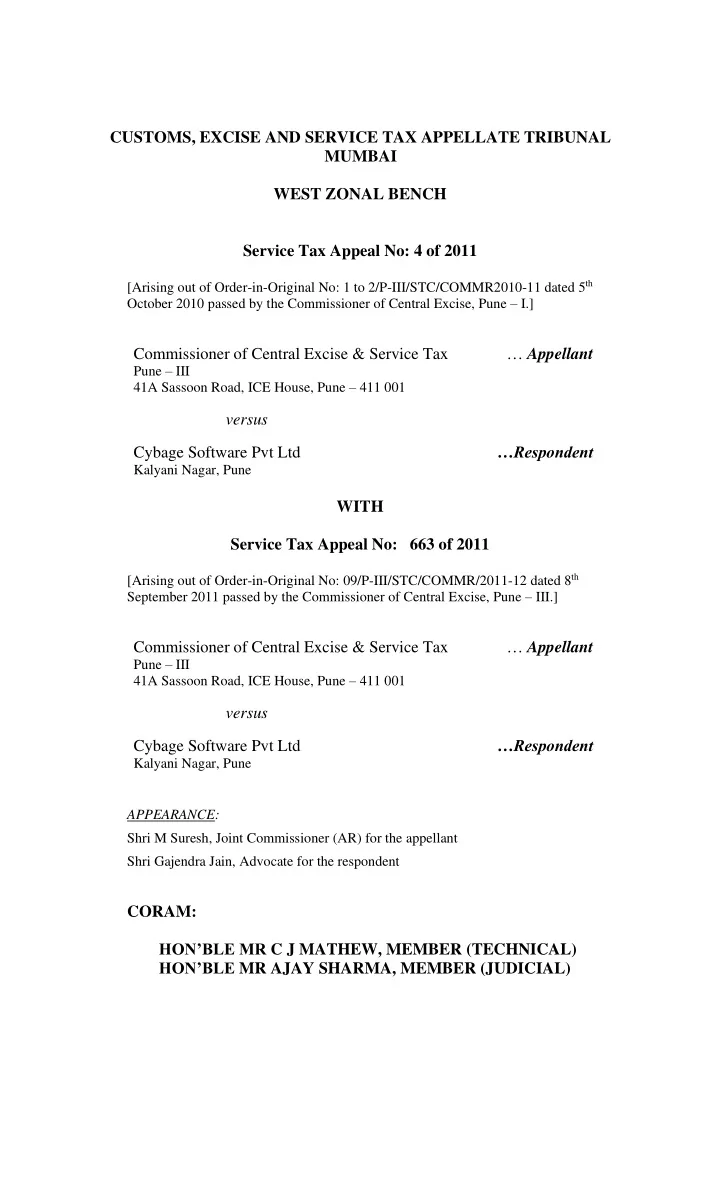
CUSTOMS, EXCISE AND SERVICE TAX APPELLATE TRIBUNAL MUMBAI WEST ZONAL BENCH Service Tax Appeal No: 4 of 2011
[Arising out of Order-in-Original No: 1 to 2/P-III/STC/COMMR2010-11 dated 5th October 2010 passed by the Commissioner of Central Excise, Pune – I.]
Commissioner of Central Excise & Service Tax … Appellant
Pune – III 41A Sassoon Road, ICE House, Pune – 411 001
versus Cybage Software Pvt Ltd …Respondent
Kalyani Nagar, Pune
WITH Service Tax Appeal No: 663 of 2011
[Arising out of Order-in-Original No: 09/P-III/STC/COMMR/2011-12 dated 8th September 2011 passed by the Commissioner of Central Excise, Pune – III.]
Commissioner of Central Excise & Service Tax … Appellant
Pune – III 41A Sassoon Road, ICE House, Pune – 411 001
versus Cybage Software Pvt Ltd …Respondent
Kalyani Nagar, Pune APPEARANCE: Shri M Suresh, Joint Commissioner (AR) for the appellant Shri Gajendra Jain, Advocate for the respondent
CORAM: HON’BLE MR C J MATHEW, MEMBER (TECHNICAL) HON’BLE MR AJAY SHARMA, MEMBER (JUDICIAL)
SLIDE 2
2
ST/4 & 663/2011
FINAL ORDER NO: A/85484-85485 / 2020
DATE OF HEARING: 16/07/2019 DATE OF DECISION: 21/01/2020
PER: C J MATHEW The issue for determination in the first of the two appeals of Revenue is the merit of the claim that to the failure on the part of the adjudicating authority to consider three aspects pertaining to taxability as provider of ‘manpower recruitment or supply service’ and to disregard of two decisions of the Tribunal as to well as inadequate appreciation of the definition of ‘support services of business commerce’ must be attributed the dropping of ₹ 89,98,459, out of total demand of ₹2,99,02,891 in show cause notice dated 21st October 2008 for the period from 16th June 2005 to 31st March 2008, and the entire demand of ₹ 30,18,30,433 in show cause notice dated 21st October 2010 for the period from 1st April 2008 to 31st March 2009. It is contended that the adjudication order should have upheld the demand of ₹21,59,950 and ₹60,71,755 as provider of ‘manpower recruitment to supply service’ and ‘support service of business or commerce’ for the earlier period in addition to the amount payable for the period from 1st April 2008 to 15th May 2008. The dropping of demand of ₹27,15,68,977, arising from having provided both these services
SLIDE 3 3
ST/4 & 663/2011
between April 2009 and March 2010, in show cause notice dated 21st January 2011 is the controversy in the second appeal. 2. The respondent herein, M/s Cybage Software Pvt Ltd, develops software for its customers, within and outside India, as an approved unit under the Software Technology Park scheme embodied in the Foreign Trade Policy notified under Foreign Trade (Development & Regulation) Act, 1992. The expansion of taxable activity under section 65(105)(k) of Finance Act, 1994 to include manpower supply, even of temporary nature, with effect from 16th June 2005 coupled with liability, under section 67 of Finance Act, 1994, on the gross amount charged from M/s HSBC Software, M/s Microsoft India, M/s Aviva and M/s Netcore Solutions for providing engineering support at the premises of the client, or from their own, led to initiation of proceedings in which the tax on the amount charged for work executed at the premises of the clients, accepted as liable by the respondent, and confirmed in order-in-original no. 1 to 2/P-III/STC/COMMR/2010 dated 5th October 2010 of Commissioner of Central Excise, Pune-I while dropping the demand pertaining to charges for ‘off site’
- deployment. For the period covered by the second notice determined in
the same adjudication order, the demand, limited to the value of exports
- n which, admittedly, tax liability had not been discharged, did not find
- favour. It was also alleged that the respondent, having operated an
‘offshore development centre’ for M/s HSBC and the consideration
SLIDE 4 4
ST/4 & 663/2011
received being taxable under section 65(105)(zzzq) of Finance Act, 1994 with the taxable activity defined in section 65(104c) of Finance Act, 1994 incorporating ‘infrastructural support service’ within the inclusion component of ‘support services of business or commerce’, failed to discharge the tax obligation. 3. The adjudication order found merit in the claim of the respondent herein that the activity occurring at the premises of the client was taxable only with effect from 16th May 2008 when ‘information technology or software service’ was included in section 65(105) of Finance Act, 1994 and that, even if ‘manpower recruitment or supply’ service was rendered, the activity undertaken at their own premises would not fall within the ambit of such tax. The claim of the noticee that ‘offshore development centre’ was only intended to enable the confidentiality of work undertaken at their own premises was also found to be acceptable by the adjudicating authority to relieve them of the demand. The second notice, pertaining as it did to tax liability on charges recovered from overseas customers, was dropped in entirety on acceptance of the claim that these were exports on which tax liability, as provider of ‘information technology software service’, would not
- arise. The notice on identical lines for a further period was similarly
dropped vide of order-in-original no. 09/P-III/STC/COMMR/2011-12 dated 8th September 2011 with the finding that it was merely a protective proceeding and that the challenge of Revenue to the dropping
SLIDE 5 5
ST/4 & 663/2011
- f notice for the earlier period not dispute the finding of export, or the
non-taxability, of the services rendered to overseas customers. 4. A few preliminaries in the proceedings need to be disposed of at the outset to mark the contours of a decision below. Learned Authorised Representative argued strenuously in support of the proposals in the show cause notice with reference to the provisions of Finance Act, 1994 and by placing reliance on various decisions pertaining to ‘manpower supply service’ that placed emphasis on the contractual underpinnings
- f transactions as determinant of taxability. Nonetheless, we need not
concern ourselves with the whole canvass of the case of tax authorities as the grounds of appeal alone are required to be considered by us in resolution of the claim of Revenue. It is indisputable that Finance Act, 1994, while defining ‘manpower recruitment or supply agency’, the intended target of taxation, in section 65 (68) has not elaborated upon the expression ‘manpower supply’; while ‘manpower recruitment’ is easily comprehensible, the other is not. M/s Cybage Software Pvt Ltd is a ‘export-oriented unit’ but has contracted with four customers, enumerated supra, based in the taxable territory and it is the consideration, computed with time as the basis, received for deployment of their staff without physical presence at the premises of these customers, which is in dispute. That the respondent herein had been discharging tax liability on consideration for providing ‘on-site’ service from 16th May 2008, as provider of ‘information technology or
SLIDE 6 6
ST/4 & 663/2011
software services’, is common ground and the dropping of demand in the second show cause notice, to the extent of covering the receipts from customers based outside India after the introduction of this new entry, is not challenged. Consequently, the second appeal pertaining to tax of ₹ 27,15,68,977, entirely attributable to receipts from customers
- utside India, for the period from 1st April 2009 to 31st March 2010
does not have to be taken up for consideration by us in view of the acceptance of such transactions as being beyond the pale of taxation in the order that is impugned before us in the first appeal; the revival for a subsequent period cannot be conceded as the contents of the very report dated 4th October 2017 does not dispute the claim of these being exports. 5. The only two issues that now subsist are the taxability of that portion of the consideration received from the four customers in India computed in terms of employees utilised at the premises of the respondent for fulfilling the transaction contracted with them and the taxability of the receipts for operation of ‘offshore development centre’; the latter of these, from the trajectory of the proposals in the two show cause notices disposed of in the first order impugned before us, is merely an extension of the former sought to be taxed under an entirely different entry. The decision on the former will squarely apply to the latter. We can now turn to the issues placed before us by Learned Authorised Representative and Learned Counsel for respondent on the
SLIDE 7 7
ST/4 & 663/2011
grounds of appeal set forth by the competent reviewing authority. 6. The decision of the Tribunal in Cognizant Tech Solutions (I) Pvt Ltd v. Commissioner, LTU, Chennai [2010 (18) STR 326 (Tri- Chennai)] to the effect that
‘8. We find that the Department’s case against the appellants is primarily based on the fact that the appellants have recruited the entire staff only on the basis of requirement of Pfizer. The learned special counsel for the Department also highlights that Pfizer assisted in recruitment and training of the staff, computer hardware and software were provided by Pfizer, the work order is covered by a separate budget which is made on ‘per seat cost’ including creation of infrastructure facilities. The learned special counsel for the Department also refers to the work order and the attachments and states that the appellants would have to provide service under FSP model in the subsequent period when there will be functional responsibilities on them but not so under the FTE model in the initial period. According to him, the appellants only recruited and provided the staff to Pfizer.
- 9. However, the learned senior counsel appearing for the
appellants has very forcefully argued that even during the initial period under the FTE model, the manpower recruited by the appellants under contract with Pfizer have been retained by the appellants. The manpower so recruited is deployed under the responsibility of the appellants and are paid for by the appellants. He states that the appellants are responsible for the overall project management. He has taken us through the work order and the attachments to demonstrate that the contracted service is only in the nature of data management, bio statistics and reporting. The employees recruited work
SLIDE 8 8
ST/4 & 663/2011
under the management of appellants and they work from the premises of the appellants and it cannot be said that the manpower has been supplied to Pfizer. His main thrust of the argument is that Pfizer is specialized in the pharmaceutical industry whereas the appellants are specialized in the information technology industry. The manpower recruited and retained by the appellants are given specialized training to be able to provide specialized service as specified by their client namely Pfizer.
- 10. We find force in the contentions made by the appellants
that the work force recruited and retained by the appellants are required to work under a project manager appointed by the appellants who has to act as single point of contact being responsible for overall management of the project. From the arguments advanced from both sides, it is clear that the learned special counsel for the Department is not disputing that in the second stage of the project, the appellants would be providing functional service to Pfizer. It is also not in dispute that such functional service relating to data management, bio statistics and reporting will be provided through the very same manpower which has been recruited, retained and trained during the first phase. It has to be appreciated that recruitment and training precedes provision of specialized services. If it is accepted that the same manpower will be providing specialized functional services to Pfizer in the second phase of the contract, it is logical to conclude that the manpower has been retained with the appellants during the first phase and not supplied to Pfizer though recruitment of manpower has no doubt been done at the instance of Pfizer. The assistance in recruitment provided by Pfizer to select suitable personnel and subsequent training provided by Pfizer is also understandable considering the strict standards Specified by FDA of USA, the export market for the pharmaceutical products of Pfizer. The
SLIDE 9 9
ST/4 & 663/2011
assistance in recruitment and imparting of specialized training for the recruited personnel cannot be held against the appellants’ claim that they have not supplied the manpower but have merely recruited and retained the same for providing specialized services to Pfizer utilizing such manpower. Moreover, we find that the nature of services required to be provided by the appellants are in the nature of information technology services as the same relates to data management. Consequently, we hold that the appellants are not liable to pay Service tax in respect of the services provided by them to Pfizer under the impugned contract. Therefore, we also hold that they are eligible for the small scale exemption in respect of the small value of services provided by them to M/s. SAP LABS India Pvt. Ltd. which is below the exemption limit of Rs. 4 lakhs.’
settles the issue of taxability of the impugned consideration. 7. It would also appear that the grounds of appeal focus on contractual consideration charged from customers who, in addition, are provided with the impugned service at their premises and attempts to levy the tax premised on the existence of two entities with consideration flowing from one to the other outside the framework of the legislatively intended limits of the taxable entry. In Senairam Doongarmall v. Commissioner of Income Tax, Assam [2002-TIOL-1053-SC-IT-LB], the Hon’ble Supreme Court had occasion to examine the nature of receipts as determinant of taxability and held that
‘35. All these cases were decided again on their special
- facts. Though they involved examination of other decisions in
SLIDE 10 10
ST/4 & 663/2011
search for the true principles, it cannot be said that they resulted in the discovery of any principle of universal
- application. To summarise them: South India Pictures' case
was so decided because the money received was held to be in lieu of commission which would have been earned by the business which was still going, and the receipt was treated as the fruit of the business. The same reason was given in Jairam Valji's case and Shamshere Printing Press case. In Vazir Sultan's case, the compensation was held to replace loss of capital, and in Godrej's case, the compensation was said not to have any relation to the likely income or profits but to loss
- f capital. Each case was thus decided on its facts.
36. We have so far shown the true ratio of each case cited before us, and have tried to demonstrate that these cases do no more than stimulate the mind, but none can serve as a precedent, without advertence to its facts. The nature of the business, or the nature of the outlay or the nature of the receipt in each case was the decisive factor, or there was a combination of these factors. Each is thus an authority in the setting of its own facts.’
8. The normal activities of a commercial transaction with the four customers, notwithstanding the deployment of staff at the premises of the latter being taxable as a service, which may have been recompensed by monetising the time spent by the employees of the respondent on discharging a contractual obligation cannot be construed as a service merely because another transaction, being taxable service, has been
- established. To extend the logic of the grounds of appeal would be
tantamount to subjecting every commercial activity, other than manufacture, to the tentacles of Finance Act, 1994 which clearly is not
SLIDE 11 11
ST/4 & 663/2011
the legislative intent. The designation of such deployed staff in a segregated portion of the premises of the respondent, not too unusual model in the software industry, is merely an extension of off-site activity pertaining to ‘information technology software service’ that is not exigibile to tax. 9. In view of the above, we find no merit in the appeals of Revenue which are dismissed.
(Order pronounced in the open court on 21/01/2020)
(C J Mathew) Member (Technical) (Ajay Sharma) Member (Judicial)
*/as