SLIDE 1
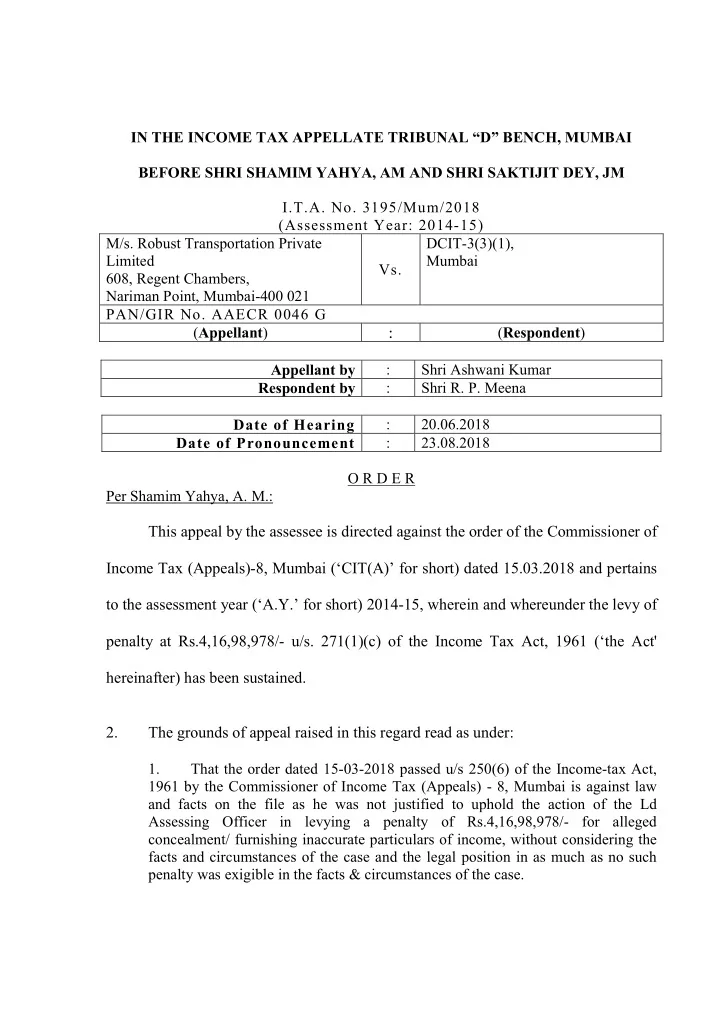
IN THE INCOME TAX APPELLATE TRIBUNAL “D” BENCH, MUMBAI BEFORE SHRI SHAMIM YAHYA, AM AND SHRI SAKTIJIT DEY, JM I.T.A. No. 3195/Mum/2018 (Assessment Year: 2014-15) M/s. Robust Transportation Private Limited 608, Regent Chambers, Nariman Point, Mumbai-400 021 Vs. DCIT-3(3)(1), Mumbai PAN/GIR No. AAECR 0046 G (Appellant) : (Respondent) Appellant by : Shri Ashwani Kumar Respondent by : Shri R. P. Meena Date of Hearing : 20.06.2018 Date of Pronouncement : 23.08.2018 O R D E R Per Shamim Yahya, A. M.:
This appeal by the assessee is directed against the order of the Commissioner of Income Tax (Appeals)-8, Mumbai (‘CIT(A)’ for short) dated 15.03.2018 and pertains to the assessment year (‘A.Y.’ for short) 2014-15, wherein and whereunder the levy of penalty at Rs.4,16,98,978/- u/s. 271(1)(c) of the Income Tax Act, 1961 (‘the Act' hereinafter) has been sustained. 2. The grounds of appeal raised in this regard read as under:
1. That the order dated 15-03-2018 passed u/s 250(6) of the Income-tax Act, 1961 by the Commissioner of Income Tax (Appeals) - 8, Mumbai is against law and facts on the file as he was not justified to uphold the action of the Ld Assessing Officer in levying a penalty of Rs.4,16,98,978/- for alleged concealment/ furnishing inaccurate particulars of income, without considering the facts and circumstances of the case and the legal position in as much as no such penalty was exigible in the facts & circumstances of the case.
SLIDE 2
2
ITA No. 3195/Mum/2018 M/s. Robust Transportation Private Limited
2. That the order dated 15-03-2018 passed u/s 250(6) of the Income-tax Act, 1961 by the Commissioner of Income Tax (Appeals)-8, Mumbai is against law and facts on the file as he was not justified to uphold the action of the Ld Assessing Officer in levying a penalty of Rs.4,16,98,978/- without clearly specifying the limb of section 271(1)(c) of the Act under which penalty proceedings had been initiated. 3. The assessee company in this case is engaged in the business of running motor lorries and motor taxies. In the course of assessment proceedings, the Assessing Officer (‘A.O.’ for short) noted that the entire amount of interest has been claimed as loss to be carry forward to set off subsequently. The A.O. noted that the assessee has earned no income from business. In response, the assessee explained that the assessee has already set up the business. It was submitted that there is a distinction between the set up and carrying of business during a particular period. It was submitted that for allowability of expenditure, what is necessary is that the business has to be set up irrespective of whether the same has been carried out in that period. In these circumstances, it was submitted that as the business of the assessee has already been set up, which was only lying dormant for the period under consideration owing to factors beyond the control of the assessee company the expenditure claimed should not be disallowed. However, the A.O. was not satisfied, he noted that the assessee company has no asset (as observed from the balance sheet) and no employee (as observed from P & L a/c, as no salary expenses are debited). It was observed that the total of the liability side is consisting of own funds & borrowed funds which has been invested in shares. It was noted that the assessee company had taken huge loans on which it was incurring huge expenditure by way of interest and on the other hand the assessee has made substantial investment in shares of Karma
SLIDE 3
3
ITA No. 3195/Mum/2018 M/s. Robust Transportation Private Limited
Industries, SRN Minerals Pvt. Ltd. and Bhushan Steel Ltd., etc. the volume of which stood at Rs.160.78 crores which yielded no income. Hence, the A.O. noted that the assessee has diverted the interest bearing funds to make investment in shares/securities. Hence, he held that the interest expenditure cannot be held to be incurred wholly and exclusively for the purpose of business of the assessee. Hence, the Assessing Officer treated the entire interest expenses as non business expenditure and disallowed the same u/s. 36(1)(iii) of the Act. In these circumstances, the A.O. observed that “penalty proceedings u/s. 271(1)(c) of the Act are initiated separately for furnishing an inaccurate particulars of income and/or concealment of particulars of income”. 4. Without prejudice to the above, the A.O. held that the interest expenditure was directly attributable towards investment activity and, therefore, liable for disallowance u/s. 14A. Hence, the A.O. held that the entire interest expenditure is hereby disallowed u/s. 14A of the Act and added back to the total income of the assessee. 5. Subsequent to the above assessment order, notice u/s. 271(1)(c) of the Act was issued to the assessee dated 24.08.2016 The charged notified to the assessee in the penalty notice reads as under: “for concealing the particulars of your income or …. Furnished inaccurate particulars of income”.
6. In the penalty order, the Assessing Officer noted that in the assessment order, there is a disallowance of interest of Rs.12,26,80,137/- u/s. 36(1)(iiii) of the Act which was made on account of the fact that the said interest expenditure was not
SLIDE 4 4
ITA No. 3195/Mum/2018 M/s. Robust Transportation Private Limited
incurred wholly and exclusively for the purpose of business of the assessee. The A.O.
- bserved that the penalty proceedings u/s. 271(1)(c) of the Act were initiated on the
above said disallowance for filing of inaccurate particulars of income leading to concealment of income. Hence, the show cause notice was issued to the assessee why penalty should not be levied in respect of the aforesaid disallowances. The assessee responded that there was no concealment or furnishing of inaccurate particulars of
- income. It was submitted that the issue of genuineness of the expenditure on interest is
not in dispute. That it was only by applying a legal fiction that a part of the interest expenditure has been disallowed. That there was no deliberate and malafide misconduct on the part of the assessee. Hence, it was submitted that no penalty is leviable in its case. The assessee has relied on various case laws including the decision of Hon’ble Supreme Court in the case of Hindustan Steel Ltd. vs. State of Orissa [1972] 83 ITR 26 (SC), the case of Commissioner of Income Tax vs. Reliance Petroproducts (P.) Ltd. [2010] 322 ITR 158 (SC), and the case of Price Water House Coopers Pvt. Ltd. vs. Commissioner of Income Tax, Kolkata -1(2012) (25 Taxman.com 400, SC). 7. However, the A.O. was not satisfied. He noted that during the assessment proceedings it was noticed that the assessee has taken huge loans on which it was incurring huge expenditure by way of interest, whereas the huge investments made by the assessee has yielded no income during the year under consideration. Hence, he
- pined that this indicates beyond doubt that the interest expenditure has not been
SLIDE 5
5
ITA No. 3195/Mum/2018 M/s. Robust Transportation Private Limited
incurred by the assessee wholly and exclusively for the purpose of business of the assessee company. Hence, the disallowance of interest expenditure u/s. 36(1)(iii) is justifiable and cannot be attributed to either difference of opinion//perceptions of or application of legal fiction as claimed by the assessee. The A.O. opined that ‘It is an attempt on the part of the assessee to evade legitimate taxes due to the Revenue and clearly falls within the ambit of furnishing of inaccurate particulars of income leading to concealment of the income’. The A.O. observed that the assessee has not been able to substantiate that as to how its claim was bonafide. Without discussing the case laws referred by the assessee, the A.O. observed that the same were distinguishable. Hence, he held that the wrong claim by the assessee is purely an attempt of furnishing of inaccurate particulars of income and concealment of income by furnishing inaccurate particulates to the extent of the aforesaid disallowance. Accordingly, the A.O. levied penalty of Rs.4,69,98,978/-. 8. Against the above order, the assessee appealed before the ld. CIT(A). 9. The ld. CIT(A) noted the ground raised by the assessee as under: That the order dated 28.02.2017 levying penalty u/s. 271(1)(c) of the Act passed by the Learned Assessing Officer is against law and facts on the file in as much as he was not justified to impose a penalty of Rs.4,16,98,978/- for alleged concealment/furnishing inaccurate particulars of income, without considering the facts and circumstances of the case and the legal position in as much as no such penalty is exigible in the facts & circumstances of the case. 10. Thereafter, the ld. Commissioner of Income Tax (Appeals) gave an extract of the written submissions of the assessee. In the initial part of the extract, the assessee
SLIDE 6 6
ITA No. 3195/Mum/2018 M/s. Robust Transportation Private Limited
had agitated about the aspect that in the notice of the penalty, it was not specified as to whether it was the case of furnishing of inaccurate particulars of income or concealment of income. Various case laws were relied upon for the proposition that in absence of the A.O.’s specifically identifying the charge, the penalty levied is not
- sustainable. Thereafter, in the same extracts, the assessee had contended that on merits
also the penalty was not liable to be levied. In these circumstances, the said extract as noted by the ld. Commissioner of Income Tax (Appeals) reads as under:
In this connection, it is also further respectfully submitted that that no penalty should be leviable on these counts, as, neither, the appellant had concealed the particulars of its income, nor, an inaccurate furnishing of the particulars of income was there. During the relevant assessment year under consideration, the appellant claimed deduction of interest expenditure amounting Rs. 12,26,80,137/- in the return of Income debited in the 'Statement of Profit or Loss' for the year ended 31.03.2014. However, the Ld. Assessing Officer alleged that the interest expenditure was not incurred wholly and exclusively for the purpose of business of the appellant, and, accordingly made a disallowance of such interest expenditure amounting Rs. 12,26,80, 137/- to the returned income of the appellant. It should be considered that, there was no contumacious conduct on part of the appellant calling for any penal action concerning the said issues in question. All the facts have been placed on record before the authorities. Disallowance of an interest expenditure would not lead to the inference of concealment of income or furnishing inaccurate particulars of income for the reason that, various claims Page 7 of 17and composition of income were clearly indicated in the return and the accompanying documents. It should be noted that the expenditure on account
- f interest has not been disputed but only by the application of legal fiction a
portion of the interest has been disallowed only on notional basis. The Ld. Assessing Officer has in the an alternative also held that the interest expenditure could be disallowed u/s 14A of the Act in which case also no case can be made out so as to attract the leviability of penalty u/s 271(1)(c) of the Act. Under the very scheme of things, the computation of disallowance u/s 14A of the Act i.e. the apportionment of expenditure attributable to earning exempt/non- taxable income cannot be done on a precise, numerical and mathematical basis but can, at best, be estimated. In this scenario an addition on account of disallowance u/s 14A of the Act can, at best and by its very nature, be termed as arising out of a
SLIDE 7 7
ITA No. 3195/Mum/2018 M/s. Robust Transportation Private Limited
variation in estimates as made by the Appellant in its return of income and by the Assessing Officer while framing the assessment proceedings. Thus, the difference in essence is on account of variations between two estimates as to the method/quantum of apportionment of expenditure attributable to earning exempt income and the same cannot tantamount to any willful or deliberate attempt at concealment of income or furnishing any inaccurate particulars of income. Penalty proceedings under the Act are quasi criminal in character and the same degree or standard of proof which is required to decide civil disputes between the parties is required to decide such proceedings. Preponderance of probabilities therefore, dictate the decisions in such matters. Penalty is not to be because it is lawful to do so. Nor, it is to be imposed for honest bonafide acts of omissions or
- commission. It is to be imposed for willful and &deliberate or grossly negligent or
fraudulent acts, resulting, in commission of defaults punishable under the Act. Merely making a claim, which is held as not sustainable under law, should not lead to penalty under section 271(1)(c) of the Act, when the appellant had furnished full details in return itself, and, the claim is debatable. This similar standpoint has been upheld by the Hon'ble High Court of Delhi in the case of Commissioner of Income Tax v. Shervani Hospitalities Ltd. reported in [(2013) 261 CTR 449 (Del)] wherein the following observations have been made: "Disallowance of claim for deduction was made. Issue raised by the assessee was debatable and capable of two views. Assessee had an arguable case or had taken a bonafide plea. Assessee had given its explanation and categorically and clearly stated the true and full facts in the return itself. It did not try to camouflage or cover up the expenses claimed. Every addition or disallowance made does not justify and mandate levy of penalty for concealment u/s 271(1)(c) of the Act. Levy
- f penalty is not automatic consequence when an addition is made by disallowance
- f an expenses and by not accepting the explanation given by the assessee. Merely
making a claim which is held as not sustainable under law should not lead to
- penalization. When the assessee had furnished full details in the Return itself and
the claim is debatable, reasonably plausible or may well have been accepted. Penalty u/s 271(1)(c) of the Act was not justified." Further, it is an established proposition, that, both the assessment proceedings and penalty proceedings are separate and distinct proceedings. An issue may call for a disallowance to income under section 143(3) of the Income-tax Act, 1961, but, in
- rder to invoke a penalty, the Ld. Assessing Officer has to walk a little extra mile
to prove that there is failure on the part of the appellant to either "conceal the particulars of income" or "furnishing of inaccurate particulars". The mere non- acceptance of the appellant's submissions, and, without any positive evidence from the Ld. Assessing Officer that, the appellant had "concealed income" or "furnished inaccurate particulars of income", doesnt ipso facto warrant penalty under section 27'1(1)(c) of the Act.
SLIDE 8 8
ITA No. 3195/Mum/2018 M/s. Robust Transportation Private Limited
Further, attention is invited to the following relevant judgements of various courts wherein, it has been held that a bona-fide claim of deduction, though, disallowed, cannot, by itself lead to the imposition of penalty:
- "Making an incorrect claim would not tantamount to furnishing of inaccurate
particulars unless it was established that the assessee had acted with a mala fide intention or had claimed deductions being aware of the well settled legal
- position. The Tribunal had observed in plain words that the assessee had
disclosed all the particulars along with the return of income and it was not a fit case for levy of penalty. The Tribunal deleted the penalty." Hon'ble Punjab & Haryana High Court in the case ofCIT vs. Rubber Udvoct Vikas Pvt. Ltd.. [335 ITR 558 (P&H)]
- "Law does not bar or prohibit an assessee for making a claim, which he believes
may be accepted or is plausible. When such a claim is made during the course of regular or scrutiny assessment, liberal view is required to be taken as necessarily the claim is bound to be carefully scrutinized both on facts and in law. Full probe and appraisal is natural and normal. Threat of penalty cannot become a gag and/or haunt an assessee for making a claim which may be erroneous or wrong, when it is made during the course of the assessment proceedings. Normally, penalty proceedings in such cases should not be initiated unless there are valid or /good grounds to show that factual were provided in the computation. Law does ''not bar or prohibit a person from making a claim, when he knows the matter is going to be examined by the Assessing Officer. There is no merit in the present appeal and the same has to be dismissed." Hon'ble High Court of Delhi in the case ofCIT vs. DCM Ltd. [359 ITR 101 (Delhi)]
- "Where Imposition of penalty under section 271(1)(c) was set aside by Tribunal
- n findings of fact that merely because assessee raised a claim which was
eventually disallowed did not mean that ingredients of clause (c) of Section 271(1) were satisfied so as to justify imposition of penalty, no substantial question of law arose from said finding of Tribunal". Hon'ble High Court of Bombay in the case of Larsen and Turbo Ltd. V. Commissioner of Income Tax-2 272 CTR 336 (Bombay) Thus, mere disallowance of the claim, should, not be the sole basis for levying penalty under section 271(1)(c) of the Act. A mere rejection of the claim of the appellant by relying on different interpretations, did, not amount to concealment of the particulars of income, or, furnishing inaccurate particulars of income by the
- appellant. The mere rejection of the explanation of the appellant, did not, render
the explanation false. Further even when two views are possible, no penalty can be imposed. While a disallowance of expenses can be made and even sustained on the ground that, the explanation given by the appellant was not found to be satisfactory, for the purpose of levy of penalty under section 271(1)(c) of the Act, the Ld, Assessing Officer is still required to demonstrate that, the conduct of the appellant is dishonest or contumacious. Until there is material or evidence to show that, the
SLIDE 9 9
ITA No. 3195/Mum/2018 M/s. Robust Transportation Private Limited
appellant had concealed its income or furnished inaccurate particulars thereof, the Assessing Officer, will, not be justified in levying penalty under section 271(1)(c)
There is no concealment, or, furnishing of inaccurate particulars of income, where the disallowance is based on bona-fide claims, debatable claims, and, difference
- fopinion, as, held inter-a!ia by the Hon'ble Supreme Court in a recent judgment
in the case of Commissioner of Income tax vs. Reliance Petroproducts Pvt. Ltd. reported in 322 ITR 158 (SC), the head notes of which read as under: "A glance at the provisions of section 271(1)(c) of the Income-tax Act 1961, suggests that in order to be covered by it, there has to be concealment of the particulars of the income of the assessee. Secondly, the assessee must have furnished inaccurate particulars of his income. The meaning of the word "particulars" used in Section 271(1)(c) would embrace the details of the claim
- made. Where no information given in the return is found to be incorrect or
inaccurate, the assessee cannot be held guilty of furnishing inaccurate particulars. In order to expose the assessee to penalty, unless the case is strictly covered by the provision, the penalty provision cannot be invoked. By no stretch of imagination can making an incorrect claim tantamount to furnishing inaccurate particulars. There can be no dispute that everything would depend upon the return filed by the assessee, because that is the only document where the assessee can furnish the particulars of his income." On the basis of the above it is clear that when an Assessee has furnished all the material in the return which was not found to be incorrect, it is up to the authorities Q accept the claim in the return or not, but, the same cannot be considered as Concealment or furnishing of inaccurate particulars. Keeping in view the facts and circumstances of the case as explained above, it is contemplated that where there is no finding that, any details supplied by the assessee in its return, were, found to be incorrect or erroneous or false, there is no question of inviting the penalty under Section 271(1)(c) of the Act. A mere making of a claim, which is not sustainable in law, by itself, will not amount to furnishing inaccurate particulars regarding the income of the assessee. Considering the above judicial pronouncements and factual position in the case of thfi appellant, it is, thus, submitted that, the appellant had, neither, concealed income, nor, furnished any inaccurate particulars of income, which, could attract levy of penalty, and, therefore, penalty levied u/s 271(1)(c) of the Income-tax Act, 1961 through an order dated 24.08.2016 is unwarranted and unjustified. To sum up, no penalty u/s 271(1)(c) of the Income-tax Act, 1961 is exigible either
- n law or on the merits of the case.
11. From the above, it is evident that it was submitted that the assessee’s conduct was not continuous inasmuch as disallowance of interest expenditure would not lead to
SLIDE 10 10
ITA No. 3195/Mum/2018 M/s. Robust Transportation Private Limited
the inference or concealment of income or furnishing of particulars of income. It was submitted that various claims and proposition of income were clearly indicated in the return of income and accompanying documents. It was submitted that there is no dispute about the veracity of the interest expenditure. It was also submitted that as an alternative, the Assessing Officer has held that the interest expenditure could not be disallowed u/s. 14A in which case no case can be made out for levy of penalty u/s. 271(1)(c). Hence, it was submitted that disallowance u/s. 14A cannot lead to levy of penalty. It was further submitted that the assessment proceedings and penalty proceedings are separate and distinct proceedings. That making a disallowance of income in assessment cannot automatically lead to levy of penalty. Thereafter, various case laws were referred for the proposition that merely making a wrong claim would not lead to levy of penalty. The case laws referred included that from Hon’ble Apex Court decision in the case of Reliance Petroproducts (P.) Ltd. (supra). 12. Considering the above, the ld. CIT(A) referred to the aspect that the A.O. noticed that the assessee has taken huge loans on which it is incurring huge expenditure by way
- f interest, whereas huge investment made by the assessee have yielded no income during
the year under consideration. Therefore, the A.O. held that the interest expenditure was liable to be disallowed u/s. 36(1)(iii). The ld. CIT(A) noted that on the merits of the addition, the assessee has not filed first appeal before the ld. CIT(A). Hence, he opined that it only leads to the conclusion that the assessee has no dissatisfaction with the decision of the A.O. and that he has accepted the decision of the A.O. on the issue on
SLIDE 11 11
ITA No. 3195/Mum/2018 M/s. Robust Transportation Private Limited
which penalty has been levied upon. The ld. CIT(A) further strangely observed that on perusal of the submission filed by the assessee, it is seen that the assessee has not contested this appeal on the issue of merits involved at all, i.e., the disallowance of interest expenditure but only on technical basis challenging the legitimate of the notice issued on penalty. Hence, the ld. CIT(A) held that the assessee has contested this appeal
- n technical ground only. That written submissions only raise technical ground of
defective penalty notice. He again reiterated that there is not a word about the merits. This speaks volume on the application of mind by the ld. CIT(A) on the facts and submissions by the assessee before him. He noted that all the decisions relied upon by the assessee, decisions have been rendered while relying upon the decision of the “Hon'ble Bombay High Court” in the case of Manjunatha Cotton & Ginning Factory (supra). He
- bserved that after perusing the ratio of the judgment rendered in Manjunatha Cotton &
Ginning Factory (supra), he found that the assessee’s appeal was allowed by Hon’ble High Court after considering multiple factors and not solely on the basis of defect in notice u/s. 274 at all. Thereafter, the ld. CIT(A) referred that he had come across several decisions in which it has been held that minor defect in the notice issued cannot be the basis of deletion of penalty levied or declaring the penalty proceedings as null and void. The ld. CIT(A) in this connection named following case laws: 1. Dhanraj Mills Pvt. Ltd. vs ACIT, ITA No.3830 & 3833/Mum/2009 dated 21.03.2017 2. Earthmoving Equipment Service Corporation vs DCIT,84 Taxmann.com 51 3. Mahesh M Gandhi vs ACIT.ITA No.2976/Mum/2016 dated 27.02.2017 4. Hon'ble Bombay High Court in the case of CIT vs. Smt. Kaushalya1 &Ors. (1995) 216 ITR 660 (Bom).
SLIDE 12 12
ITA No. 3195/Mum/2018 M/s. Robust Transportation Private Limited
5. Hon'ble Bombay HighCourt(Nagpur Bench) in the case of M/s. Maharaj Garage & Company Vs. CIT Dt.22-08-2017. 6. Hon'ble Patna High court in the case of CIT v. Mithila Motors (P.) Ltd. [1984] 149 ITR 751 (Patna) 13. Thereafter, the ld. CIT(A) referred to the extract of the decision of the ITAT in the case of Dhanraj Pvt. Ltd. vs ACIT (in ITA Nos.3830 & 3833/Mum/2009 dated 21.03.2017). After referring to the said extracts, the ld. CIT(A) summarily held as under: 3.1.7 In both the above cases, the Hon’ble ITAT Mumbai after considering the decision of Hon’ble Karnataka High Court in Manjunatha Cotton & Ginning Factory (supra) held that mere mistake in language used or mere non-striking off
- f inaccurate portion cannot by itself invalidate notice issued under section 274 of
the Income Tax Act, 1961. These are administrative lapses/defects which cannot be the basis of deletion of penalty. Therefore, on this part, I do not find any reason to allow these grounds of the appellant. The appeal of the appellant fails. The appeal is dismissed. Penalty levied is confirmed. 14. Against the above order, the assessee is in appeal before us. 15. We have heard both the counsel and perused the records. The ld. Counsel of the assessee submitted that the penalty levied in this case is not at all sustainable inasmuch as the charge for which assessee was given notice was not specified in the penalty notice. 16. Further, the ld. Counsel of the assessee submitted that the assessee has duly raised the issue that the penalty is also liable to be deleted considering the merits of the addition
- also. He submitted that the elaborate submissions have been made before the ld.CIT(A).
These submissions extracted by the ld. CIT(A) itself extensively bring upon the agitation and submission of the assessee that on merits also that these penalties are not leviable. The ld. Counsel of the assessee submitted that despite the above, the ld. CIT(A) has held that the assessee has not raised the issue on merits. The ld. Counsel of the assessee
SLIDE 13 13
ITA No. 3195/Mum/2018 M/s. Robust Transportation Private Limited
submitted that on merits also the issue is squarely covered in favour of the assessee. In this regard, he submitted that merely wrong claim cannot lead to the levy of penalty. Furthermore, he claimed that the assessee had set up the business and was making investments in shares and securities, but the transport business was not carried out. In these circumstances, the assessee has claimed interest expenditure. Hence, it was submitted that the assessee’s explanation cannot be held to be malafide. 17. Furthermore, the ld. Counsel of the assessee submitted that throughout the assessment order, penalty order and the order of the ld. CIT(A) it had been mentioned that the assessee has borrowed huge funds and made investments in shares and securities
- n which no interest has been earned. In this regard, the A.O. himself has held that the
amount was liable to disallowed u/s. 14A. Hence, he submitted that then where is the question of assessee not doing any business. The ld. Counsel of the assessee submitted that in the assessment order, penalty has not at all been levied with reference to this disallowance u/s.14A. The ld. Counsel of the assessee submitted that the disallowance u/s. 14A cannot at all lead to penalty u/s. 271(1)(c). He submitted that in this case just because the assessee has not challenged the addition on merits, it cannot be said that the levy of penalty is automatic. The ld. Counsel of the assessee submitted that it is undisputed that the assessee has not earned any income on its investments. He submitted that it has been held by the Hon'ble jurisdictional High Court in the case of Principal CIT
- vs. Ballarpur Industries Ltd. (in ITA No. 51 of 2016 vide order dated 13.10.2016), that
when no exempt income is earned, no disallowance u/s.14A is permissible. In this view
SLIDE 14 14
ITA No. 3195/Mum/2018 M/s. Robust Transportation Private Limited
- f the matter, the counsel submitted that the addition itself is not sustainable. Hence,
there is no question of levy of penalty. In support of his arguments, the ld. Counsel of the assessee placed reliance upon the following case laws: 1) CIT vs. Manjunatha Cotton & Ginning Factor [2013] 359 ITR 565 (Karn); 2) Shri Brijesh Kumar vs. ITO (in ITA No. 701/Chand/2017); 3) CIT vs. Shri Samson Perinchery (in ITA No. 1154, 953, 1097 & 1226 of 2014); 4) Sanghavi Savla Commodity Brokers P. Ltd. vs. The Asst. CIT (in ITA No. 1746/Mum/2011); 5) CIT vs. SSA’s Emerald Meadows [2016] 242 Taxman 180 (SC); 6) CIT vs. Whiteford India Ltd. [2013] 219 Taxmann 98 (Guj)(MAG) 7) Pillai vs. Asst. CIT (in ITA No. 1339/Mum/2016); 8) Vidyavardhini vs. Asst. CIT [2012] 51 SOT 17 (Mum)(URO); 9) Sanraj Engineering Pvt. Ltd. vs. ITO (in ITA No. 5988/Del/2016); 10) CIT vs. Filatex India Limited [2015] 229 Taxman 555 (Del); 11) CIT vs. Shervani Hospitalities Limited [2013] 261 CTR 449 (Del); 12) CIT vs. Rubber Udyog Vikas (P.) Ltd. [2011] 335 ITR 558 (P&H); 13) CIT vs. DCM Ltd. [2013] 359 ITR 101 (Del); 14) CIT vs. Larsen and Turbo Ltd. [2014] 366 ITR 502 (Bom); 15) CIT vs. Reliance Petroproducts (P.) Ltd. [2010] 322 ITR 158 (SC); and 16) Waman Hari Pethe Sons Private Limited vs. DCIT (in ITA No. 2730/Mum/2016) 18. Per contra, the ld. DR submitted that the assessee’s contention that the levy of penalty is not sustainable on account of defect in the notice issued, is not at all
- sustainable. In this regard he extensively referred to the case laws. As regards the merits
- f the levy of penalty, the ld. DR referred to ld. CIT(A)’s observation that the same was
not contested before the ld. CIT(A). In this regard he referred to the following case laws: 1) SBI DFHI Ltd. vs. Asst. CIT [2016] 71 taxmann.com 178 (Mum-Trib); 2) Ms. Laudres Austin vs. ITO (in ITA No. 1683/Mum/2009 vide order dated 28.09.2017); 3) MAK Data (P) Ltd. vs. CIT [2013] 38 taxmann.com 448 (SC); 4) CIT vs. Smt. Kaushalya [1995] 216 ITR 660 (Bom); 5) M/s. Airen Metals Pvt. Ltd. vs. Asst. CIT (in ITA No. 820/JP/2016 vide
6) CIT vs. Zoom Communication Pvt. Ltd. (in ITA No. 07/2010 vide order dated 24.05.2010); and
SLIDE 15 15
ITA No. 3195/Mum/2018 M/s. Robust Transportation Private Limited
7) CIT vs. ECS Ltd. [2011] 336 ITR 162 (Del) 19. Upon careful consideration, we note that it will be apposite to refer to the merits of the penalty in this case. To recapitulate as mentioned in earlier part of this order, the addition was made by the A.O. by disallowing interest expenditure of an amount of Rs.12,26,80,137/- u/s. 36(1)(iii) of the Act. This was done on the ground that no income has been earned by the assessee, so the expenditure cannot be held to be incurred exclusively for the purpose of business of the assessee. The A.O. then contradicted himself that the assessee was not doing any business by holding that the assessee has made huge investments. That in this view of the matter, the assessee has diverted interest bearing funds to earn exempt income. Hence, this amount was also disallowed u/s. 14A
- f the Act. In this regard, we note that the penalty has been levied only with respect to
that limb of the disallowance in which the A.O. has held that amount was disallowed u/s. 36(1)(iii) of the Act. 20. In this connection, we note that all the particulars of interest were duly disclosed. The veracity of the expenditure claimed has not been doubted by the authorities below. The assessee has explained that it has claimed the expenditure as in the opinion of the assessee it has set up the business which mandates the allowance of claim of expenditure. It was the assessee’s opinion that it was not necessary to carry on the business. This explanation has not been accepted by the authorities below. In our considered opinion, the explanation by the assessee is a plausible one. The assessee’s admission that it was not carrying on business was admittedly with respect to the transport business inasmuch
SLIDE 16 16
ITA No. 3195/Mum/2018 M/s. Robust Transportation Private Limited
as A.O. had himself admitted that the assessee was making huge investment by diverting interest bearing funds. In this view of the matter, the very premise that the assessee was not carrying on ‘any’ business fails. By no stretch of imagination, that assessee’s explanation can be said to be spurious, vexatious, mere bluster or frivolous. In similar situation, the Hon’ble Apex Court in the case of Reliance Petroproducts (P.) Ltd. (supra) has held that disallowance of a claim made by the assessee or a wrong claim by the assessee cannot by itself lead to levy of penalty u/s. 271(1)(c) of the Act. 21. Hence, on the anvil of the aforesaid discussion and precedent, this penalty is not liliable to be sustained. 22. Another reason for the ld. CIT(A) upholding the penalty is that the assessee has not appealed against the addition. We find that this cannot at all lead to a conclusion that the levy of penalty is automatic when addition is not appealed against or for that matter it is sustained. It is settled law that the assessment proceedings and penalty proceedings are different. 23. We further find that another limb which is important in this respect is that the A.O. in his order himself has given a finding that the assessee has diverted interest bearing funds to make huge investments from which no income has been earned. Hence, the disallowance has also been sustained on account of invoking of the provision of section
- 14A. When the A.O. has himself said that the assessee had borrowed huge amounts and it
has made huge investments in shares and securities which did not yield any income and the interest so incurred is liable to disallowance u/s.14A where the question of
SLIDE 17 17
ITA No. 3195/Mum/2018 M/s. Robust Transportation Private Limited
disallowance on the premise that the assessee has not conducted “any business” arises. Conspicuously, the A.O. himself has not mentioned that the penalty is being initiated for this aspect of the disallowance. We find that disallowance u/s. 14A in this regard is itself not sustainable on the touch stone of the Hon'ble jurisdictional High Court decision in the case of Ballarpur Industries Ltd. (supra). In this view of the matter also in the facts and circumstances of the case, the penalty in this case is not at all leviable. 24. Hence, in our considered opinion, the penalty levied u/s. 271(1)(c) in this case is liable to be deleted. We set aside the orders of the authorities below and delete the levy of
- penalty. We note that the assessee has also raised that the penalty is not leviable
inasmuch as penalty notice did not specify the charge on which the penalty was being
- levied. We note that various case laws in this regard have also been mentioned in their
respective favours by the ld. Counsel of the assessee and the ld. DR also. 25. Be as it may, we find that since we have already deleted the penalty as mentioned above, the adjudication on the levy of penalty on the defect in the mentioning of the charge is only of academic interest. Hence, we are not engaging into the same. 26. In the result, this appeal by the assessee stands allowed. Order pronounced in the open court on 23.08.2018 Sd/- Sd/- (Saktijit Dey) (Shamim Yahya) Judicial Member Accountant Member Mumbai; Dated :23.08.2018 Roshani, Sr. PS
SLIDE 18
18
ITA No. 3195/Mum/2018 M/s. Robust Transportation Private Limited
Copy of the Order forwarded to : 1. The Appellant 2. The Respondent 3. The CIT(A) 4. CIT - concerned 5. DR, ITAT, Mumbai 6. Guard File BY ORDER, (Dy./Asstt. Registrar) ITAT, Mumbai