In general, the lead block of the transfer function speeds up the - - PowerPoint PPT Presentation

in general the lead block of the transfer function speeds
SMART_READER_LITE
LIVE PREVIEW

In general, the lead block of the transfer function speeds up the - - PowerPoint PPT Presentation

Department of Chemical Engineering I.I.T. Bombay, India Lead Lag Systems If a transfer function is of the form , s 1 G ( s ) K s 1 In general, the lead block of the transfer function speeds up the process. A


slide-1
SLIDE 1

Department of Chemical Engineering I.I.T. Bombay, India
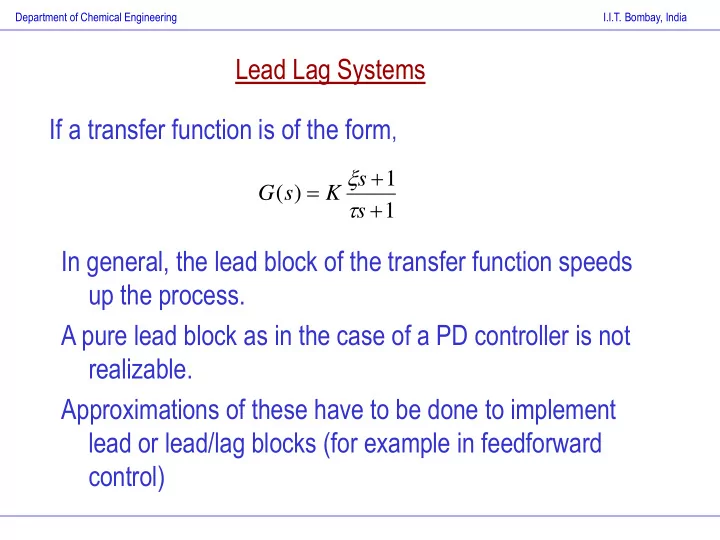
Lead Lag Systems If a transfer function is of the form,

1 1 ) (    s s K s G  

In general, the lead block of the transfer function speeds up the process. A pure lead block as in the case of a PD controller is not realizable. Approximations of these have to be done to implement lead or lead/lag blocks (for example in feedforward control)

slide-2
SLIDE 2

Department of Chemical Engineering I.I.T. Bombay, India

Dynamic Response of a Lead Lag System

1 1 ) (    s s K s G  

Using partial fraction expansion,

] 1 [ 1 1 ) (

1

      s A A K s s K s G   

where A0=/ and A1=1-A0 = 1-

) ( 1 ) 1 ( ) ( ) ( ) ( s u s K K s u s g s y              

slide-3
SLIDE 3

Department of Chemical Engineering I.I.T. Bombay, India

Step Response of a Lead Lag System

Depending on the value of , an effective lead or lag action is seen

slide-4
SLIDE 4

Department of Chemical Engineering I.I.T. Bombay, India

Lectures 7: Dynamics of higher order systems

slide-5
SLIDE 5

Department of Chemical Engineering I.I.T. Bombay, India

Dynamic behaviour of second order systems

Number of dynamic elements are 2. F

h1

h2

Second order systems can arise because of two first order systems in interacting or noninteracting setups Inherent dynamics in the system is of higher order U-tube manometer. Presence of a controller in a closed loop even if the process is first order (such as PI or PID controllers in a closed loop) can give a second order system.

Interaction between the holdups could give an

  • scillatory response.
slide-6
SLIDE 6

Department of Chemical Engineering I.I.T. Bombay, India

F0

h1 h2

IIlustrative example: Interacting system of tanks in series First Principles Model

2 2 2 1 1 2 2 2 1 1 1 1

) ( ); ( h c h h c dt dh A h h c F dt dh A

    

slide-7
SLIDE 7

Department of Chemical Engineering I.I.T. Bombay, India

) ( 1 ) ( ) ( ; 1 ; c A ; c A If

1 2 2 1 2 2 1 2 1 2 2 1 2 1 1 2 2 2 1 1 1

s u s K s K K s y c c K c K                

First Principles Model The roots of the denominator (poles of the transfer function) could be complex. They could give rise to oscillatory behaviour for different u.

slide-8
SLIDE 8

Department of Chemical Engineering I.I.T. Bombay, India

Second Illustrative example: Control of a first order process

Ku y dt dy             

t d I d c

dt y y y y K t u ) ( 1 ) ( ) ( 

and

          

t d I d c

dt y y y y KK y dt dy ) ( 1 ) (  

Therefore,

d I c c

y y KK dt dy KK dt y d       ) 1 (

2 2 1

This is a second order system and will give rise to a second

  • rder transfer function.

Plant controller yd +

  • y

u

slide-9
SLIDE 9

Department of Chemical Engineering I.I.T. Bombay, India

plane of initial rest when DP = 0 h h P1 P2 DP = P1 - P2

U-Tube Manometer

P g h dt dh R g L dt h d g L D       2 1 4 2

2 2 2

L = length of fluid in the manometer tube ,  = density and viscosity

  • f manometer fluid

R = radius of manometer tube g = gravitation constant