in Business Associate Agreements Allocating and Transferring Risk in - - PowerPoint PPT Presentation

in business associate agreements
SMART_READER_LITE
LIVE PREVIEW

in Business Associate Agreements Allocating and Transferring Risk in - - PowerPoint PPT Presentation

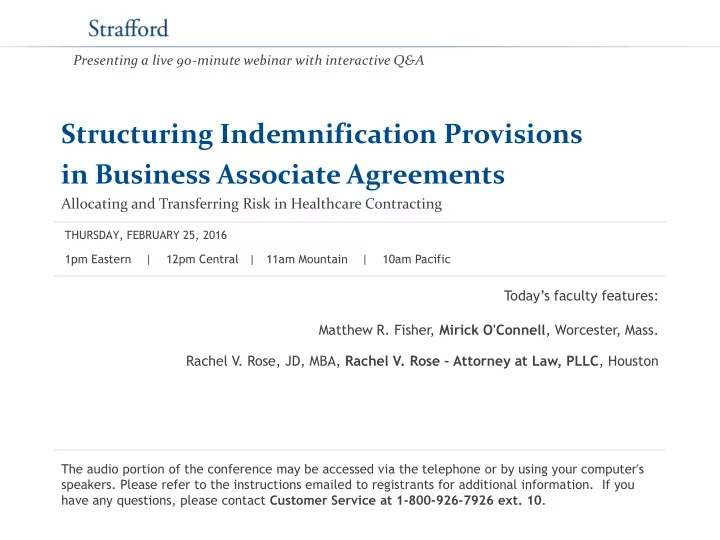
Presenting a live 90-minute webinar with interactive Q&A Structuring Indemnification Provisions in Business Associate Agreements Allocating and Transferring Risk in Healthcare Contracting THURSDAY, FEBRUARY 25, 2016 1pm Eastern | 12pm


slide-1
SLIDE 1

The audio portion of the conference may be accessed via the telephone or by using your computer's

  • speakers. Please refer to the instructions emailed to registrants for additional information. If you

have any questions, please contact Customer Service at 1-800-926-7926 ext. 10.

Structuring Indemnification Provisions in Business Associate Agreements

Allocating and Transferring Risk in Healthcare Contracting

Today’s faculty features:

1pm Eastern | 12pm Central | 11am Mountain | 10am Pacific THURSDAY, FEBRUARY 25, 2016

Presenting a live 90-minute webinar with interactive Q&A Matthew R. Fisher , Mirick O'Connell, Worcester , Mass. Rachel V. Rose, JD, MBA, Rachel V. Rose – Attorney at Law, PLLC, Houston

slide-2
SLIDE 2

Tips for Optimal Quality

Sound Quality If you are listening via your computer speakers, please note that the quality

  • f your sound will vary depending on the speed and quality of your internet

connection. If the sound quality is not satisfactory, you may listen via the phone: dial 1-866-819-0113 and enter your PIN when prompted. Otherwise, please send us a chat or e-mail sound@straffordpub.com immediately so we can address the problem. If you dialed in and have any difficulties during the call, press *0 for assistance. Viewing Quality To maximize your screen, press the F11 key on your keyboard. To exit full screen, press the F11 key again.

FOR LIVE EVENT ONLY

slide-3
SLIDE 3

Continuing Education Credits

In order for us to process your continuing education credit, you must confirm your participation in this webinar by completing and submitting the Attendance Affirmation/Evaluation after the webinar. A link to the Attendance Affirmation/Evaluation will be in the thank you email that you will receive immediately following the program. For additional information about continuing education, call us at 1-800-926-7926

  • ext. 35.

FOR LIVE EVENT ONLY

slide-4
SLIDE 4

Disclaimer

THE INFORMATION PRESENTED IS NOT MEANT TO CONSTITUTE LEGAL ADVICE. CONSULT YOUR ATTORNEY FOR ADVICE ON A SPECIFIC SITUATION.

4

slide-5
SLIDE 5

5

Structuring Indemnification Provisions in Business Associate Agreements

Matthew Fisher, JD mfisher@mirickoconnell.com Rachel V. Rose, JD, MBA rvrose@rvrose.com February 25, 2016

slide-6
SLIDE 6

6

Overview

  • Intro to HIPAA and BAA Regulatory

Requirements

  • Types of Indemnification Clauses & Their

Impact on Other Contractual Provisions

  • Considerations for Attorneys and Other

Professional Responsibility Issues

  • International Considerations
  • Practical Negotiation Considerations

6

slide-7
SLIDE 7

7

Intro to HIPAA and BAA Requirements

slide-8
SLIDE 8

8

Legislative History

  • 1996 -HIPAA (Public Law 104-191) – need for consistent framework

for transactions and other administrative items.

  • 2002 – The Privacy Rule (Aug. 14, 2002)
  • 2003 – The Security Rule (Feb. 20, 2003)
  • 2009 - Health Information Technology for Economic and Clinical

Health (“HITECH”) Act, Title XIII of Division A and Title IV of Division B of the American Recovery and Reinvestment Act of 2009 (Pub. L. 111-5) (Feb. 17, 2009)

  • 2009 – The Breach Notification Rule (Aug. 24, 2009)
  • 2010 – Privacy and Security Proposed Regulations (Feb. 17, 2010)
  • 2013 – Omnibus Rule (Effective March 26, 2013, Compliance Sept.

23, 2013).

8

slide-9
SLIDE 9

9

Business Associate

A “business associate” is a person or entity, other than a member of the workforce of a covered entity, who performs functions or activities on behalf of, or provides certain services to, a covered entity that involve access by the business associate to protected health information.” Business associate includes: (i) A Health Information Organization, E- prescribing Gateway, or other person that provides data transmission services with respect to protected health information to a covered entity and that requires access on a routine basis to such protected health information. (ii) A person that offers a personal health record to one or more individuals on behalf of a covered entity. (iii) A subcontractor that creates, receives, maintains, or transmits protected health information on behalf of the business associate.

9

slide-10
SLIDE 10

10

KEY DEFINITIONS

  • Confidentiality – “the property that data or information is not

made available or disclosed to unauthorized persons or processes.”

  • Integrity – “the property that data or information have not been

altered or destroyed in an unauthorized manner.”

  • Availability - “the property that data or information is accessible

and useable upon demand by an authorized person.”

10

slide-11
SLIDE 11

11

Business Associate Agreement (“BAA”)

  • Covered entities may not disclose protected health

information to business associates or allow BAs to use PHI unless the parties have executed a business associate agreement

– Have to use reasonable efforts, but if can’t get. . .

  • BAs have same obligation to have agreement in place

with subcontractors

11

slide-12
SLIDE 12

12

What Is a BAA?

  • A contract.
  • Required under HIPAA.
  • Several items must be included – for example:

– Establishment of permitted and required disclosures and uses – Non-disclosure of information – Appropriate safeguards – Breach notification

  • Require elements found in both Privacy and Security

Rules

12

slide-13
SLIDE 13

13

BAA Basics

  • How know when one is needed?

– Will one party handle PHI for or on behalf of another entity? – Is a service being performed?

  • Covered Entity Considerations:

– When in doubt, get one executed??

  • Business Associates

– Carefully consider situation, try not to be forced into signing unnecessarily

slide-14
SLIDE 14

14

Is Indemnification Required in a BAA Under HIPAA?

No.

14

slide-15
SLIDE 15

15

Types of Indemnification Clauses & Their Impact on Other Contractual Provisions

slide-16
SLIDE 16

16

What is Indemnification?

  • “To save harmless; to secure against loss or damage; to give

security for the reimbursement of a person in case of an anticipated loss falling upon him. Also to make good; to compensate; to make reimbursement to one of a loss already incurred by him.” Cousins v. Paxton &

Gallagher Co., 122 Iowa. 405, 98 N- W. 277.

  • Law Dictionary: What is INDEMNIFY? definition of INDEMNIFY

(Black's Law Dictionary)

16

slide-17
SLIDE 17

17

Types of Indemnification Provisions

  • Broad Form
  • Intermediate Form
  • Limited Form

17

slide-18
SLIDE 18

18

The BAA, Indemnification and Additional Considerations

Relationship between the parties. Type of indemnification. Has due diligence been done? Are the parties located internationally? Have state and international laws been considered? How does the indemnification clause impact arbitration and other related contracts?

18

slide-19
SLIDE 19

19

Indemnification:

Impact on and Interrelation with Related Provisions

slide-20
SLIDE 20

20

Related Provisions

  • Stay away from agency relationship
  • Reallocation of breach responsibility
  • Limitation on liability
  • Insurance coverage
  • Don’t forget the underlying service agreement
slide-21
SLIDE 21

21

HIPAA and Agency

  • HIPAA provides that a covered entity (or a business

associate) will be liable under federal common law of agency

  • Then again, if an agent, may not be a business associate
slide-22
SLIDE 22

22

HIPAA and Agency

  • What is an agent under federal law?

– Determined by specific factual scenario – Can the covered entity (business associate) control the activities

  • r conduct of the other party

– what authority or obligations are being delegated – What skill is required to perform the services

  • What are avenues for control?

– Just contract? General oversight?

slide-23
SLIDE 23

23

Consequences of Agency

  • What happens if there is an agency relationship?

– Could result in covered entity having more direct liability – Could go around the contract provisions – Harder to avoid liability

  • As a good practice, avoid falling into agency situation

– Disclaim this type of relationship

slide-24
SLIDE 24

24

Breach Notification

  • What are response obligations?

– Is CE retaining full control? – Does the BAA assign notification or other actions to the BA?

  • What is required?

– BA: notify CE, mitigate incidents and breaches – CE: provide notification to individuals (media and HHS, depending on circumstances)

slide-25
SLIDE 25

25

Breach Notification

  • May require:

– Indemnity for response costs – Indemnity for other costs associated with breach – Cooperation and assistance with mitigation, notification, more

slide-26
SLIDE 26

26

Limitation on Liability

  • Some party may try to put cap on what it may owe
  • Apply only to specific costs?

– Only breach response? – Cut out anything but direct damages?

  • i.e. no punitive, special, indirect, consequential, or other

damages

slide-27
SLIDE 27

27

Limitation on Liability

  • Other Considerations:

– Disclaim for damages caused by subcontractors – Seek comparative fault: each party responsible only for what it caused

slide-28
SLIDE 28

28

Insurance Coverage

  • Should insurance coverage be required?

– General liability, cyber, privacy, other?

  • Can it be obtained?
  • If include, identify policy limits
  • Be aware of exclusions and conditions
  • Could indemnification invalidate?
slide-29
SLIDE 29

29

Insurance Coverage

  • If include, consider:

– Require CE/BA, as applicable, be named as additional insured – Ask for certificate of insurance and actually review – Being able to review and/or approve coverage

  • But be careful of exerting too much control

– Require notification in advance of any change or cancellation – Tail coverage

slide-30
SLIDE 30

30

The Service Agreement

  • Don’t forget, the BAA attaches to a Service Agreement

– Does not exist in isolation

  • What terms are in the Service Agreement?

– Limitation of Liability? – Indemnification? – More

  • Which agreement (Service or BAA) controls?
slide-31
SLIDE 31

31

Considerations for Attorneys and Other Professional Responsibility Issues

slide-32
SLIDE 32

32

Indemnification and Lawyers’ Professional Rules of Responsibility

  • Some states do not allow it (North Carolina, New

York, Illinois, Indiana, Kansas, Missouri, Arizona and Florida)

  • Is the party a non-profit or for-profit?
  • Request a formal ethics opinion

– Found in State Bar ethics opinions - NYC Bar Association Ethics Opinion 2010-3

http://www.abcny.org/nycbar/index.php/ethics/ethics-opinions-local/2010-opinions/844- settlement-agreements-requiring-the-financial-assistance-of-counsel

– Under the New York Rules of Professional Conduct, attorneys signing hold harmless agreements along with their clients is a violation of Model Rules 1.8(e), possibly creating a conflict of interest. In addition, it is in violation of NY Model Rule 1.7(a).

32

slide-33
SLIDE 33

33

To Include or Not To Include…

  • Factors to address when considering an

indemnification provision

Who are the parties? What are the relevant state laws? How have the parties’ HIPAA compliance been evaluated? What third parties could impact the contract? Will a breach of a BAA provision cause harm?

slide-34
SLIDE 34

34

Who are the parties and where are they doing business?

slide-35
SLIDE 35

35

Recovery of Attorney Fees

Long v. Abbruzzetti, 254 Va. 122, 128 (1997).

("[W]e recognized that, in the absence of contractual or statutory liability, attorneys' fees incurred in present or previous litigation between the same parties generally are not

  • recoverable. However, we also stated that when a breach of

contract has forced a plaintiff to maintain or defend a suit against a third person, the plaintiff may recover reasonable attorneys' fees incurred by him in the former suit.")

slide-36
SLIDE 36

36

International Considerations

slide-37
SLIDE 37

37

International Issues

  • The reach of the U.S. Department of Justice.
  • Venue, forum and arbitration clauses.
  • ISO standards.
  • The laws of other countries.
  • Legal consequences (e.g., criminal and civil) of breaches
  • utside the United States.
  • Where is my data?
slide-38
SLIDE 38

38

Best Practices for Negotiating and Structuring Indemnification Provisions

38

slide-39
SLIDE 39

39

Best Negotiating Practices

  • Who do you represent?

– Covered entity? – Business Associate? – Subcontractor?

  • What is the level and/or nature of risk?
  • What is your client’s goal?
  • What role will each party play?
  • Who is likely to sue?

39

slide-40
SLIDE 40

40

Negotiations

  • Terms very often depend on each
  • rganization’s size
slide-41
SLIDE 41

41

Covered Entity Considerations

  • What is important from CE’s perspective?

– What services are being provided? – What is the extent of information being shared? – Confidence in business associate – Utilize “standard form” for all business associate agreements? – What extent of damages want covered? – Level of sophistication of both parties

41

slide-42
SLIDE 42

42

More Covered Entity Considerations

  • Could indemnity provision boomerang because of

state law?

  • Is there a limitation or cap on the amount of

damages that can be recovered?

slide-43
SLIDE 43

43

Business Associate Considerations

  • How much leverage can the BA exert?
  • Seek mutual obligation?
  • Put limit on any indemnification provided?
  • Other responsibilities? – i.e. professional obligations

depending on type of BA

  • Put pressure on CE by proposing own form BAA
  • How handle a subcontractor?

43

slide-44
SLIDE 44

44

Specific Business Associate Issues

  • Lawyer as BA

– What professional responsibilities apply? – Could there be an ethical conflict? – Are you negotiating with a client over a BAA that you prepared? – How much can you negotiate with a client?

slide-45
SLIDE 45

45

Specific Business Associate Issues

  • CE as a Business Associate

– Yes, this can happen – Is the CE willing to be treated the same way that it treats its BAs? – What terms has the CE been willing to accept from its BAs?

slide-46
SLIDE 46

46

Specific Business Associate Issues

  • Hybrid Entities

– Is the entire entity on the hook for the terms of the BAA? – Can indemnification be limited to certain resources of the hybrid entity?

slide-47
SLIDE 47

47

Structural Considerations

  • Impact on and of liability insurance
  • Can other parties benefit
  • Is the indemnification provision consistent with public

policy

  • Mutuality
  • Limit on damages
  • Scope of actions covered

47

slide-48
SLIDE 48

48

Structural Considerations

  • Carve outs for certain acts
  • What is the reality that a party can meet the

indemnification obligations

  • General limitation of liability necessary?
  • Leave out altogether?

48

slide-49
SLIDE 49

49

Questions and Contact Information

Matthew Fisher, JD, Associate Mirick, O'Connell, DeMallie & Lougee, LLP mfisher@mirickoconnell.com 508-929-1648 Rachel V. Rose, JD, MBA Rachel V. Rose – Attorney at Law, PLLC Attorney at Law, PLLC rvrose@rvrose.com 713-907-7442

49